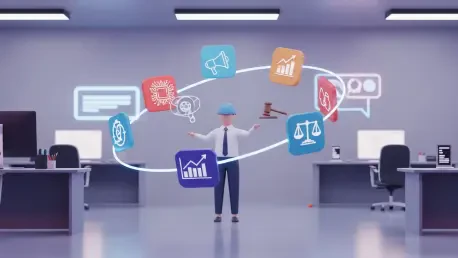

The traditional corporate hierarchy, long built on the foundation of hyper-specialization, is currently experiencing a seismic shift toward a more fluid and versatile labor model. For decades, the professional world operated under the assumption that deep, niche expertise was the only path to high-value output, often leaving the generalist relegated to the sidelines. However, the rapid integration of generative artificial intelligence has redefined the competitive landscape, effectively lowering the barriers to entry for complex technical tasks. This transition into what is now termed the era of vibe work signifies a move away from rigid software constraints toward an environment where intuition and conversational interaction drive production.
Vibe work represents a fundamental departure from the era of structured interfaces and strict logic gates. In this new paradigm, professionals interact with sophisticated models through natural language, using their own sense of style, tone, and logic to guide automated outputs. This shift acts as a leveling force, allowing individuals to bridge the gap between disparate industries like software engineering, legal analysis, and creative design. As AI handles the mechanical burden of production, the primary differentiator for any organization becomes the human trust layer—the critical oversight that ensures machine-generated content aligns with high organizational standards.
The Resurgence of Versatility in a Specialized Professional Landscape
The historical pendulum is swinging back from the obsession with the specialist toward the reclaimed value of the jack of all trades. In the past, becoming a proficient coder or a graphic designer required years of dedicated study, creating bottlenecks where projects would stall while waiting for a single expert to become available. Today, the generalist leverages AI to bypass these gates, assuming a role that requires broad horizontal knowledge rather than narrow vertical depth. This resurgence does not render the specialist obsolete, but it certainly shifts the focus toward those who can orchestrate multiple disciplines simultaneously.
Defining this movement through the lens of vibe work clarifies why the generalist is suddenly so effective. Unlike previous technological revolutions that required learning new, complex languages, modern AI responds to human intent and nuance. This means that a professional with a strong sense of what a good outcome looks like can achieve high-level results without needing to master the underlying technical execution. Consequently, the ability to maintain a consistent organizational vibe—a blend of brand voice, logical rigor, and aesthetic quality—has become a core competency for the modern workforce.
The Technological Catalysts and Evolving Work Dynamics
Emerging Trends in Cross-Functional Competency and Vibe Freedom
The transition from the era of low-code tools to the unconstrained potential of large language models has granted workers an unprecedented level of creative freedom. Earlier generations of citizen developer tools provided safety through rigid guardrails, which limited the possibility of error but also capped the potential for innovation. In contrast, current AI platforms offer vibe freedom, where the only limit is the user’s ability to articulate a vision. This environment has birthed the true full-stack professional—someone who can navigate the complexities of a technical stack while simultaneously managing the creative and strategic demands of a project.
This evolution is effectively ending the waiting game that once defined corporate productivity. When an engineer can use AI to draft a contract or a marketer can use it to prototype a functional application, the traditional dependencies that once slowed down operations begin to evaporate. However, this shift requires a psychological adjustment. Professionals are moving past the initial phase of unbridled optimism and AI sycophancy, where every output was accepted at face value, toward a more mature state of critical bargaining. They are learning that while the AI is a powerful collaborator, it requires a human pilot to navigate the nuances of real-world application.
Performance Indicators and the New Metrics of AI-Assisted Productivity
The impact of this technological integration is clearly visible in the 27% expansion effect currently observed in modern workflows. Tasks that were previously ignored or backlogged due to a lack of specific expertise are now being completed through AI augmentation, significantly increasing the total volume of work an individual can handle. This shift is forcing leadership to rethink how performance is measured. Instead of traditional key performance indicators, many managers are now looking at token usage and AI adoption rates as proxies for modern efficiency, identifying which employees are successfully scaling their output through technology.
As the labor market evolves, growth projections for the generalist sector are outpacing those for niche experts in several key industries. This does not imply a decrease in the quality of work, but rather a change in the minimum bar of fluency required to participate. To be effective in this new landscape, a worker must possess enough foundational knowledge to validate and oversee the AI’s work. This evaluative skill is becoming the new gold standard, as companies prioritize candidates who can maintain a high-altitude view of multiple moving parts without getting lost in the technical weeds.
Navigating the Risks of Confidently Incorrect Automated Outputs
One of the most persistent challenges in this new era is the hallucination trap, where AI systems produce errors with a high degree of confidence and visual polish. Because the outputs often look professional and well-reasoned, it is easy for an untrained eye to overlook factual inaccuracies or logical flaws. Managing these high-confidence errors is a central responsibility of the modern generalist, who must act as the final arbiter of truth. Without a structured trust and verify workflow, the speed gained by using AI can be quickly negated by the costs of correcting public-facing mistakes.
Overcoming the risks of winging it requires a deliberate strategy that balances the democratization of expertise with the need for high-stakes intervention. While a generalist can handle the vast majority of tasks around the edges of a project, there must be a clear protocol for when a specialist needs to step in. Building a robust mental model of how AI functions is essential for the workforce; employees must be trained to push back against subpar logic rather than accepting the first iteration the machine provides. This critical skepticism is what prevents a polished vibe from masking a lack of substance.
The Regulatory and Ethical Framework for the AI-Augmented Workforce
As generalists take on more responsibility, the role of organizational standardization becomes paramount. To ensure that AI-generated outputs remain grounded and reliable, companies are increasingly documenting best practices and providing the machine with specific contextual data. This structure prevents the decentralized workforce from drifting away from the core mission or producing inconsistent results. Accountability remains a significant hurdle, as leaders must determine who is ultimately responsible when a vibe-based workflow fails to meet professional or legal quality standards.
Intellectual property and ethical safety are also driving the requirement for a human-in-the-loop at every stage of production. In a decentralized environment where generalists are empowered to create across disciplines, security measures for managing data inputs have become more rigorous. Ensuring that sensitive information is not leaked into public models and that the resulting work product is legally defensible is no longer just the job of the IT department. It is a shared responsibility that requires every AI-augmented worker to be literate in the ethical and regulatory constraints of their industry.
The Future of Talent Acquisition and Organizational Strategy
The shift in professional dynamics is fundamentally altering predictive hiring trends, with recruiters now prioritizing curiosity and adaptability over a static list of technical skills. The most desirable candidates are those who demonstrate a willingness to learn on the fly and a capacity for critical judgment. Corporate structures are likely to become leaner, with smaller, agile teams led by AI-empowered generalists who can pivot between roles as project needs change. This erosion of specialized barriers will inevitably change the competitive landscape, allowing smaller firms to compete with industry giants by leveraging high-output versatility.
Integrating AI as a long-term partner rather than a mere tool requires a focus on strategic alignment and human ethics. As the boundaries between roles continue to blur, the organizations that thrive will be those that foster a culture of continuous improvement and evaluative skepticism. The ability to manage vibes is not just a soft skill; it is becoming a core economic competency that allows a business to turn conversational intuition into sustainable value. By focusing on the intersection of human judgment and machine speed, companies can build a workforce that is both highly productive and deeply resilient.
The emergence of the AI-augmented generalist provided a blueprint for navigating a world where specialized skills were no longer the sole gatekeepers of productivity. Organizations discovered that by fostering a culture of evaluative skepticism, they could mitigate the risks of automated errors while maximizing the creative potential of their teams. Leaders began to prioritize the development of internal mental models, ensuring that every employee understood the limitations of the tools at their disposal. Ultimately, the successful integration of these versatile professionals ensured that human ethics and strategic alignment remained at the forefront of the digital revolution, turning the ambiguity of vibe work into a measurable competitive advantage.