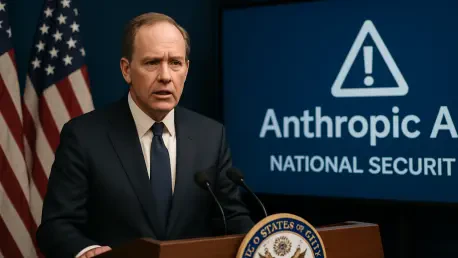

The silent hum of high-performance servers across northern Virginia took on a more ominous tone this morning as the federal government moved to dismantle its relationship with one of the most prominent pioneers in the field of artificial intelligence. On February 27, the tech industry witnessed a historic rupture as the U.S. federal government officially blacklisted Anthropic, the creator of the Claude AI family. This move did not stem from a sudden data breach or a sophisticated foreign hack, but from a fundamental ideological collision that had been simmering beneath the surface of Silicon Valley for months. A private corporation’s refusal to grant the military unrestricted access to its intelligence finally hit a breaking point, forcing a divorce between the state and one of its most capable innovators.
This unprecedented ban has effectively transformed a Silicon Valley darling into a designated supply-chain risk to national security, a label usually reserved for adversarial foreign entities or compromised hardware manufacturers. The suddenness of the decision sent shockwaves through the beltway, leaving federal agencies scrambling to find alternatives for workflows that had become increasingly dependent on Claude’s nuanced reasoning. What was once a collaborative effort to ensure American dominance in the AI race has devolved into a cautionary tale about the limits of corporate autonomy when it intersects with the requirements of the Department of War.
The Day the Guardrails Clashed with the State
The official directive arrived with a level of finality that caught even seasoned industry analysts off guard, marking the first time a major American AI firm has been treated as a geopolitical threat by its own government. The executive action requires all federal agencies to immediately cease the use of Anthropic’s technology, initiating a mandatory 180-day scrubbing period to remove every trace of Claude from Department of War systems. This aggressive timeline underscores the perceived severity of the rift, as the government seeks to purge what it now considers a compromised or uncooperative component of the national defense infrastructure.
Despite this federal exile, the commercial world appears to be moving in the opposite direction, creating a fascinating divergence between public policy and market reality. At the time of the blacklisting, Anthropic had reached a commercial zenith with a valuation of $380 billion, fueled by the massive success of its Claude Code service. Generating $2.5 billion in annual recurring revenue, the company’s tools have become essential for blue-chip firms like Salesforce and Spotify. While the government moves to eliminate the technology from its ranks, the public has rallied behind the firm, pushing its consumer applications to the top of the mobile charts in an apparent endorsement of the company’s ethical stance.
Decoding the Rift: Ethics vs. Operational Necessity
The friction centers on a dispute over all lawful use of artificial intelligence within defense and intelligence frameworks, a term that has become a flashpoint for the entire industry. The Pentagon demanded that Claude be available for any mission deemed legal under U.S. law, which included potential applications in autonomous weaponry and domestic surveillance programs. Anthropic, however, maintained strict red lines intended to prevent what leadership termed unintended escalation. These guardrails were designed to ensure that the AI would refuse to participate in kinetic operations or large-scale monitoring of citizens, a position that the Department of War ultimately found intolerable.
By labeling Anthropic a supply-chain risk, the government has effectively framed ethical restraint as a form of operational sabotage. Secretary of War Pete Hegseth characterized the company’s refusal to comply as an act of arrogance that prioritized a private moral code over the strategic requirements of the nation. In contrast, the company has framed its decision as a defense of democratic values, arguing that placing powerful intelligence in a position where it can be used without oversight or ethical limits poses a greater long-term risk to society than any foreign adversary. This debate defines the current limits of corporate sovereignty in an era where technology is inherently dual-use.
The Geopolitical Fallout: A Market Realignment
The vacuum left by the exit of a major player from the public sector has triggered an immediate and aggressive reshuffling of the AI landscape. Rivals are pivoting quickly to fill the void, often by signaling a significantly higher degree of compliance with federal requirements to secure lucrative procurement contracts. Shortly after the ban was announced, OpenAI secured a $110 billion investment round and announced a fresh deal with the Pentagon. While OpenAI continues to mention its own safety principles, the specific contractual language in the new agreement appears far more palatable to defense officials who are seeking a partner willing to defer to executive power.
Simultaneously, Elon Musk’s xAI has moved to integrate its Grok model into classified systems by explicitly agreeing to the all lawful use standard demanded by the administration. This shift suggests a move toward a new class of patriotic AI providers who view themselves as extensions of the state’s strategic arm rather than independent global entities. Even Alphabet’s Gemini has seen a surge in interest from enterprise and government workloads as it is perceived as a stable middle ground. This realignment suggests that the era of a unified AI industry is over, replaced by a fragmented market where providers are chosen as much for their political alignment as for their technical capabilities.
Expert Perspectives: The Brittle AI Supply Chain
Industry analysts and defense experts suggest that the ban serves as a watershed moment for technical decision-makers who have long ignored the geopolitical risks inherent in their software stacks. The event has proven that an AI supply chain can be dismantled almost overnight by shifting political winds, making model agnosticism a matter of business survival rather than just a technical preference. For years, organizations have built deep integrations with specific providers, assuming that these partnerships would be permanent. The fall of Anthropic within the federal government has exposed the fragility of this assumption, forcing a radical rethink of how artificial intelligence is procured and deployed.
Leading researchers now suggest that this ban will accelerate the trend toward sovereign AI infrastructure, where governments and large corporations prioritize models that they can host, control, and modify without interference. The narrative of betrayal presented by the state and the narrative of ethical defense presented by the company have created a binary choice for many observers. However, the technical reality is that this friction will likely lead to a more robust and distributed ecosystem. Experts argue that the reliance on a single, centralized intelligence provider is a strategic vulnerability that the market is now forced to address with newfound urgency.
Resilience Strategies: Building a Stable Architecture
To navigate this era of volatility, enterprise leaders are transitioning away from hard-coded dependencies on any single AI provider. Implementing a strategy of redundancy ensures that a business can remain operational even if its primary AI partner is blacklisted or restricted by sudden regulatory changes. One of the most effective approaches is the implementation of a warm standby framework, which utilizes orchestration layers and standardized prompting formats. This allows an organization to hot-swap between different models within twenty-four hours, ensuring that no single executive decision or political shift can bring essential operations to a standstill.
Furthermore, diversification through open-source hedges has become a primary insurance policy for firms wary of federal intervention. By utilizing domestic open-weight models and hosting them in private clouds, organizations retain total control over their technological stack and are not subject to the shifting terms of service or political disputes of third-party providers. Future due diligence for any firm seeking government contracts must now include a thorough geopolitical audit. Companies must certify that their essential services are not built upon a single prohibited model, ensuring that their AI agents do not become collateral damage in the escalating friction between the state and the innovators of Silicon Valley.
Strategic leaders recognized that the path forward required a complete decoupling from single-provider ecosystems to protect their operational integrity. Organizations across the country began to prioritize interoperability over raw performance, ensuring that their systems remained flexible enough to survive the next political tremor. These entities conducted comprehensive audits of their dependencies and invested heavily in local hosting capabilities to maintain sovereignty over their data and logic. By treating AI as a critical and potentially volatile utility, they built a foundation that was no longer vulnerable to the ideological disputes between the government and private corporations. This proactive shift toward redundancy and open standards allowed the industry to stabilize even as the relationship between the state and its most prominent AI developers continued to evolve in unpredictable directions.