
The massive shift toward localized intelligence is currently dismantling the traditional reliance on distant, power-hungry data centers that have long dictated the pace of digital innovation. For nearly a decade, the standard operating procedure for artificial intelligence involved a rigid “device-to-cloud” pipeline where peripheral hardware—ranging from smartphones to industrial sensors—functioned merely as data couriers. These devices would capture raw information and transmit it across thousands of miles to centralized servers, which would then perform the heavy computational lifting before sending back actionable insights. However, this model reached a breaking point as the demand for instantaneous response times and absolute data privacy became non-negotiable. The industry is now embracing edge computing, an architecture that places high-performance processing directly at the point of data collection through specialized semiconductors known as Edge AI chips. These chips represent a fundamental departure from general-purpose silicon, as they are engineered specifically to handle the mathematical intensity of machine learning models within the strict power and thermal constraints of portable devices. By integrating Central Processing Units, Graphics Processing Units, and dedicated Neural Processing Units into a single system-on-a-chip, manufacturers are enabling a new generation of autonomous hardware that thinks for itself.
Overcoming Critical Operational Hurdles
Instant Action: The Elimination of Latency
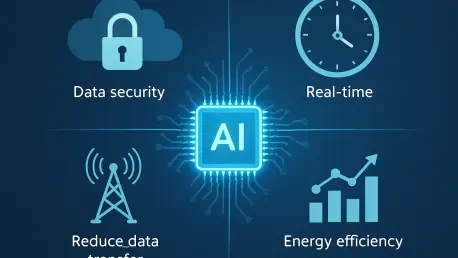
The most immediate strategic advantage of deploying Edge AI chips is the dramatic reduction of round-trip latency, which is the time required for data to travel from a device to a server and back again. In high-stakes environments such as autonomous transportation or industrial robotics, even a delay of a few hundred milliseconds can lead to catastrophic failures. For instance, a self-driving vehicle traveling at highway speeds covers significant distance every second; waiting for a cloud server to identify an obstacle or interpret a traffic signal is simply not a viable option. By processing sensor data locally on the vehicle’s internal hardware, Edge AI chips enable instantaneous decision-making that ensures safety and operational continuity. This immediate feedback loop is equally critical in the manufacturing sector, where robotic arms must adjust their movements in real-time to avoid collisions or to handle delicate components. The ability to perform complex inference at the “edge” removes the unpredictability of network congestion and ensures that mission-critical systems remain responsive under all conditions.
Furthermore, the elimination of network dependence allows for a more consistent user experience in consumer-facing applications. When a user interacts with a voice assistant or utilizes real-time language translation, the presence of localized AI chips ensures that the service remains snappy and reliable, regardless of the local Wi-Fi or cellular signal strength. This shift toward local processing also alleviates the burden on the global telecommunications infrastructure. Instead of flooding networks with raw, uncompressed data streams, devices equipped with Edge AI can interpret the environment and only transmit the most essential metadata. This optimization is particularly beneficial for smart city initiatives, where thousands of interconnected sensors monitor everything from traffic patterns to air quality. By filtering and analyzing information at the source, these systems reduce the overall strain on urban networks, allowing for a more scalable and cost-effective rollout of intelligent infrastructure across sprawling metropolitan areas without requiring massive investments in new fiber-optic cabling or cellular towers.
Privacy Protection: Security by Design
Localized processing offers a formidable solution to the growing concerns surrounding digital surveillance and the unauthorized handling of personal data. In the current landscape, data breaches and the mishandling of sensitive information have become significant liabilities for corporations and a source of anxiety for the general public. Edge AI chips mitigate these risks by ensuring that raw data—such as biometric markers, private conversations, or high-resolution video feeds—never leaves the physical device. This “privacy-by-design” architecture means that the most sensitive information is processed and discarded locally, with only the resulting high-level insights ever being transmitted to external servers. For example, a home security camera can use its internal AI chip to distinguish between a family member and an intruder, sending only a brief text alert to the homeowner rather than streaming hours of private domestic footage to a third-party cloud provider. This localized approach creates a secure perimeter around the user’s digital life, making it much harder for malicious actors to intercept raw data during transmission.
In the highly regulated healthcare sector, the strategic value of Edge AI chips is even more pronounced as they allow for the development of sophisticated medical monitoring tools that comply with strict data sovereignty laws. Wearable devices can now analyze heart rhythms or glucose levels in real-time, detecting anomalies and alerting medical professionals without the need to upload a patient’s entire medical history to a centralized database. This localized intelligence ensures that sensitive health data remains under the patient’s control, reducing the risk of identity theft or insurance discrimination. Beyond healthcare, this architecture is vital for industrial espionage prevention. Companies operating in competitive markets can deploy Edge AI to monitor factory floors or research labs, confident that the proprietary visual or acoustic data being analyzed is not being exposed to the risks inherent in cloud-based processing. By moving the “brain” of the AI system to the device itself, organizations can leverage the power of machine learning while maintaining an unprecedented level of control over their most valuable informational assets.
The Synergy of Hardware and Software
Specialized Accelerators: Hardware Tailored for Intelligence
The architectural innovation found in Edge AI chips is primarily driven by the need to handle the specific mathematical operations required by neural networks far more efficiently than a standard processor. Traditional Central Processing Units are designed for general-purpose logic and serial tasks, which makes them poorly suited for the massive parallel workloads inherent in modern machine learning. To address this, Edge AI hardware utilizes specialized components like Neural Processing Units or AI accelerators, which are optimized specifically for matrix multiplication and tensor operations. These components allow a device to achieve trillions of operations per second while consuming a fraction of the power required by a desktop-grade processor. This energy efficiency is the key enabler for “always-on” intelligence in battery-powered devices, such as drones and smartwatches. By offloading AI tasks to these dedicated accelerators, the main processor can remain in a low-power state, significantly extending the operational lifespan of the hardware between charges.
Software engineering plays a parallel role in this ecosystem, as developers must find creative ways to shrink massive AI models so they can fit onto these localized chips without losing their predictive accuracy. This process involves sophisticated techniques such as quantization, where the numerical precision of the model’s calculations is reduced to save memory and processing cycles. For instance, moving from 32-bit floating-point numbers to 8-bit integers can drastically reduce the footprint of a model while having a negligible impact on its performance in tasks like image recognition or sentiment analysis. Another critical technique is pruning, which involves identifying and removing redundant connections within a neural network that do not contribute significantly to the final output. This creates a leaner, faster model that is perfectly matched to the capabilities of the edge hardware. Through the use of knowledge distillation, a large “teacher” model can even be used to train a smaller “student” model, effectively compressing the vast intelligence of a cloud-based system into a package that can run on a chip no larger than a fingernail.
Real-World Impact: Transforming Industry and Infrastructure
The deployment of Edge AI chips is currently catalyzing a revolution across diverse industries, turning once-passive machines into proactive, autonomous agents. In the realm of Industry 4.0, manufacturing plants are using localized intelligence to perform predictive maintenance on a scale that was previously impossible. By equipping factory machinery with Edge AI-enabled sensors, companies can monitor vibrations, heat signatures, and acoustic patterns in real-time. The chips analyze these signals on-site to detect the earliest signs of mechanical wear, allowing repairs to be scheduled before a total breakdown occurs. This shift from reactive to proactive maintenance saves millions of dollars in downtime and ensures that supply chains remain uninterrupted. The transportation sector is seeing a similar transformation, as Edge AI chips allow modern vehicles to navigate complex urban environments by processing data from Lidar, Radar, and cameras simultaneously. This localized processing is what enables advanced driver-assistance systems to react to a sudden pedestrian crossing or a changing traffic light with a level of precision that exceeds human capability.
In the consumer electronics market, Edge AI has become the invisible force driving the most popular features of modern mobile devices. Computational photography, which allows a smartphone’s small lens to produce images comparable to professional cameras, relies entirely on the rapid processing power of integrated AI accelerators. These chips can perform billions of calculations in the split second between the user pressing the shutter and the image being saved, adjusting lighting, focus, and depth of field in real-time. Beyond photography, Edge AI enables secure biometric authentication, such as facial recognition, to occur entirely on the device, ensuring that the user’s facial map is never stored on an external server. As we look toward the integration of neuromorphic computing—chips designed to mimic the neural structure of the human brain—the efficiency of these systems will only increase. This will lead to a new generation of “smart” infrastructure where bridges monitor their own structural integrity and energy grids autonomously rebalance themselves to prevent blackouts, all powered by localized intelligence that is as efficient as it is powerful.
The Evolution of Decentralized Intelligence
The widespread adoption of Edge AI chips has effectively redrawn the map of the digital world, establishing a hybrid ecosystem where localized processing and cloud computing work in tandem rather than in competition. While the cloud remained the ideal environment for the initial training of massive, complex models that require petabytes of data, the edge became the definitive venue for the “inference” phase, where those models are put to work in the physical world. This decentralized model proved to be the only sustainable way to manage the data explosion caused by the billions of connected devices currently in operation. By distributing the computational workload across the network, organizations avoided the bottlenecks and high costs associated with centralized processing. The success of this transition was largely dependent on the ability of hardware manufacturers to balance performance with power efficiency, a challenge that was met through the development of specialized silicon and the optimization of machine learning software for constrained environments.
Looking ahead, the priority for developers and organizational leaders should be the continued integration of Edge AI into long-term digital strategies to maximize both security and operational agility. Businesses that leveraged localized intelligence achieved a significant competitive advantage by reducing their operational expenses and providing a more secure, responsive experience for their customers. The future of this technology lies in the convergence of Edge AI with emerging high-speed networks, creating a global nervous system where intelligence is ubiquitous and invisible. To capitalize on these advancements, it was necessary for engineers to move beyond a “cloud-first” mindset and embrace a “device-centric” approach to system architecture. By prioritizing localized processing, the technology sector successfully addressed the most persistent challenges of the digital age, creating a world that is not only smarter but also more resilient and protective of individual privacy. This era of decentralized intelligence has set a new standard for how technology interacts with the physical world, ensuring that the most critical decisions are made exactly where they matter most.