


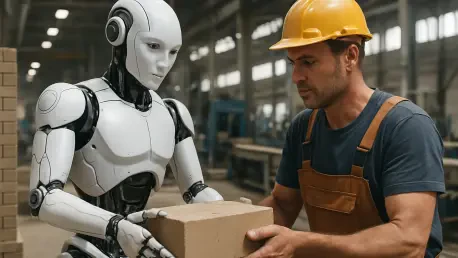

The boundary between digital intelligence and mechanical execution has dissolved as industrial leaders move from software-based simulations to the deployment of versatile, humanoid systems on the global factory floor. This transformation marks a departure from the static automation of the past, introducing a new era where embodied artificial intelligence adapts to dynamic environments in real-time. As major corporations pivot toward these hardware-software hybrids, the urgency is driven by a need for resilience in a shifting global economy. This roundup explores the strategic alliances and technological breakthroughs defining the current landscape, alongside the socio-economic friction that inevitably follows such rapid disruption.
The Convergence of Software and Steel: Why Embodied AI Matters Now
The recent acceleration in robotics is less about incremental mechanical improvements and more about the integration of sophisticated neural networks with mobile chassis. Unlike traditional robotic arms, Physical AI possesses the cognitive capacity to interpret complex spatial data and execute tasks that require situational awareness. The industry now sees a shift toward general-purpose humanoid forms capable of navigating environments originally designed for people, making them more versatile than specialized machinery.
Industrial giants are no longer viewing these machines as experimental novelties but as essential infrastructure. The transition from digital-only algorithms to embodied systems allows software to feel and interact with the physical world, creating a feedback loop that enhances machine learning. This shift highlights the growing importance of securing robust supply chains and high-quality data, as the race for physical supremacy in the labor market intensifies across both manufacturing and service sectors.
Deconstructing the Roadmap to a Robotic Labor Market
Engineering Symbiosis: How Industrial Partnerships Are Scaling Humanoid Deployment
A landmark collaboration between the technology firm Humanoid and the industrial supplier Schaeffler illustrates how vertical integration is stabilizing the robotics supply chain. By the early 2030s, this partnership aims to deploy nearly two thousand robots throughout the global manufacturing network of Schaeffler. The roadmap began with a phased rollout starting in late 2026, focusing on German facilities where these systems are being tested for box handling and logistical transport within high-volume production lines.
This alliance functions as a dual-sided strategy where Humanoid provides the AI platforms while Schaeffler secures its position as a primary supplier for joint actuators. Integrating wheeled or legged platforms into existing brownfield infrastructure remains a technical challenge, yet the commercial viability of these systems depends on such deep technical synergies. As thousands of robots enter the workforce, the focus remains on ensuring that hardware can keep pace with the rapid updates of the underlying software.
The Human Mimicry Pipeline: Teaching Machines the Nuances of Physical Touch
Startups like RLWRLD are tackling the challenge of robotic dexterity by gathering massive amounts of motion data from human workers. By utilizing body cameras and sensors, these companies capture the subtleties of force and movement that traditional programming cannot replicate. This human-to-machine pipeline translates organic movement into data, allowing robots to learn tasks through observation and mimicry rather than rigid lines of pre-defined code.
Real-world data collection is occurring in diverse settings, from the precise folding of napkins at the Lotte Hotel to the heavy lifting required in CJ logistics warehouses. This process records joint angles and force-feedback, bridging the gap between seeing an object and knowing how to handle it delicately. As machines move away from binary instructions, they gain the ability to navigate the unpredictability of hospitality and retail environments with increasing grace.
Accelerating Timelines: The Shift Toward Autonomous “AI-Driven” Factories by 2030
Global leaders like Hyundai and Samsung have identified the period between 2028 and 2030 as the definitive tipping point for mass robotic adoption. Hyundai, leveraging its acquisition of Boston Dynamics, plans to integrate humanoids into its electric vehicle plants, starting with operations in Georgia. Meanwhile, Samsung is pursuing a vision of fully AI-driven factories, where human intervention in repetitive manufacturing tasks becomes the exception rather than the rule.
The common assumption that humanoids are a distant reality has been challenged by the structured testing phases currently underway. From 2026 through 2027, companies are refining the interaction between autonomous fleets and human supervisors to ensure safety and efficiency. This aggressive timeline reflects a global competitive race to reduce labor costs and increase production speeds through total system autonomy.
Beyond the Assembly Line: Assessing Impact on Service Sectors and Labor Rights
While factory floors provide controlled environments, the service sector presents a more complex set of hurdles where robots currently trail human speed. At the Lotte Hotel, a robot might require significantly more time to prepare a guest room compared to a skilled housekeeper. However, the long-term goal is to utilize these machines for back-of-house support, potentially automating up to 40% of preparatory tasks by the end of the decade.
This shift has introduced tension with labor unions, particularly regarding data privacy and the future of entry-level roles. Critics argued that the use of worker data to train robotic replacements threatened the traditional skilled labor pipeline. There is a growing demand for policy frameworks that protect workers while acknowledging the inevitable integration of Physical AI into the broader economic fabric.
Key Takeaways for Navigating the Transition to an Automated Workforce
Organizations must prioritize transparent data collection and collaborative training models to successfully navigate this transition. Integrating human workers into the training process not only improved the quality of machine learning data but also helped maintain morale by involving the workforce in the technological evolution. Establishing clear milestones for robot deployment ensured that the infrastructure was ready for the change without causing abrupt operational shocks.
Balancing the pursuit of efficiency with the preservation of human expertise is critical for long-term stability. Industry leaders should look toward hybrid models where robots handle the most strenuous or repetitive tasks, allowing human employees to focus on supervisory or high-level creative roles. By fostering an environment of shared progress, businesses mitigated the social friction associated with automation.
The Final Frontier of Work: Balancing Technological Progress with Human Value
The integration of Physical AI represented a fundamental shift in the valuation of manual labor and mechanical precision. As robots mastered human movement, society began to redefine the meaning of skill, separating physical execution from cognitive oversight. The importance of ethical frameworks grew, ensuring that the march of progress did not disregard the human element that remained the core of economic value.
Ultimately, the successful synergy between human and machine became the benchmark for industrial excellence in the modern era. Leaders recognized that while machines could mimic motion, the nuance of human judgment was irreplaceable. The journey toward an automated workforce provided a new perspective on productivity, emphasizing the need for a future where technology served to amplify human potential.







