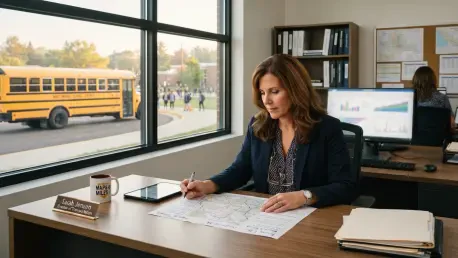

Six hours of manual planning for one after-school bus run has made transportation an early AI use case at Sweet Home Central School District. Superintendent Mike Ginestre says a routing tool built with Anthropic’s Claude can reduce that work to minutes, allowing students to register that morning rather than two weeks beforehand. The district hopes to launch it next week, with printed driving instructions as its practical output.
A Bus Route Becomes an Administrative Pilot
Students joining an after-school activity would no longer have to commit to transportation so far in advance. Giving them that flexibility currently takes considerable staff time. Staff collect student names and addresses, then manually organize each run, accounting for timing while working around a shortage of drivers.
Ginestre describes the driver shortage as a serious constraint for Sweet Home and other districts. Faster planning won’t supply more drivers, but it could make the existing transportation operation easier to manage. Sweet Home’s pilot targets a specific bottleneck between a student’s request for a ride and a driver’s ability to carry out the route.
The district’s description of the workflow is simple:
- Students register for transportation during the morning.
- Staff enter the relevant information into the routing tool.
- The system produces printed, step-by-step driving instructions.
That handoff is central to the use case. Drivers receive an output they can use on the road, while office staff spend less time constructing the run. AI operates within a service the district already provides, rather than requiring students or drivers to adopt an entirely new activity.
The reported time saving remains Ginestre’s account of the pilot, not evidence of a completed district-wide rollout. Before routine use, a practical question is how staff will check the generated route and handle changes or errors. Producing directions quickly is useful only if transportation employees can rely on them.
From a Local Technology Meeting to a Department-Level Plan
Sweet Home’s broader interest began with a discussion about corporate administrative work. Jeffrey Botteron, TechBuffalo’s president and CEO, invited Ginestre to a technology advisory council meeting with senior business leaders from Buffalo. Their discussion of using AI to reduce routine work prompted Ginestre to ask how the same approach might fit schools.
His starting point was paperwork. Reports and manual information entry consume time that he would rather spend visiting school buildings and speaking with people. As a former teacher, Ginestre frames the technology around access to students and families: reducing screen-based duties should create more room for relationships.
To put that idea into practice, the district is now working with TechBuffalo aLocated near Buffalo, the district serves about 3,800 students.ut 3,800 students. TechBuffalo’s work focuses on developing technology talent in the region, while Radial Agency supports local businesses. Their planned AI assistants would take on selected paperwork and administrative duties within a single department.
The district hasn’t yet chosen a department. Transportation, special education, and finance are under consideration. For now, the bus-routing pilot offers an early example, rather than a settled blueprint for every office.
| Area | Current position | Intended operational value |
|---|---|---|
| After-school transportation | Routing tool has been piloted; launch is planned | Shorter planning time and later student registration |
| Department administration | Initial department has not been selected | Less paperwork, with more time for meetings and planning |
| Classroom support | Teachers may choose whether to use AI | Assistance that supports instruction without removing teacher judgment |
Working within one department would let the district focus its implementation effort. Staff could look at repetitive tasks and decide where human judgment is still needed. They could then check whether the time saved makes a difference to their working day. That would tell them more about adoption than simply counting the tools introduced.
Ginestre says the purpose is to support educators, not replace them. He rejects the idea that this effort will cost teachers their jobs and argues that reducing administrative demands can let them concentrate on students and parents. That is the district’s stated intention; achieving it will depend on how the tools are assigned and how the freed time is used.
Classroom Access Follows a Different Adoption Path
Administrative automation does not settle how students should use generative AI. Sweet Home students already have access to Google’s Gemini, and Ginestre favors teaching responsible use rather than withholding the technology. He believes restrictions could leave students less prepared for a working world in which he expects AI to be widely used.
Asked about New York City’s pause on student AI access through 8th grade, Ginestre argued against that approach. In his view, students may use these systems at home regardless of school restrictions. Schools therefore have a role in helping them understand appropriate use, rather than assuming a classroom ban resolves the issue.
Teacher adoption remains voluntary. Ginestre says educators can continue with established methods when those methods support strong learning. Technology coaches offer individual and classroom-level help to teachers who want to explore AI, making support available without turning experimentation into a requirement.
That flexibility gives the classroom rollout a different shape from the transportation pilot. An office can test a tool against a defined output such as a route. Teachers have to decide whether the assistance suits the learning task and leaves students doing the work they need to learn.
Essay writing is one example of that judgment. Ginestre wants students to produce their own writing, rather than submit an instantly generated response. He sees a possible use for AI when teachers check an essay against learning standards and look for gaps.
Students could also receive feedback suggesting ways to improve their work. Ginestre presents that as a possibility developed alongside the teacher, not an established automated grading system. The intended value is more targeted support; the boundary is that responsibility for instruction stays with the educator.
Device Controls Put Limits Around Experimentation
Access to AI sits alongside a more selective approach to school devices. Every Sweet Home student has an iPad, but Ginestre says teachers identified tools last year that did little for learning. Over the summer, the district cleared the devices and used teacher input to establish an approved application list.
Students can’t install additional apps, and games and social media are excluded. The technology department monitors usage. These controls limit access on district devices, but questions about the quality and appropriateness of AI-generated work still need to be addressed.
Ginestre would rather districts set responsible screen-use practices themselves than have state or federal authorities dictate them. At Sweet Home, that position combines controlled device access with professional discretion for teachers. Availability is broader than mandatory use.
The approach also leaves room for correction. Ginestre acknowledges that prompts and tool-building can involve mistakes, and he describes adjustment as part of learning. For implementation, that means staff need permission to flag weak results and revise a workflow rather than treat a new system as finished on arrival.
Sweet Home’s immediate opportunity is concrete: shorten the work required to arrange an after-school ride, then test whether similar assistance can reduce departmental paperwork. The planned launch makes those questions operational now. The district’s next step is to establish whether the pilot’s reported savings hold up in daily service and give staff more time with the students and families they serve.