


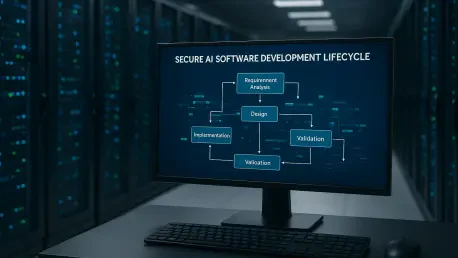

Many enterprise risks emerge during data preparation, model training, and deployment rather than after the final software release is complete. In the current landscape of 2026, the rapid adoption of artificial intelligence across the United Kingdom has transformed the traditional software development lifecycle into a more complex, data-centric process. This evolution has introduced a myriad of vulnerabilities that legacy security protocols—designed for static code and fixed logic—are often ill-equipped to handle. For major firms in the financial, healthcare, and legal sectors, the shift toward a Secure AI Software Development Lifecycle (SDLC) is no longer a peripheral technical concern but a central pillar of corporate governance. As these systems move from isolated experiments to integrated operational cores, the potential for systemic failure or malicious exploitation grows exponentially, necessitating a specialized approach that addresses the probabilistic nature of machine learning. The modern enterprise must recognize that securing an intelligence-driven platform requires continuous vigilance throughout the entire creation process, rather than a final check before the launch.
The urgency for a dedicated AI security framework is further amplified by the evolving expectations of British regulators and the public’s demand for algorithmic transparency. Within the UK, the regulatory environment has moved toward a sector-led enforcement strategy where authorities like the Information Commissioner’s Office and the Financial Conduct Authority are actively monitoring how automated decisions impact consumer privacy and market stability. This means that a security breach in an AI system is not merely a technical error but a significant legal liability that can result in substantial fines and irreparable damage to a brand’s reputation. By adopting a Secure AI SDLC, organizations can demonstrate a proactive commitment to “security-by-design,” ensuring that every piece of data utilized and every model parameter adjusted meets the highest standards of integrity. This strategic alignment between development speed and defensive rigor allows enterprises to innovate with confidence, knowing that their foundational technologies are resilient against both emerging cyber threats and the inherent risks of automated processing.
1. The Necessity of Multi-Departmental Oversight: Aligning Strategic Goals
Successful implementation of a Secure AI SDLC begins with breaking down the traditional silos that often separate technical development from executive decision-making. In the modern British enterprise, security is a shared responsibility that requires the active participation of legal, security operations, and data science teams from the very inception of a project. When these departments work in isolation, the technical team may overlook regulatory nuances, while the legal team might not fully grasp the security implications of specific model architectures. Establishing a cross-functional steering committee ensures that every AI initiative is evaluated through multiple lenses—compliance, risk management, and technical feasibility—before the first line of code is written. This collaborative approach allows for the early identification of potential conflicts, such as the tension between model accuracy and data privacy requirements, which can be resolved much more cost-effectively during the planning phase than after a system has been deployed.
Moreover, multi-departmental oversight fosters a culture of accountability that is essential for maintaining long-term trust in automated systems. By involving security operations early, enterprises can ensure that the infrastructure supporting the AI models is compatible with existing defense mechanisms and monitoring tools. Meanwhile, the inclusion of legal teams ensures that data acquisition strategies remain compliant with the UK GDPR and other local privacy mandates, which are increasingly stringent regarding automated profiling. This alignment also helps in setting realistic expectations for stakeholders, as the diverse expertise on the oversight board can provide a more comprehensive view of the potential risks and the timeline required for thorough security testing. Ultimately, this unified front transforms security from a perceived bottleneck into a strategic enabler, providing the necessary governance framework to scale AI solutions across the entire organization without sacrificing safety or regulatory standing.
2. Investing in Specialized Defense Technologies: Real-Time AI Vigilance
Conventional security tools are largely ineffective against the unique threats targeting machine learning environments, such as prompt injection, model inversion, or membership inference attacks. To protect sophisticated AI assets, UK enterprises must invest in specialized defense technologies that are purpose-built to monitor the health and behavior of models in real time. These tools go beyond simple firewall rules or endpoint protection; they analyze the mathematical outputs and internal states of a model to identify anomalies that could indicate tampering or adversarial manipulation. For instance, continuous model observation platforms can detect subtle shifts in output distributions—known as model drift—which might signal that the system is being fed biased data or is under an active “poisoning” attack. Implementing these advanced monitoring solutions allows security teams to intervene immediately when a model deviates from its expected performance parameters, preventing small errors from cascading into major operational failures.
Beyond observation, the procurement of AI-specific defense technology should focus on the automation of security audits and the sanitization of inputs and outputs. In the high-stakes environment of 2026, where generative AI often interacts directly with customers, the ability to intercept and filter malicious prompts is critical. These specialized defenses use sophisticated linguistic analysis to block attempts at bypassing model guardrails, ensuring that the system remains within its defined ethical and operational boundaries. Furthermore, these tools provide the auditable logs required by UK regulators to prove that a model has been behaving as intended and that all security incidents were promptly identified and mitigated. By integrating these specialized technologies into the core infrastructure, enterprises create a robust defensive layer that shields the probabilistic nature of the AI from the deterministic world of cyber warfare, ensuring that the organization’s most valuable intellectual property remains secure.
3. Conducting Regular Internal Evaluations: NCSC Guidelines and Compliance
Maintaining a secure AI environment is not a one-time event but a continuous cycle of evaluation and improvement that must be aligned with national standards. In the United Kingdom, the National Cyber Security Centre (NCSC) provides a comprehensive framework that serves as the gold standard for securing machine learning systems. Enterprises should conduct regular internal audits based on these guidelines to identify gaps in their current development lifecycle and to ensure that their defensive strategies are keeping pace with the latest threat vectors. These evaluations should not only focus on the technical aspects of the model but also on the human elements of the development process. Providing specialized training for engineers is a vital component of this strategy, as it equips them with the knowledge to recognize AI-specific threats—such as training data poisoning or unauthorized logic extraction—that are rarely covered in traditional software engineering curricula.
Furthermore, these internal evaluations should incorporate rigorous red-teaming exercises where internal or external security professionals attempt to break the AI system using known adversarial techniques. This proactive testing reveals hidden vulnerabilities in the model’s architecture or the surrounding application logic that might not be apparent during standard quality assurance testing. By documenting the results of these audits and the subsequent remediation efforts, UK firms can build a “security-by-design” portfolio that is invaluable during regulatory inspections or when seeking cyber insurance. The goal of these evaluations is to move beyond simple compliance and toward a state of operational resilience, where the organization can confidently adapt its AI strategies in response to new information or changing market conditions. Consistently aligning with NCSC standards ensures that the enterprise remains part of a broader national effort to secure the UK’s digital economy, fostering a safer environment for all participants.
4. Strategic Collaboration with Regional Experts: Navigating the UK Landscape
For many UK enterprises, the complexity of building a secure AI SDLC from scratch is a daunting task that can divert resources away from core business objectives. Partnering with a regional AI development expert who possesses a proven track record in both technology and governance can provide a significant competitive advantage. These local partners understand the specific nuances of the British regulatory landscape, including the intricacies of the ICO’s guidance on generative AI and the FCA’s requirements for operational resilience in financial services. By selecting a partner that integrates security directly into the system architecture from day one, enterprises can avoid the costly “bolt-on” security approach that often leads to performance bottlenecks and integration failures. These experts bring a wealth of experience in building auditable, transparent, and robust systems that are designed to withstand the scrutiny of both regulators and sophisticated cyber attackers.
Collaborating with UK-based experts also facilitates better communication and faster response times, which are critical when dealing with complex AI-related security incidents. Local partners are often more attuned to the regional threat landscape and can provide tailored advice that reflects the specific risks faced by organizations operating within the British market. This partnership extends beyond mere technical implementation; it includes the development of a long-term governance strategy that evolves as the technology matures. Whether it is refining data anonymization techniques for sensitive healthcare datasets or architecting secure pipelines for automated manufacturing, a regional expert ensures that the AI deployment remains compliant with local laws and ethical standards. This strategic collaboration empowers UK leadership to focus on driving innovation and growth, secure in the knowledge that their technological foundation is built on a bedrock of security expertise and regional regulatory alignment.
5. Mitigation of Risks During Information Gathering: Data Integrity Measures
The integrity of an AI system is fundamentally tied to the quality and security of the data used to train and inform it. During the information-gathering phase, UK enterprises face significant risks related to data corruption and the use of biased or unverified source material. If the initial dataset is compromised or contains inherent prejudices, the resulting model will inevitably produce flawed or even dangerous outputs, leading to poor business decisions and potential legal challenges. To mitigate these risks, organizations must implement strict verification processes for all data sources, whether they are internal databases or third-party providers. This includes validating the lineage of the data to ensure it was collected ethically and legally, as well as performing rigorous statistical analysis to identify and correct any underlying biases that could skew the model’s performance in a production environment.
Once data sources are verified, the focus must shift toward the protection of this information during the refinement process. Data refinement involves cleaning, labeling, and transforming raw information into a format suitable for model training, a phase where the disclosure of sensitive or private information is a primary concern. To address this, enterprises should employ advanced data classification and anonymization techniques, such as differential privacy or k-anonymity, to ensure that personal identifiable information is never exposed to the model or the development team. These protections are particularly critical for firms operating under the UK GDPR, as they help satisfy the “data minimization” principle by ensuring that only the necessary information is used for training. By establishing a secure and transparent data pipeline from the very beginning, organizations can build a foundation of trust that supports the entire lifecycle of the AI system, preventing many of the most common security failures before they ever occur.
6. Ensuring Integrity During Model Training: Pipeline Security and Logic
The model training phase is perhaps the most vulnerable point in the AI development lifecycle, as it is where the core logic of the system is established. During this stage, attackers may attempt to inject “backdoors” or corrupted logic into the model by manipulating the training process or the environment in which it occurs. For instance, a poisoned training pipeline could result in a model that functions perfectly under normal conditions but performs a specific, malicious action when it encounters a certain “trigger” in the input data. To defend against these sophisticated threats, UK enterprises must maintain highly secure and isolated training pipelines that are protected by strict access controls and continuous integrity checks. Every change to the training code, hyperparameters, or datasets must be logged and audited to ensure that no unauthorized modifications have been introduced.
Beyond securing the pipeline itself, the optimization and fine-tuning of the model present additional security challenges, particularly regarding information leakage. Fine-tuning a pre-trained model on proprietary or sensitive data can inadvertently cause the model to “memorize” specific details of that data, which can then be extracted through clever prompting by an external actor. To prevent this, organizations should implement strict access controls over the fine-tuning environment and use specialized auditing tools to check for potential information leakage in the model’s weights and outputs. Overfitting must also be carefully managed, as a model that is too closely tuned to its training data may lose its ability to generalize, making it more susceptible to adversarial manipulation. By maintaining a rigorous and transparent training process, enterprises ensure that the final model is not only accurate but also robust and resistant to the various forms of logical corruption that can occur during its creation.
7. Securing System Launch Protocols: Protecting APIs and Access Points
As an AI system moves from the development environment to a live launch, the focus of security must shift toward protecting the interfaces through which the model interacts with the outside world. The primary risks during this transition include the abuse of Application Programming Interfaces (APIs) and unauthorized system entry, which can lead to data theft, service disruption, or the manipulation of the model’s outputs. For UK enterprises, protecting these access points is critical for maintaining the confidentiality and availability of their services. Implementing robust authentication mechanisms, such as multi-factor authentication and secure token management, ensures that only authorized users and applications can interact with the AI system. Additionally, rate-limiting measures should be put in place to prevent “scraping” attacks, where an adversary makes thousands of automated requests to systematically extract the model’s underlying logic or data.
The system launch also marks the beginning of the model’s exposure to real-world adversarial inputs, making the implementation of runtime protections essential. These protections act as a gateway, scrutinizing every request sent to the model and every response generated by it to ensure they comply with security policies. For example, input sanitization can block prompt injection attacks that attempt to trick a generative model into revealing internal configuration files or generating harmful content. At the same time, output filtering can prevent the accidental disclosure of sensitive information that might have slipped through the earlier stages of the lifecycle. By securing the perimeter of the AI system during its launch, organizations create a controlled environment where the benefits of the technology can be realized without exposing the enterprise to unmanaged external threats. This careful transition from development to production is a hallmark of a mature and secure AI SDLC.
8. Maintaining Rigorous Version Control: Governance and Iterative Standards
The lifecycle of an AI system does not end with its deployment; rather, it enters a phase of ongoing iteration where the model is continuously updated and refined based on new data and performance feedback. This stage introduces risks related to unauthorized changes and “model drift,” where the system’s accuracy and behavior gradually degrade over time. To manage these hazards, UK enterprises must enforce strict version control and governance protocols that track every iteration of the model, its associated datasets, and its configuration settings. This ensures that the organization can always revert to a known-secure version of the system if a new update introduces vulnerabilities or performance issues. Comprehensive documentation and auditable logs of every change are essential for meeting the transparency requirements set by British regulatory bodies and for conducting forensic analysis following a security incident.
Moreover, effective governance during the iteration phase requires a formal process for approving and deploying updates. Every new version of a model should undergo a subset of the security tests performed during the initial development, including vulnerability scanning and performance validation. This iterative security approach prevents “configuration drift,” where small, undocumented changes accumulate over time to create significant security gaps. By maintaining a centralized inventory of all deployed models and their dependencies, the enterprise can quickly assess the impact of a newly discovered vulnerability in a third-party library or a foundational model. This disciplined approach to version control and governance ensures that the AI system remains a reliable and secure asset throughout its entire operational life, providing the stability needed to support long-term business goals in an increasingly unpredictable digital environment.
9. Establishing a Pre-Scaling Readiness Framework: Asset and Lineage Tracking
Before any AI initiative is expanded from a localized pilot to an enterprise-wide deployment, leadership must confirm that the organization is fully prepared to manage the increased risk profile. This pre-scaling readiness requires a formal AI risk framework that has been officially adopted at the board level, ensuring that the organization’s risk appetite is clearly defined and communicated. A critical component of this framework is the maintenance of a full asset inventory, which tracks every model, version, and dependency across the enterprise. Without this visibility, it is impossible to effectively manage the security of a large-scale AI ecosystem, as unknown or “shadow” models can quickly become entry points for attackers. Additionally, clear tracking of data lineage for all training sets must be active, allowing the organization to prove the origin and integrity of the data powering its most important systems.
Furthermore, pre-scaling readiness involves the implementation of advanced validation protocols and continuous threat simulations. Training pipelines must be secured with integrity checks that automatically detect and block unauthorized changes, while production systems should be under constant runtime monitoring to identify adversarial manipulation in real time. Regular “red teaming” exercises, specifically tailored to the unique vulnerabilities of AI, should be performed and documented to ensure that the organization’s defenses are robust enough to withstand a determined attack. Finally, a specific incident response plan for AI failure must be ready, outlining the steps to be taken if a model begins to behave erratically or is compromised. This comprehensive checklist ensures that all documentation meets the high standards of the UK GDPR and NCSC, providing a solid foundation for sustainable growth and long-term resilience in the face of evolving technological challenges.
10. Future-Proofing Enterprise Resilience: Actionable Security Insights
The organizations that successfully navigated the complex security landscape of recent years did so by transitioning from a reactive defensive posture to a proactive governance strategy. They moved beyond the traditional boundaries of software security and embraced a lifecycle approach that recognized data as both a primary asset and a potential liability. By integrating legal, technical, and operational perspectives into a single, unified framework, these enterprises ensured that their AI deployments were resilient against the sophisticated threats that emerged in 2026. The shift toward a Secure AI SDLC eventually proved to be the most critical investment for any UK firm aiming to balance rapid innovation with systemic safety. These leaders understood that transparency and structural integrity were not obstacles to growth but rather the catalysts that allowed them to scale their operations across international markets with full confidence in their automated systems.
In retrospect, the firms that prioritized these actionable next steps gained a significant advantage in maintaining consumer trust and meeting the rigorous demands of British regulators. They established clear protocols for data lineage and model versioning, which allowed them to respond to audits and security incidents with unprecedented speed and precision. By fostering a culture of continuous learning and specialized training, they empowered their engineers to build systems that were inherently robust rather than merely compliant. The development of specific incident response plans for AI failure ensured that even when things went wrong, the impact was contained and the path to recovery was clear. These strategic choices eventually solidified the UK’s position as a global hub for secure and responsible artificial intelligence, demonstrating that the future of business belongs to those who view security as a fundamental component of technological progress.







