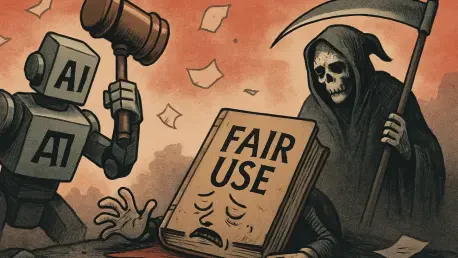

Protecting the digital ecosystem requires maintaining legal standards that support the transformative use of data for scientific advancement and public benefit. The current legal landscape is dominated by high-stakes lawsuits pitting content creators and publishers against artificial intelligence developers like OpenAI. While these battles are frequently characterized as a “David vs. Goliath” struggle for fair compensation, this narrow focus obscures a much larger threat. At the heart of these disputes lies the potential dismantling of the fair use doctrine, a legal cornerstone that allows for the unauthorized use of copyrighted material under specific conditions. If courts rule against AI companies, the fallout will extend far beyond Silicon Valley, impacting the fundamental rights of journalists, researchers, and the general public to interact with digital information in 2026. This judicial tension suggests a pivotal shift in how intellectual property is managed, moving away from a balanced system toward one of total control.
The Foundational Role: Transformative Use and Innovation
Historically, copyright law was never intended to grant authors an absolute monopoly over information; instead, it was designed to incentivize creativity for the ultimate benefit of the public. The fair use doctrine serves as a critical safety valve, particularly when a new use of material is transformative in nature. This principle ensures that culture and knowledge can evolve without every minor reference requiring a costly license. In the context of large language models, the primary goal is not to redistribute original works, but to extract underlying linguistic patterns and statistical relationships. This shift from consumption to computation represents the essence of transformative purpose. Without these protections, the legal framework would become a tool for stagnation, effectively locking away the building blocks of human knowledge behind paywalls. This would fundamentally alter the creative landscape for future generations and limit the diversity of digital expression.
Initial fears that AI models would act as simple infringement machines have largely failed to materialize as the technology matured throughout 2026. Instead, judicial observations have increasingly recognized that training an AI model—where data is processed to create a functional tool—is fundamentally different from the original intent of creative works. By framing AI training as simple infringement, plaintiffs are asking the judiciary to rewrite the basic tenets of copyright law. This move could stifle the very innovation the law was meant to protect by treating data analysis as a form of piracy. If the act of learning from public information is criminalized, the precedent would likely extend to any software that reorganizes data for user convenience. Such a restrictive interpretation threatens to reverse decades of legal progress that favored the democratization of information. Ultimately, the focus must remain on whether technology adds value rather than whether it simply exists.
Universal Internet Functionality: The Scraping Debate
A major concern emerging from these legal arguments is the claim that scraping or downloading public data without an explicit license is inherently illegal. The digital world operates on intermediate copying, where billions of temporary data copies are made every second to facilitate routine activities like opening an email or streaming a video. If the legal standard for fair use is restricted to exclude the automated gathering of data, the seamless nature of the modern web could break. Users would face an impossible burden of verifying licenses for every piece of content they encounter, turning the internet into a legal minefield for the average citizen. This potential fragmentation of the web would mean that simple browsing could be characterized as a series of copyright violations. Consequently, the fluidity of the digital experience would be replaced by a rigid system of micro-transactions that prioritize profits over a global utility, hindering the free flow of information.
The techniques used to train generative AI are identical to those employed by investigative journalists and academic researchers to hold powerful institutions accountable. Watchdog organizations rely on data scraping to track misinformation, monitor hate speech, and investigate anticompetitive behavior by major corporations. If acquiring public data without a license is deemed unfair, independent researchers who lack the massive budgets of tech giants will be the first to lose their legal protection. Ironically, a ruling intended to punish Big Tech could end up shielding those same companies from public scrutiny by making it illegal to analyze their public-facing data. This shift would create a world where only the entities that own the data can study it, effectively ending the era of independent digital auditing. The loss of these investigative tools would significantly weaken the ability of civil society to monitor corporate power in a digital world where transparency is already at a premium.