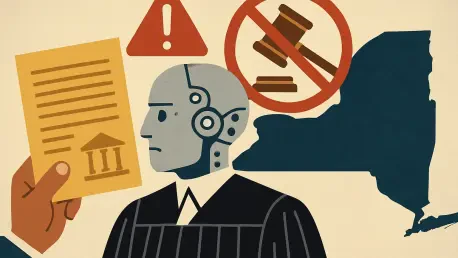

New York State Senator Michelle Hinchey has introduced a bill that would make judges legally accountable for issuing court orders containing fabricated information generated by artificial intelligence. This legislative move comes at a critical juncture as the legal profession grapples with the rapid integration of large language models into daily workflows. While these tools offer unparalleled efficiency in drafting and research, they are prone to producing hallucinations—convincing but entirely fictitious legal citations, statutes, and case histories. When a judge inadvertently includes such fabrications in an official court order, the consequences can be devastating, potentially stripping individuals of their rights based on digital myths. The proposed legislation seeks to bridge the gap between technological convenience and the non-negotiable requirement for human verification. By establishing a clear legal framework, New York aims to protect the sanctity of the courtroom from the unintended side effects of automation, ensuring that every citation used to uphold the law is rooted in reality.
Accountability Mechanisms
Oversight by the State Commission
The cornerstone of this proposal is the empowerment of the State Commission on Judicial Conduct to investigate and discipline members of the bench who fail to vet AI-generated content. Under current New York law, this commission serves as the primary watchdog for judicial ethics, holding the unique authority to issue public admonishments or recommend the full removal of a judge from their position. This bill explicitly expands their purview to include reckless usage of automated software that results in the issuance of inaccurate legal authority. Rather than creating an entirely new agency, the legislation leverages an existing, rigorous oversight structure to ensure that judges are held to the same high standards as the attorneys who appear before them. This transition is essential because, while lawyers have long faced sanctions for filing false information, the judiciary has often operated in a regulatory gray area regarding their personal use of emerging technologies during the drafting of opinions and orders.
Evaluation of Culpability Levels
Determining the level of professional misconduct requires a nuanced evaluation of a judge’s intent and the resulting impact on the litigation at hand. The proposed law mandates that the commission assess whether the fabrication was the product of simple negligence or a more egregious lack of oversight that fundamentally altered a case’s outcome. For instance, a minor citation error might result in a private warning, whereas an order that relies on a fictitious precedent to incarcerate a defendant would trigger severe disciplinary actions. This case-by-case approach recognizes that the goal is not to stifle innovation or punish technological curiosity but to mandate a human-in-the-loop verification process. By focusing on culpability, the bill creates a tiered system of accountability that encourages judges to view AI as an assistive tool rather than a replacement for their own legal research and critical thinking. This ensures that the final word in any legal proceeding remains the product of human intellect and ethical responsibility.
Regulatory Context
Prevalence of Technology in Courts
The urgency of this bill is underscored by the widespread adoption of artificial intelligence within the federal and state court systems over the past several years. Data from the current decade indicates that more than sixty percent of judges now utilize at least one AI tool to streamline their administrative tasks or initial research phases, with a significant portion doing so on a daily basis. While these tools can increase efficiency in an overburdened legal system, high-profile failures in other jurisdictions have served as a stark warning. In recent years, judges in states like Mississippi and New Jersey have faced public scrutiny after court documents were found to contain hallucinated case law and incorrect party details produced by popular chatbots. These incidents have demonstrated that even experienced legal professionals can fall victim to the persuasive nature of AI-generated prose. The New York bill directly addresses this risk by creating proactive guardrails, acknowledging that the speed of technological progress must be balanced with human oversight.
Integration With Existing Standards
Moving forward, the success of this legislation will depend on its integration with the Unified Court System’s existing security and training protocols. New York has already taken significant steps by requiring employees to complete specialized training before using AI on state devices, but this bill adds a necessary layer of personal liability for the decision-makers on the bench. Legal experts recommend that the next steps involve the development of a comprehensive registry of vetted AI tools that meet specific accuracy benchmarks. Furthermore, judicial institutions should prioritize the creation of internal auditing processes to catch potential errors before orders are finalized and entered into the public record. In the coming years, the focus must shift toward a collaborative environment where technology enhances access to justice without compromising the accuracy of the law. By establishing these benchmarks, New York demonstrates a commitment to evolving its statutes alongside rapid innovation. This proactive stance provides a model for other states to follow in the transition to a tech-centric era.