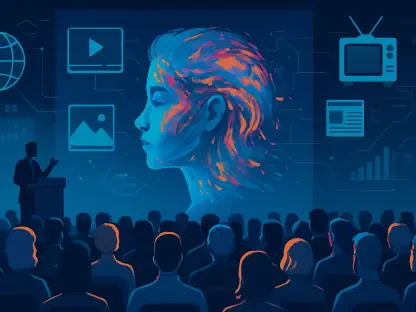

Many creators believe that machines lack the intrinsic human drive to leave a personal, intentional imprint on the world through their creative work. This sentiment has become the focal point of intense discourse at institutions like the UNC Hussman School of Journalism and Media, where the Converge-Con convention recently brought together experts to dissect the shifting boundaries of digital expression. As the creative industry navigates the complexities of the mid-2020s, the emergence of advanced neural networks has forced a reevaluation of what it means to be an author or an artist. The central tension lies between those who view these algorithms as revolutionary instruments for expanding the limits of imagination and those who fear they are merely sophisticated mimics capable of diluting the soul of artistic production. This ongoing debate is not merely academic; it represents a fundamental shift in how professionals approach the very act of invention, demanding a balance between the speed of automation and the depth of human intentionality.
The Technical Paradox: Balancing Efficiency and Originality
The integration of algorithmic tools into technical fields such as 3D modeling and projection mapping has fundamentally altered the timeline of professional production. Grant Sizemore, a specialist in these disciplines, observed that while software can now handle the heavy lifting of rendering and geometry generation, there is a looming risk of eroding the critical thinking required for high-level design. The danger lies in the potential for creators to become passive observers of their own work, relying on the machine to make aesthetic choices that were once the result of laborious human trial and error. Lived experiences, which inform the subtle nuances of lighting, texture, and composition, are difficult to quantify within a data set. Consequently, the reliance on automated systems could lead to a homogenization of visual styles where the unique perspective of the individual is sacrificed for the sake of rapid delivery, leaving the final output technically perfect but emotionally hollow.
Professor Scott Geier, who organized the convention, emphasized that the creative sector is currently undergoing a more profound disruption than almost any other professional field. He proposed a dual framework for evaluating these tools, centered on the concepts of ethics and efficacy. This approach requires artists to interrogate whether a specific technology actually enhances the conceptual quality of their output or if it serves merely as a convenient shortcut to bypass the necessary struggles of the creative process. In the current landscape, the ease with which content can be generated often masks the underlying questions regarding the origin of the training data and the long-term impact on professional standards. By focusing on whether a tool genuinely contributes to the clarity of a message or the impact of a story, practitioners can maintain their role as intentional creators rather than becoming mere prompt engineers who facilitate the output of a black-box system.
The Human Quotient: Preserving Identity in the Digital Age
The musical landscape has become a primary battleground for the preservation of artistic identity, particularly as AI-generated compositions become indistinguishable from those written by humans. During the Mixed Signals experiment led by Professor Pablo Vega, participants often struggled to identify the source of various musical pieces, raising significant concerns about the potential for stolen voices. This ambiguity suggests that the technical proficiency of algorithms has reached a point where they can mimic the superficial structures of emotion and melody with alarming accuracy. However, this mimicry often lacks the historical context and the specific personal history that a human composer brings to a score. The fear among many in the industry is that as these tools become more prevalent, the value of a unique artistic voice could be diminished, replaced by a system that prioritizes pattern replication over genuine innovation, leading to a future where the distinction between art and data is blurred.
The creative community eventually realized that the path forward required a strategic pivot toward human-centric curation rather than total reliance on automated output. This shift meant that the most successful practitioners were those who utilized algorithmic tools to handle the monotonous glitches of production while reserving the final, most critical decisions for themselves. By establishing clear boundaries between generative processes and pattern-recognition assistance, artists maintained their status as the ultimate tastemakers in a crowded digital marketplace. The implementation of transparency standards allowed the audience to appreciate the effort behind the craft, fostering a deeper social connection that machines simply could not replicate. Consequently, the industry successfully balanced the speed of the Intelligence Age with the contemplative nature of traditional art, ensuring that the intrinsic drive to leave a personal imprint remained at the heart of all creative endeavors.