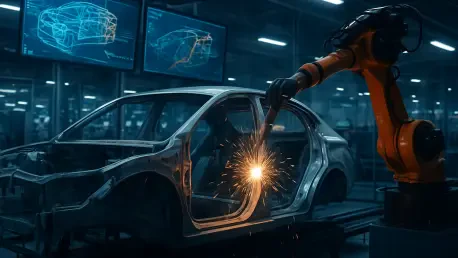

A vehicle can require as many as 1,700 welds, each demanding a precisely positioned robot. Hyundai Motor is using AI to plan those movements in a virtual environment, taking over programming work previously handled by people. The company plans to introduce the technology at its domestic plants starting next year, bringing simulation closer to everyday production.
Welding Paths Become a Software Task
At Hyundai Motor Group Uiwang Research Center, a demonstration showed welding robots working beside a vehicle body frame. On monitors, a virtual version of the equipment mapped welding locations and movement routes. When errors appeared, the robots revised their routes and poses before locating the weld points and starting work.
For manufacturing teams, the change concerns the preparation behind automation. Workers previously performed “teaching”: specifying how a robot should move to reach each target. With so many welding locations on a vehicle, that preparation involves both precision and complexity. AI-generated paths could reduce the manual effort required to get equipment ready.
The demonstration was part of a preview for E-Forest Tech Day 2026. Hyundai Motor and Kia said the event, entering its seventh year, would run for three days beginning on the 19th and feature more than 200 manufacturing technologies from their Manufacturing Solutions Division and partner companies.
Across the preview, the practical direction was consistent: develop and test more of a production task digitally before asking physical equipment to perform it.
| Factory task | Demonstrated or developing approach | Practical purpose |
|---|---|---|
| Welding preparation | AI plans robot routes around a virtual vehicle body | Reduce manual movement programming |
| Body weatherstrip installation | A dedicated gripper adjusts pressure, followed by 3D imaging | Handle flexible parts and check assembly |
| Transport suspension wire loops | Robot hands use tactile sensing and a vision model | Develop automation for work still performed manually |
Virtual Training Reduces Disruption on the Line
Testing equipment in an operating factory can require stopping production. Hyundai Motor’s approach first runs machinery and working conditions in simulation, where teams can look for potential collisions and quality problems. Reducing physical test interruptions offers a route to saving time and expense.
Hyundai Motor Group is developing an AI Factory to organize that process. When an inspection model’s performance falls, the system creates additional virtual training material, then repeats training and validation. Teams can change camera viewpoints, vehicle models and body colors rather than relying solely on new observations from the plant.
Defect inspection illustrates why this is useful. Producing faulty items deliberately for training is difficult in a real factory; simulation allows those situations to be constructed without disrupting normal manufacturing. An inspection system can then learn from examples that would otherwise be hard to collect.
The proposed training loop follows a concrete sequence:
- Create virtual examples suited to the inspection problem.
- Retrain the AI using those examples.
- Validate its performance before applying the learning to physical equipment.
Hyundai Motor is also developing sim-to-real technology, which transfers learning from simulation into actual machinery. Its development uses Nvidia GPUs and Isaac Sim. Researchers demonstrated virtual robot control with a leader arm, collecting training data and testing movements before operating real equipment.
That transfer remains a deployment consideration. Virtual testing provides a way to prepare and check behavior, but the company describes sim-to-real as technology still under development. Performance in a digital environment alone doesn’t establish readiness for the production line.
Flexible Parts Demand More Than a Fixed Movement
Body weatherstrips present a different challenge from welding. These large rubber components bend and have irregular shapes, making automated installation difficult. A robot demonstrated at the research center used a purpose-built gripper to place the material into a door frame while continuously adjusting pressing force.
After fitting the component, the system used 3D imaging to examine the assembly. A Hyundai Motor official explained that repeated AI training captured the order and speed of a worker’s gripping and insertion actions, which then informed the robot’s movements. Human technique supplied the learning material for a more delicate automated task.
Another development targets the wire loops securing suspension equipment used to transport electric vehicle front chassis. Workers currently tie and untie those loops. Hyundai Motor is developing robot hands that combine tactile sensors with a vision model to check whether a grip is secure.
Two models, described as pinching and grasping, are being developed. Different hand motions are intended to accommodate varying component shapes and tasks, potentially extending their use across production processes.
Domestic Rollout Will Proceed in Stages
Hyundai Motor and Kia plan to introduce these technologies gradually as they move all domestic production lines toward software-defined factories, or SDF. In this approach, data, AI and software underpin factory operations.
Choi Young-tae, head (executive director) of the E-Forest Hyundai Motor and Kia Manufacturing Solutions Division Center, described the goal as more flexible, sustainable operations supported by data and AI. He also said broader robot use would allow people to concentrate on safer work with greater value.
For factory teams, the immediate significance is the connection between virtual preparation and physical execution. Welding-path generation has a planned domestic rollout, while robot hands and simulation transfer remain development efforts. Keeping those stages distinct will help manufacturers assess where AI can reduce preparation work now and where further validation is needed before deployment.