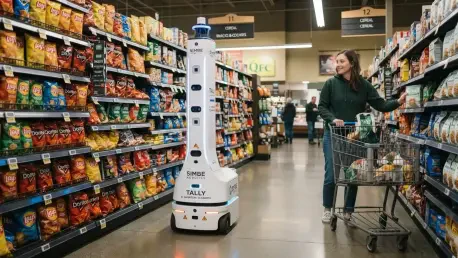

Customers at a Fred Meyer in Seattle’s Greenwood neighborhood shop alongside an autonomous robot scanning the shelves. The robot turns images of merchandise and shelf labels into tasks employees can act on. Kroger gets an opportunity to improve inventory visibility, while privacy and staffing questions remain unresolved for the people sharing the aisles.
From Shelf Images to an Employee’s Next Task
Developed by Simbe Robotics, Tally inspects merchandise using cameras, computer vision and AI. Retailers can use it to find inventory gaps, verify prices and check that products are in their intended positions. Its rounds at the Greenwood store also cover electronic shelf labels. The operational handoff happens through software. Rather than sending immediate alerts to employees as it moves, Tally supplies information to Simbe’s platform, which organizes replenishment work into ranked tasks. Employees still have to investigate and resolve the gaps it identifies.
For a grocery team, that distinction is useful.
A shelf-scanning system can reduce the need to discover every shortage through manual inspection, but detection alone doesn’t put an item back on display. Its value depends on how reliably the resulting tasks fit into the store’s existing work.
Tiffany Sanders, head of public affairs for QFC & Fred Meyer Divisions of Kroger, described the intended benefit as helping employees find and address depleted shelves more quickly. Sanders also said the technology could free staff to spend more time helping customers. Those are the retailer’s stated goals, rather than measured results disclosed for this location. Kroger started testing robotic systems in 2024 with the aim of getting more current inventory information. Simbe has since exceeded 3,000 autonomous units under contract worldwide, with 500 robots across Kroger’s operations. Contracts indicate commercial traction, though they don’t establish how effectively each store uses the resulting data.
Deployment Extends Beyond Whether a Robot Can Navigate
Putting a robot to work in a grocery store also means getting it to move reliably through the space. Tally has a narrow body on a rounded base and stands over 6 feet tall. As it travels slowly around customers and merchandise displays, it relies on dozens of sensors.
At Greenwood, shoppers could see both how the machine navigated and where it ran into difficulty. It made its way past displays and waited for shoppers.
Beside a Doritos end-cap display, though, it stopped for several minutes. Customers reacted differently: some watched with interest, while others appeared irritated by its presence.
These encounters raise a practical adoption question: can the robot collect inventory information without making shopping or stocking harder? A successful scan has limited operational value if the route repeatedly interrupts the people the system is meant to support.
The regional deployment is also difficult to assess from the information Kroger has provided. Reports on Reddit place Tally at Fred Meyer locations in Lynnwood, Puyallup, Port Orchard and University Place, as well as Seattle. Kroger runs over 50 multi-department stores in Washington, but Sanders did not specify how many regional locations have robots.
Assessing the rollout also requires answers to several questions:
- Operating coverage: Kroger did not disclose the machines’ daily running hours.
- Staffing effects: Sanders left unanswered whether introducing the machines had displaced employees.
- Customer data: The retailer did not explain what privacy safeguards it has for shoppers.
Each gap limits a different judgment. Operating hours help establish how often shelves are checked. Staffing information would clarify how work is changing. With more privacy detail, customers could better understand what happens around the cameras they see in the aisles.
A Competing Approach Puts the Sensors on Employees
Augmodo, a Seattle startup, approaches the same inventory problem through staff movement. Its Smartbadge collects shelf information while employees carry out their normal duties, rather than assigning that collection to a separate roaming machine. Augmodo founder and CEO Ross Finman argues that employees already cover store aisles repeatedly, making their movement a useful basis for gathering information. He says simple, inexpensive badges can collect data more frequently and at lower cost. Those remain company claims, not a demonstrated comparison with Tally.
The two approaches place different demands on store operations:
| Operational question | Tally | Augmodo |
|---|---|---|
| How does collection happen? | An autonomous machine travels through aisles. | Employees wear a Smartbadge during their work. |
| Where does it fit into the workflow? | Shelf observations feed software that prioritizes employee tasks. | Shelf observations come from routes staff already travel. |
| What needs attention during adoption? | Navigation, aisle access and handling the resulting task queue. | Wearable use and how staff movement supports coverage. |
Finman’s broader ambition is an AI assistant that supports employees beyond shelf checks, including delivery work, maintenance and back-of-store duties. He describes the aim as giving each associate the equivalent of two additional years of experience.
That is a product vision, not an established workforce outcome.
Funding shows that investors are backing this alternative collection model. Augmodo raised $21 million during the summer, following a $37.5 million round a year earlier. For retailers considering either approach, the useful comparison is how well collected information translates into completed work, alongside the cost and disruption of collecting it.
Privacy and Staffing Shape Acceptance on the Floor
Visible cameras create questions that an inventory use case alone cannot answer. Patrick, a Seattle shopper working in cybersecurity, said he tries to avoid aisles occupied by Tally. He expressed concern about possible collection of device signals and information about customers. His comments describe suspicion, not evidence that the robot collects Bluetooth signals or tracks shoppers. Still, Kroger’s lack of disclosed privacy details leaves customers without a clear explanation of the boundaries around the system.
Finman offered a more specific account of Augmodo’s approach. He said its hardware targets merchandise and filters people, along with other irrelevant material, before information leaves the premises. Retailers evaluating such systems would need to examine how those stated controls operate in practice.
Local policy makes the distinction between shelf data and personal data especially relevant. Seattle City Council recently prohibited surveillance pricing that uses personal information and AI tracking to determine individualized prices. Tally’s stated purpose is inventory management; that purpose does not itself establish a connection to individualized pricing.
Employment concerns also sit within a wider restructuring. Under CEO Greg Foran, Kroger plans to eliminate roughly one-third of corporate positions over three years while putting more emphasis on technology and simpler operations. Those corporate cuts do not establish that shelf robots have replaced store workers, but they help explain why assurances about employee support face scrutiny.
Tally’s deployment shows AI moving into a recurring store process: finding shelf problems and directing human follow-up.
Its relevance now rests on that operational handoff. Retailers pursuing similar systems need to show that better visibility produces useful work, while explaining clearly how employee roles and customer information are handled.