


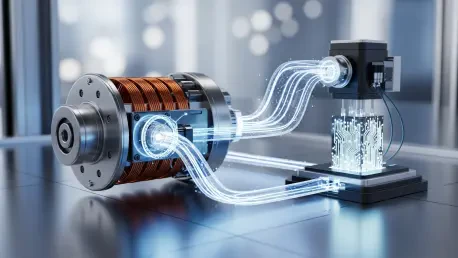

Industrial manufacturing facilities across the globe are currently grappling with the dual pressure of skyrocketing electricity costs and increasingly stringent carbon emission regulations that demand immediate technological intervention. While traditional motion control systems have relied on fixed Proportional-Integral-Derivative (PID) loops for decades, these legacy frameworks are often tuned for worst-case scenarios, leading to significant energy waste during standard operations. The shift toward artificial intelligence (AI) in motor control represents a fundamental change in how machinery manages kinetic energy and thermal loss. By replacing static algorithms with dynamic, neural-network-based controllers, factories can now adapt to real-time load variations with unprecedented precision. This transition is not about incremental improvements but rather a complete overhaul of how electricity is converted into mechanical work. As manufacturers integrate these intelligent systems, the focus has shifted from simple mechanical throughput to holistic energy optimization that accounts for every millisecond of a motor’s duty cycle.
Machine Learning: Transitioning From Static to Dynamic Control Architectures
Reinforcement learning (RL) has emerged as a cornerstone of modern industrial motion control, allowing servo drives to learn the specific nuances of their mechanical environment through iterative feedback. Unlike standard controllers that follow a rigid set of instructions, RL-enabled drives experiment with different torque profiles to find the most efficient path for a given task. This capability is useful in applications like high-speed packaging or robotic assembly, where inertia and friction can fluctuate based on temperature or material weight. Companies such as Fanuc and Siemens have begun deploying drives that utilize edge-based AI to analyze current consumption patterns on the fly. By identifying and eliminating unnecessary overshooting and mechanical oscillations, these systems reduce the total energy drawn from the grid while extending the operational lifespan of hardware by minimizing mechanical stress and heat generation within the motor windings.
Beyond individual motor performance, the integration of AI-driven motion control facilitates a more sophisticated approach to regenerative braking and energy recovery within multi-axis systems. In traditional setups, excess kinetic energy generated during deceleration is often dissipated as waste heat through resistors, but AI algorithms can now synchronize the deceleration of one axis with the acceleration of another. This coordinated energy sharing ensures that power remains within the DC bus of the machine rather than being lost to the environment. Furthermore, deep learning models can predict the exact moment a machine needs to enter a low-power state without compromising startup times for the next production cycle. This level of control eliminates the “idle drain” that accounts for a substantial portion of industrial energy bills, turning once-static production lines into fluid, energy-aware ecosystems that prioritize conservation without sacrificing speed.
Operational Standards: Strategies for Intelligent Implementation
The application of predictive modeling within motion control ecosystems extends far beyond simple movement, reaching into the critical domain of proactive maintenance and friction compensation. AI-driven systems are now capable of detecting microscopic changes in vibration signatures or current draws that indicate a bearing is starting to fail or a lubricant is breaking down. By recognizing these patterns before they manifest as mechanical failures, the system can adjust its control parameters to compensate for increased resistance, preventing the motor from overworking and consuming excess power. This real-time adaptation ensures that the system maintains its peak efficiency even as mechanical components naturally age over time. Strategic implementation of these technologies allows maintenance teams to transition from scheduled interventions to condition-based actions, ensuring that every watt of electricity is used for production rather than fighting inefficiencies of worn-out parts.
Leaders in the manufacturing sector recognized that the path to true sustainability required a departure from the “set-and-forget” mentality of previous industrial eras. By adopting AI-driven motion control, organizations moved toward a model where hardware and software operated in a continuous feedback loop of optimization and refinement. The integration of high-fidelity data with kinetic execution proved that significant energy reductions were possible without downgrading performance metrics. Moving forward from the current landscape of 2026 to 2028, the industry should prioritize the standardization of data protocols to ensure that AI controllers can communicate across different vendor platforms. Investing in edge computing infrastructure will also be a critical step for facilities looking to minimize latency in their energy-saving algorithms. Ultimately, the successful deployment of these intelligent systems demonstrated that efficiency and productivity are not mutually exclusive goals.







