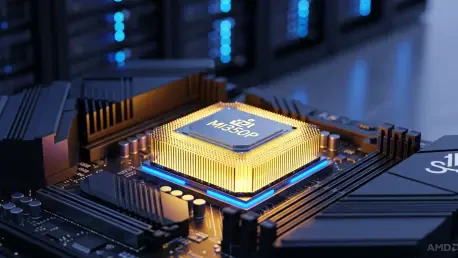

The relentless expansion of large language models has created an insatiable demand for compute power that traditionally only one silicon giant could satisfy. While NVIDIA maintained a vice-like grip on the market for years, the introduction of the AMD MI350P signaled a fundamental shift in how hyperscalers and private cloud providers approach their infrastructure investments for 2026 and beyond. This new contender leverages the sophisticated CDNA 4 architecture, which was designed from the ground up to address the specific bottlenecks found in training trillion-parameter models. By focusing on a massive increase in memory capacity and a leap in energy efficiency, AMD has positioned itself not just as a secondary source, but as a primary architect for the next phase of generative intelligence. The industry is now witnessing a pivot toward heterogeneous environments where the once-impenetrable wall of software exclusivity is beginning to crumble under the weight of open-source innovation and the pressing need for supply chain resilience across the entire technology sector.
Architectural Evolution: The Technical Foundation of CDNA 4
Building on the technical milestones of its predecessors, the MI350P architecture introduces 288GB of high-speed HBM3e memory, providing the necessary bandwidth to keep compute engines fed during complex inference tasks. This specific memory configuration allows for significantly larger context windows in transformer models without the need for excessive model partitioning, which often introduces latency and power overhead. The transition to a more advanced 3nm process node has enabled AMD to pack more transistors into each chiplet while simultaneously reducing the thermal design power per teraflop of performance. This architectural refinement proved critical for data centers that reached their cooling limits with earlier hardware generations. By prioritizing the throughput of FP8 and FP4 data types, the hardware effectively doubled the performance-per-watt for most modern training workloads. Consequently, organizations looking to scale their AI clusters found that the MI350P offered a more sustainable path for multi-year expansions.
The competitive landscape was further altered by the MI350P’s integration of the next-generation Infinity Fabric, which facilitates ultra-low latency communication across massive clusters of GPUs. Unlike proprietary networking stacks that often lock users into a specific hardware ecosystem, AMD’s interconnect strategy emphasizes interoperability with standard Ethernet and InfiniBand technologies. This flexibility allows engineering teams to optimize their network topology based on specific workload requirements rather than hardware limitations. When compared directly to the Blackwell architecture, the MI350P demonstrated a remarkable ability to maintain high utilization rates even as cluster sizes grew into the tens of thousands of nodes. This scalability is essential for training the next generation of multimodal foundation models that require synchronous updates across vast distributed systems. Furthermore, the inclusion of advanced hardware-based security features ensured that sensitive enterprise data remained protected throughout both training and inference.
Strategic Integration: Navigating the Software Ecosystem Barrier
The evolution of the ROCm 7.0 software stack played a pivotal role in neutralizing the historical advantage held by the CUDA ecosystem through enhanced compatibility and performance optimization. By providing native support for industry-standard frameworks like PyTorch and TensorFlow, AMD allowed developers to port their existing codebases with minimal friction and virtually no performance penalty. This shift was accelerated by the widespread adoption of the Triton programming language, which effectively abstracted hardware-specific kernels and allowed for a more unified development experience. Enterprise software teams found that the MI350P could be integrated into their existing CI/CD pipelines as easily as any other accelerator, reducing the time-to-market for new AI-driven features. Additionally, the open-source nature of the ROCm project encouraged a collaborative environment where researchers could contribute specialized kernels for emerging model architectures. This community-driven approach ensured that the software layer remained agile.
Strategic decisions made by infrastructure architects during this transition period prioritized the creation of a balanced and resilient compute portfolio. Organizations that successfully integrated the MI350P into their data centers achieved a significant reduction in their total cost of ownership while maintaining a high level of performance for mission-critical AI applications. They implemented rigorous testing protocols that validated the hardware’s reliability over long training runs, confirming that the silicon could withstand the thermal stresses of continuous high-load operations. IT leaders moved away from single-vendor dependencies and instead embraced a modular approach that favored open standards and interoperable software layers. This shift allowed firms to negotiate better pricing and support contracts, as they no longer remained captive to a single supplier’s roadmap or supply chain constraints. By investing in a diverse array of compute resources, these companies positioned themselves to capitalize on breakthroughs without hardware limitations.