



Laurent Giraid is a distinguished technologist who has spent the last decade at the forefront of the artificial intelligence revolution, specializing in the delicate balance between high-performance machine learning and the practicalities of natural language processing. His expertise lies in understanding how hardware architectures—specifically those designed for local execution—can democratize access to the industry’s most powerful models. As the economic reality of cloud computing begins to weigh heavily on innovation, Giraid offers a deep dive into the engineering and strategic shifts that are redefining how developers interact with large-scale AI. He has a keen eye for how the “unmetered intelligence” movement might dismantle the current barriers to entry for startups and individual researchers alike.
This interview explores the transition from cloud-dependent development to a hybrid local model, anchored by the technical specifications of Microsoft’s newest hardware. We discuss the technical necessity of 128 gigabytes of unified memory for handling massive context windows and 100,000-token caches, the innovative thermal management provided by 3D-printed aluminum, and how a pre-configured developer environment can eliminate hours of setup friction. Finally, Giraid analyzes the competitive edge Microsoft gains over Apple through the CUDA ecosystem and the strategic three-tier plan that aims to make AI costs fixed rather than variable.
Cloud-based per-token pricing often creates unpredictable overhead during the early stages of model development. How does shifting to a local hardware model fundamentally alter the economic landscape for a developer or a team currently iterating on a prototype?
The current economic model of AI development is essentially a tax on experimentation, where every single iteration carries a literal price tag. When you are iterating rapidly on a prototype, running the same model dozens or even hundreds of times a day, those per-token charges from cloud providers compound into a boardroom-level concern almost overnight. By moving to a device that allows for “unmetered intelligence,” a developer can reserve those expensive frontier model calls for truly frontier-level problems and handle the bulk of their work—like fine-tuning or agentic loops—on their own desk. This shift transforms AI compute from a variable, scaling expense into a predictable, fixed capital expenditure. It means a developer can load and interact with models exceeding 120 billion parameters without the anxiety of watching a cloud meter run in the background. Every dollar saved on inference is a dollar that can be redirected back into the creative process, allowing for the kind of “fail fast” mentality that actually drives breakthroughs in this field.
The technical heart of this new hardware is the 128-gigabyte unified memory pool shared between the CPU and GPU. Why is this specific architectural choice more significant for AI than the traditional discrete memory setups we see in high-end gaming rigs?
In a traditional PC setup, you are usually dealing with a fragmented system where the CPU, discrete GPU, graphics memory, and system RAM all live in separate silos, which creates a massive bottleneck for large-scale AI. Most high-end gaming laptops top out at roughly 24 gigabytes of GPU-accessible memory, which is nowhere near enough to run the class of models that developers are currently targeting. When you look at a model running with 100,000 tokens of context, the key-value cache alone can consume between 40 to 50 gigabytes of memory, which would instantly choke a standard discrete GPU. By implementing a 128-gigabyte unified memory pool through the Unified Memory Access architecture, the system can dynamically allocate resources where they are needed most. This allows a developer to run models in the 100-billion-parameter range locally, maintaining high context windows that were previously only possible in massive cloud data centers. It’s not just about raw capacity; it’s about the fluidity with which the GPU can address the entire system memory to maintain sustained performance during heavy workloads.
Given that these machines are intended to run intensive training and inference jobs for hours at a time, how does the physical design—specifically the 3D-printed aluminum chassis—contribute to sustained performance?
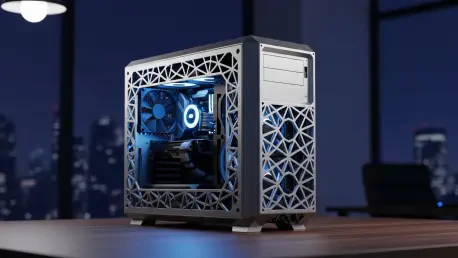
Thermal management is the silent killer of local AI performance, and solving for it in a compact desktop requires moving beyond traditional manufacturing constraints. This device operates within a 100-watt sustained thermal envelope, which is quite modest for a desktop but requires incredible efficiency to prevent throttling during overnight fine-tuning jobs. The use of metal 3D printing for the top panel allows for internal geometries—like specific angled perforations—that simply couldn’t be achieved through CNC machining or injection molding. These complex shapes optimize the airflow from the cold-air intake through to heat dissipation, allowing the entire aluminum chassis to function as a highly efficient passive heatsink. When you’re working in an open office, you can’t have a machine that sounds like a jet engine, and this architectural choice ensures the device runs quietly enough to be ignored while still delivering a petaflop of compute. It turns the physical shell of the computer into an active participant in the cooling process, ensuring that the Nvidia Blackwell-architecture RTX Spark processor doesn’t lose a step even under a constant, heavy load.
The out-of-box experience for developer hardware has historically been quite poor, often requiring hours of configuration. What specific changes to the software environment were necessary to make this a truly “developer-first” machine?
The philosophy behind this setup is a recognition that the “time to first line of code” is a critical metric for productivity. Instead of the typical consumer Windows experience, the machine boots into a environment specifically tuned for high-level work, featuring a dark theme, a simplified taskbar, and Do Not Disturb enabled by default to minimize distractions. From a technical standpoint, the inclusion of WSL 2—the Windows Subsystem for Linux—with pre-configured GPU passthrough and CUDA support is a game-changer because it eliminates the most common configuration headaches developers face. Essential tools like Visual Studio Code, GitHub Copilot, Git, and various runtimes like Python and Node.js are already installed and ready to go. The operating system itself has been modified with new memory management logic that allows the GPU to address more system memory while ensuring the CPU isn’t starved during heavy multitasking. By handling the friction of setup at the image level, the machine allows a developer to transition from unboxing to running a local inference prototype in a matter of minutes rather than hours.
Apple’s Mac Mini has been a dominant force in the compact desktop market for developers. How does a CUDA-based system like the RTX Spark Dev Box compete with Apple’s established Silicon architecture?
While Apple has certainly made impressive strides with the M4 Pro and Max chips—reaching up to 128 gigabytes of unified memory—the real battleground is the software ecosystem. The overwhelming majority of the AI and machine learning world, including frameworks like PyTorch, TensorRT, and the Hugging Face libraries, is built and optimized first for Nvidia’s CUDA stack. A developer using a CUDA-based machine can write code that is 100% portable; the same library they use on their desk is what will run on an H100 in the cloud when they are ready to scale to production. Apple’s Metal framework is improving, but it still lacks that “write once, run anywhere” level of compatibility that the AI industry demands. Furthermore, by pairing that 128 gigabytes of memory with a Blackwell-class GPU, the Dev Box is intentionally positioned in a higher class of performance than a standard Mac Mini. It’s not just about having the memory; it’s about having the specific compute architecture that the entire open-source community is already using as its primary development target.
Microsoft is moving toward a “three-tier” strategy for local AI hardware, ranging from laptops to deskside supercomputers. How does this tiered approach, specifically the new “/fleet” functionality in GitHub Copilot, change the way a developer manages their daily tasks?
This tiered strategy is all about right-sizing the compute to the complexity of the task, which is a much more sophisticated way of thinking about AI than just “everything in the cloud.” You have the Surface Laptop Ultra for portability, the Dev Box for mid-range local work, and the DGX Station for massive frontier models up to a trillion parameters. The real magic happens with features like the /fleet command in the GitHub Copilot CLI, which acts as a traffic controller for intelligence. It allows a primary agent in the cloud to assess a project, break it into subtasks, and then route the less complex parts to a local model—like the Aion 1.0 family—running right on the developer’s hardware. This means the cloud handles the high-level planning while the local machine handles the “grunt work” of code generation or unit testing at zero marginal cost. It’s a hybrid model that maximizes both quality and cost-efficiency, ensuring that you aren’t paying premium cloud prices for tasks that a local 70-billion-parameter model can handle perfectly well.
What is your forecast for the future of hybrid AI development?
I believe we are entering an era where “local-first” development will become the standard, and the concept of renting every single token of intelligence will start to look like an historical anomaly. Within the next two to three years, the most successful enterprise teams will be those that have mastered this hybrid balance, treating the cloud not as their primary workbench, but as a specialized high-tier resource. We will see the open-source community continue to optimize models in that 70-to-120-billion-parameter sweet spot specifically to fit into the memory envelopes of these types of machines. As the “unmetered intelligence” model takes hold, the barrier between a prototype and a production-ready application will thin, as the local hardware will finally be powerful enough to mirror the deployment environment accurately. Ultimately, the market will shift away from companies that only offer cloud services and toward those that can provide a seamless, integrated workflow that spans from a developer’s desk all the way to a massive data center. The era of buying your intelligence rather than just renting it is officially here.







