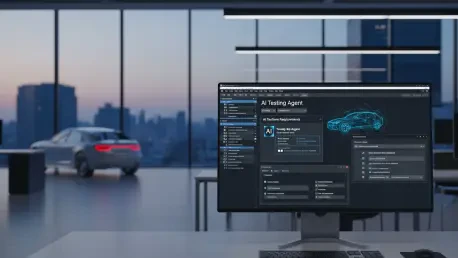

The modern vehicle has evolved far beyond its mechanical roots, transforming into a complex data center on wheels that requires millions of lines of code to operate safely and efficiently. As the automotive industry navigates this seismic shift from hardware-reliant designs to software-defined vehicle architectures, the traditional methods of manual testing have reached a breaking point. To address this mounting complexity, Marelli has joined forces with Amazon Web Services to develop an AI-driven System Test Generation agent. This sophisticated tool is designed to automate the labor-intensive task of creating system test cases directly from engineering requirements, ensuring that validation remains both rapid and consistent across global platforms. By utilizing generative AI to bridge the gap between design and verification, this collaboration marks a pivotal moment in automotive engineering, where the speed of software development finally aligns with the rigorous safety demands of the physical world.
The Mechanics of AI-Driven Validation
Integrating Generative AI and Automated Engineering Workflows
The deployment of the System Test Generation agent represents a fundamental change in how engineers approach the validation of complex vehicle systems. By utilizing advanced foundation models such as Amazon Nova and the Strands Agents framework, the system can interpret technical documentation with a level of nuance previously reserved for human specialists. The AI analyzes high-level system specifications and automatically derives structured, traceable test cases that are designed to verify specific product behaviors. This automation does not replace the human element but rather redirects it; engineers are now free to focus on the initial, creative phase of capturing customer intent and defining the core logic of a system. The AI then takes these definitions and handles the repetitive, detail-oriented task of exhaustive test creation, which significantly reduces the time required for validation cycles and allows for a much faster time-to-market for innovative vehicle features.
Furthermore, the integration of generative AI into these workflows ensures that safety and quality standards are never compromised by the accelerated pace of production. Utilizing Amazon Bedrock Knowledge Bases, the agent can integrate seamlessly with existing requirement management software, pulling relevant data without disrupting the established engineering pipeline. This creates a closed-loop system where every software requirement is automatically linked to a corresponding verification test, eliminating the risk of human error or oversight during the manual documentation phase. By maintaining a rigid, AI-managed connection between what a feature is intended to do and how it is tested, manufacturers can establish a reliable benchmark for industry quality. This level of precision is essential in an era where software governs everything from braking systems to cabin infotainment, making automated verification a cornerstone of modern automotive reliability and consumer trust.
Enhancing Reliability Through Machine Learning Insights
Moving beyond simple automation, the application of machine learning within the testing environment allows for a more predictive approach to vehicle reliability. The AI agent does not merely follow a static set of rules; it learns from historical data and previous testing outcomes to identify potential edge cases that a human engineer might overlook. For example, when a new driver-assistance feature is introduced, the system can simulate thousands of permutations of sensor data and environmental conditions to ensure the software responds correctly in every scenario. This depth of analysis is impossible to achieve manually within the compressed timelines of modern vehicle development. By identifying software regressions or unexpected interactions between different vehicle modules early in the development cycle, the AI prevents costly recalls and ensures that the final product is robust enough to handle the complexities of real-world driving environments.
This predictive capability also facilitates a more agile response to emerging technical challenges that arise during the integration phase. As different software components from various suppliers are merged into a single vehicle architecture, the AI agent can continuously run compatibility tests to ensure that updates in one area do not negatively impact the performance of another. This continuous monitoring creates a high-fidelity feedback loop for development teams, allowing them to iterate on software code with the confidence that the overall system integrity is being maintained. Consequently, the transition to AI-driven validation transforms the testing phase from a final hurdle into a dynamic, ongoing process that adds value throughout the entire design lifecycle. This shift ensures that as vehicles become more complex, the methods used to secure them become more sophisticated, maintaining a delicate balance between rapid innovation and uncompromising safety.
The Strategic Shift Toward Software-Defined Vehicles
Adapting to New Vehicle Architectures and Connectivity
The transition toward software-defined vehicles is no longer a niche trend but has become the primary strategic objective for approximately 45% of automotive manufacturers and suppliers. This priority has now surpassed other major industry shifts, including the drive toward full electrification and the pursuit of autonomous driving capabilities. To support this software-first mindset, there is a massive evolution occurring in vehicle architecture, moving away from traditional distributed electronic control units toward centralized zonal systems. These modern architectures utilize powerful central computers to handle the heavy processing loads required by advanced software applications, effectively simplifying the physical wiring and hardware complexity of the car. This centralization is a critical enabler for AI testing tools, as it provides a single point of entry for monitoring and validating the vast streams of data moving between different vehicle functions.
Connectivity serves as the indispensable backbone of this new era, enabling the cloud integration that makes software-defined vehicles truly dynamic. By linking vehicles directly to cloud environments, manufacturers can implement over-the-air updates, a feature that 73% of original equipment manufacturers now view as a top priority. This capability allows for the remote management of a vehicle’s entire software and firmware lifecycle, providing a way to enhance performance or patch security vulnerabilities without requiring a physical visit to a service center. For the AI testing agent, this cloud-connected environment offers a wealth of real-time data that can be used to refine testing protocols based on actual driving conditions. This continuous exchange of information between the vehicle and the cloud ensures that the software remains optimized for the lifetime of the car, effectively decoupling the evolution of vehicle features from the rigid timelines of physical hardware manufacturing.
Implementing Agile Practices and Service-Oriented Architectures
To maintain the pace of innovation required in the current market, the automotive sector is rapidly adopting engineering methodologies that were once the exclusive domain of the technology industry. By implementing Agile and DevOps practices, automakers are now able to iterate on software code independently of the hardware production cycle. This means that a vehicle’s interface, safety features, and performance parameters can be updated and improved even after the car has been sold to a customer. AI automation is the linchpin of this strategy, providing the continuous integration and testing necessary to validate frequent software releases. This transformation turns traditional manufacturers into dynamic service providers, capable of deploying new features on demand and responding to consumer needs with a level of speed and flexibility that was previously unimaginable in the automotive world.
Supporting this operational flexibility is the adoption of service-oriented architecture, which treats different software functions as independent modules. This modular approach is essential for the long-term management of a vehicle, as it allows specific components—such as a navigation update or a battery management tweak—to be deployed without risking the stability of the entire system. AI agents are particularly effective in this modular environment, as they can perform isolated validation on individual services while also checking for systemic harmony. By leveraging cloud-based AI to manage these complex interdependencies, companies can maintain high product integrity while offering a customized and evolving user experience. This comprehensive shift toward a software-centric development model, underpinned by robust AI validation, is establishing a new global standard for how vehicles are designed, built, and maintained throughout their operational lives.
The integration of the AI-driven System Test Generation agent into the automotive development cycle has fundamentally altered the path forward for vehicle manufacturing and software validation. By automating the transition from engineering requirements to executable test cases, organizations can now manage the overwhelming complexity of software-defined architectures without sacrificing speed or safety. The collaboration between Marelli and Amazon Web Services proved that the “complexity crisis” in modern engineering can be resolved by utilizing generative AI to handle repetitive documentation and validation tasks. Looking ahead, manufacturers should prioritize the implementation of centralized zonal architectures and cloud-native development environments to fully capitalize on these AI capabilities. Transitioning toward a service-oriented architecture will also be a critical step for companies aiming to provide continuous value through over-the-air updates. As the industry continues to move away from hardware-centric design, the ability to rapidly and accurately validate software will become the ultimate competitive advantage, ensuring that the vehicles of tomorrow are safer, more efficient, and capable of constant evolution.