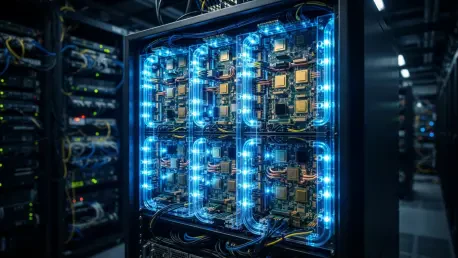

Global AI development is moving toward a more interoperable cloud landscape where customer choice and specific workload optimization take precedence over hardware silos. The strategic alliance between Oracle and Google Cloud, finalized in late 2026, signals a definitive end to the era of proprietary cloud hardware exclusivity. By integrating Google’s proprietary Tensor Processing Units directly into Oracle Cloud Infrastructure, the two companies have created an unprecedented bridge for enterprise customers who require both specialized acceleration and high-performance cloud environments. This move is particularly significant as the industry enters the Agentic Era, a phase defined by the shift from simple conversational interfaces to autonomous systems capable of complex, multi-step reasoning. By breaking traditional barriers, Oracle and Google are providing the diverse architectural foundation necessary to sustain the massive computational rigors of modern frontier models while offering the flexibility that large-scale organizations now demand.
Architectural Innovation and Hardware Diversity
Optimized Training: The Impact of TPU 8t
The deployment of the eighth-generation TPU architecture within Oracle Cloud Infrastructure provides a dual-track solution for the distinct phases of model development. The TPU 8t was engineered specifically for the rigorous demands of model training, offering a significant leap in computational throughput. By delivering nearly three times the compute performance per pod compared to previous hardware iterations, the architecture effectively slashed development cycles for frontier models from months to mere weeks. This shift allows engineering teams to iterate faster on massive datasets, significantly reducing the time-to-market for complex large language models. The integration ensures that researchers can push the boundaries of neural network complexity without facing the diminishing returns of aging silicon. Furthermore, the specialized design of the 8t version facilitates a more direct path to achieving state-of-the-art results in dense model architectures that require massive parallel processing power.
Streamlined Inference: The Power of TPU 8i
In contrast to training-focused hardware, the TPU 8i was optimized for large-scale inference, facilitating the rapid communication between chips and fast data access required for modern applications. This version of the silicon is particularly adept at handling long-context applications and complex mixture-of-experts models, where latency and throughput are critical for maintaining the illusion of seamless interaction. Oracle’s high-performance networking stack complements this hardware by ensuring that data moves efficiently between the TPU clusters and the primary storage layers. This synergy is vital for specialized AI agents that must perform multi-step reasoning in real-time, as any bottleneck in chip-to-chip communication can degrade the performance of the entire autonomous system. By offering the 8i architecture, Oracle enables enterprises to deploy high-concurrency workloads that remain responsive even as the complexity of the underlying model grows, effectively bridging the gap between theoretical potential and practical deployment.
Strategic Economic Shifts and Future Roadmap
Resource Efficiency: Performance per Watt
A primary driver behind this partnership was the increasing focus on performance per watt as a critical metric for both economic and environmental sustainability. As AI models expand in size, energy consumption has become a significant overhead for enterprises, often rivaling the cost of the hardware itself. Google’s TPU architecture was purpose-built to maximize processing power relative to electricity usage, an advantage that Oracle now leverages to offer more cost-effective AI services. By reducing the energy required for intensive workloads, organizations can scale their AI initiatives without seeing a linear increase in their carbon footprint or utility expenses. This focus on efficiency allows for a more sustainable expansion of the data center footprint, ensuring that high-density compute clusters do not place an undue burden on local power grids. Consequently, the integration represents a shift toward a more responsible AI lifecycle where economic value is balanced against the environmental realities of the current technological expansion.
Strategic Integration: Actionable Multi-Cloud Steps
Organizations that integrated these multi-cloud strategies early achieved superior operational efficiency compared to those tied to a single hardware ecosystem. The migration toward Google’s specialized architecture on Oracle’s infrastructure necessitated a shift in how engineering teams approached model deployment and cost management. Technical leads moved toward optimizing their codebases for eighth-generation silicon, ensuring that training and inference workloads were allocated based on the specific strengths of the TPU 8t and 8i processors. This transition allowed for a more sustainable approach to AI scaling, where energy consumption and computational throughput were balanced against long-term business objectives. Furthermore, the collaboration served as a catalyst for enterprises to re-evaluate their data residency policies, facilitating a more fluid exchange of information across high-performance networks. Businesses navigated the complexities of the agentic era, transforming AI investments into scalable, autonomous assets.