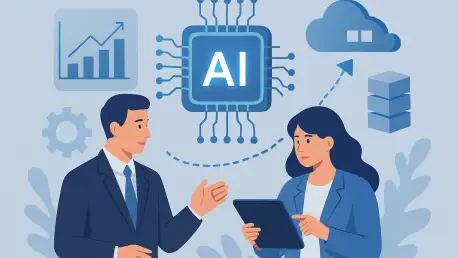

Successful AI transformation requires a workforce that understands the nuances of regulatory environments and data privacy requirements alongside technical software engineering skills. This realization sits at the heart of the strategic alliance between NTT DATA and Microsoft, which aims to transition global enterprises away from isolated pilot projects into a new era of industrial-scale automation. By moving beyond the limitations of experimental sandboxes, these two entities are architecting a blueprint for comprehensive business modernization that integrates Microsoft’s cloud infrastructure with NTT DATA’s deep domain knowledge. The deployment of over 500 specialized Microsoft Frontier engineers signals a departure from traditional consulting models, prioritizing the direct embedding of high-level technical talent within corporate environments. This approach ensures that the path to digital maturity is not just a theoretical roadmap but a practical execution of software engineering excellence designed for modern markets.
Establishing the AI-Native Framework
At the core of this initiative is the concept of AI-native industry solutions, a design philosophy that reimagines corporate workflows from the ground up rather than simply adding automated layers to existing legacy systems. Being AI-native implies that every business process, from supply chain management to customer engagement, is scrutinized through the lens of human-machine collaboration. This structural shift addresses the next frontier of enterprise technology where the fundamental question is no longer about where an agentic system can be superficially inserted, but how entire industry-specific operations should be rebuilt now that high-level intelligence is a baseline requirement. This methodology prevents the common pitfall of technological fragmentation by ensuring that every new implementation remains compatible with the data environments and technological ecosystems that organizations currently utilize. The transition becomes a transformative evolution grounded in operational realities.
Governance and Privacy Safeguards
Maintaining a balance between innovation and risk management is a critical component of the AI-native framework, ensuring that security and governance are foundational elements rather than secondary considerations. In a landscape where data privacy and ethical standards are paramount, this collaboration prioritizes the creation of robust safeguards that oversee how information is processed and utilized across different geographies. By integrating these controls directly into the architecture of the AI agents, the partnership allows enterprises to scale their operations with confidence, knowing that human oversight remains central to the decision-making loop. This proactive approach to risk ensures that automated systems operate within the strict boundaries of corporate policy and international law, protecting both the organization and its stakeholders. Furthermore, by standardizing these governance protocols across diverse solutions, the alliance provides a consistent and reliable environment for experimentation.
Deployment via Forward Engineering
To facilitate this large-scale transformation, the operational strategy relies heavily on the Forward-Deployed Engineering model, which places technical experts directly into the client’s business environment. This proximity fosters a continuous feedback loop between the engineers building the systems and the professionals who possess the most intimate knowledge of the daily business operations. By working side-by-side with internal teams, the 500 Frontier engineers can identify subtle operational friction points that might be missed by remote development teams. This high-touch model allows for the rapid adjustment of technical parameters to better align with specific business outcomes, ensuring that the technology remains relevant and impactful as market conditions evolve. The mobilization of such a large, specialized workforce provides the capacity to manage complex global deployments across multiple time zones, effectively bridging the gap between high-level vision and localized implementation.
Utilizing Reusable Industry Assets
Efficiency and consistency are further enhanced by leveraging a vast library of over 400 reusable industry assets and proprietary platforms like AI Vista and AI Studio. These tools represent proven patterns of deployment, encompassing established agent architectures, security connectors, and sector-specific data models that have already demonstrated success in real-world scenarios. By building on this extensive foundation, development teams avoid the inefficiencies of starting every project from a blank slate, which significantly accelerates the time-to-market for new solutions. These assets provide a modular framework that can be customized to meet the unique requirements of a specific business while maintaining a high standard of quality across the entire enterprise ecosystem. This reliance on standardized yet flexible platforms ensures that even the most complex AI-native solutions can be deployed at scale, offering a level of technical reliability that is often difficult to achieve with bespoke efforts.
Measurable Outcomes Across Industries
The collaboration strategically targets high-impact industries such as insurance, manufacturing, healthcare, and telecommunications, where the potential for quantifiable improvement is greatest. In the insurance sector, the focus centers on automating high-stakes decisions in claims processing and underwriting, while manufacturing applications utilize real-time operational data to solve quality control issues on the factory floor. Healthcare and life sciences organizations benefit from clinical workflow orchestration that ensures medical professionals are supported by accurate data without being removed from the critical decision-making process. Meanwhile, telecommunications providers utilize these solutions to optimize network performance and enhance customer service by predicting issues before they affect the end-user. By concentrating on these specific sectors, NTT DATA and Microsoft demonstrate that AI-native strategies can solve highly complex challenges, delivering measurable results that contribute to the bottom line.
Internal Validation and Actionable Steps
The path forward for organizations seeking to replicate this level of success involves recognizing the necessity of long-term technical partnerships and internal validation. NTT DATA set a benchmark by deploying Microsoft AI to its own workforce of 120,000 Copilot users, navigating the cultural and technical hurdles of integration before offering these insights to the market. Leaders should prioritize the establishment of a centralized AI studio to manage the governance and ethical deployment of agentic systems across all business units. It is crucial to invest in continuous training programs that bridge the gap between technical staff and domain experts to ensure that new tools are adopted effectively. Furthermore, companies have realized that the successful scaling of technology requires a commitment to maintaining a library of reusable assets to avoid redundant development costs. By treating AI as a structural foundation, enterprises turn technological change into sustainable business value.