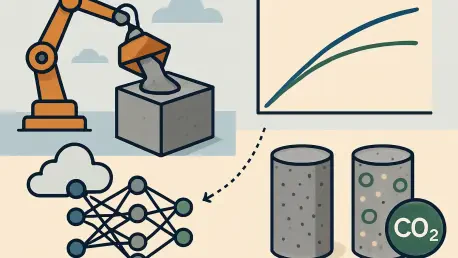

Unlike traditional water-based hydration, carbonation curing utilizes carbon dioxide as a reactive agent to initiate accelerated chemical reactions that enhance the mechanical properties of cementitious materials. This revolutionary approach, which has seen significant advancement by 2026, serves as a critical strategy for an industry responsible for approximately eight percent of global carbon emissions. The primary culprit behind this environmental impact remains the production of ordinary Portland cement, where the calcination of limestone releases massive quantities of gas into the atmosphere. By pivoting from conventional water curing to carbon-intensive curing processes, engineers can effectively transform a structural liability into a carbon sink. This transition involves more than just a change in curing media; it represents a fundamental shift in the chemical evolution of concrete, turning the very gas that threatens climate stability into a stable mineral within the built environment.
Data Acquisition and Methodological Foundations
Synthesizing Global Research for Predictive Modeling
The researchers initiated their investigation by constructing a high-fidelity database derived from fifteen independent scholarly sources, providing a diverse cross-section of experimental outcomes. This meta-analytical approach was necessary because no single laboratory could realistically test the myriad possible binder combinations and curing conditions required to develop a universal predictive tool. By the time the study reached its conclusion, the team had successfully compiled 423 distinct datasets specifically for compressive strength and 131 for carbon dioxide uptake. The significant disparity between these two numbers highlights the underlying difficulty in quantifying carbon mineralization compared to simple mechanical testing. Measuring the actual amount of gas sequestered within a concrete matrix often requires highly specialized equipment, such as thermogravimetric analysis, which measures mass loss at specific temperatures to confirm the presence of calcium carbonate.
Building a reliable machine learning model in 2026 requires more than just raw data; it demands a deep understanding of why certain metrics are harder to obtain than others. The difficulty in amassing sequestration data stems from the fact that carbon uptake is a multiphase chemical process involving diffusion, dissolution, and precipitation. In contrast, compressive strength is a standard industry metric recorded in nearly every construction-related experiment. To overcome this data imbalance, the research team focused on advanced data-cleaning protocols to ensure the smaller sequestration dataset was of the highest possible quality. This involved auditing the methodologies of the original fifteen studies to ensure that the carbon uptake measurements were consistent and replicable. By harmonizing these disparate sources into a single, cohesive framework, the researchers laid the groundwork for an algorithm that could generalize across different cement types and environmental variables.
Statistical Trends Within the Experimental Database
The statistical profile of the compiled data provided immediate insights into the current limitations and potential of carbonation curing technologies. Across the various studies, the average compressive strength of the specimens was recorded at approximately 31.7 megapascals, a figure that places carbon-cured materials firmly within the range of standard structural concrete. However, the data for carbon dioxide uptake presented a more nuanced story, with values averaging around 9.5 percent. One significant observation was the heavy skew toward lower sequestration percentages, reflecting the fact that most experimental literature currently focuses on standard curing cycles rather than high-efficiency, long-term carbonation. This skew presented a unique challenge for the machine learning model, as it meant the algorithm had fewer examples of high-performance sequestration to learn from during the initial training phase.
This distribution of data points underscores the necessity of moving toward more aggressive carbonation strategies in future industrial applications. Most existing research focused on the immediate benefits of early-stage strength gain, often overlooking the potential for maximum carbon storage. The database revealed that while strength can be achieved relatively quickly, the mineralization of carbon dioxide often requires more specific chemical conditions and extended exposure times. By analyzing these trends, the researchers were able to identify “data deserts” where more experimental focus is needed, particularly in the realm of high-uptake scenarios. The resulting statistical landscape provided the algorithm with a realistic, if conservative, foundation for making predictions about how typical concrete mixtures will behave under standard industrial carbonation protocols.
Algorithmic Engineering and System Calibration
Utilizing Least Squares Boosting for Precision
To process this complex web of chemical and physical variables, the study employed the Least Squares Boosting algorithm, a powerful ensemble machine learning technique. Unlike simpler models that might struggle with the nonlinear relationships between cement chemistry and carbon absorption, this method works by sequentially adding decision trees to the model. Each new tree is specifically designed to minimize the residual errors of the previous ones, creating a highly refined predictive architecture that learns from its own mistakes. This iterative process is particularly effective for concrete science, where small changes in the water-to-binder ratio or the concentration of carbon dioxide can lead to significantly different outcomes in terms of strength and durability. By the year 2026, such ensemble methods have become the gold standard for predicting material behavior due to their robustness and accuracy.
A critical aspect of the modeling process involved the normalization of input data to prevent numerical bias. Since variables like curing pressure and binder mass exist on completely different scales, the researchers used min-max normalization to scale all values between zero and one. This ensured that no single variable would exert an outsized influence on the model simply because it had a larger numerical range. Furthermore, by utilizing the entire feature set for each learner—rather than random subsets—the algorithm maintained a high degree of sensitivity to the intricate chemical interactions occurring within the cement paste. This comprehensive approach allowed the model to capture the synergy between different minerals, such as how the presence of fly ash might alter the effectiveness of a specific carbon dioxide concentration, providing a level of detail that traditional linear regression models simply cannot match.
Refining Model Hyperparameters for Generalization
The researchers dedicated a significant portion of their efforts to hyperparameter optimization, testing 420 distinct configurations to find the ideal balance between complexity and accuracy. This process involved fine-tuning the number of learning cycles, the learning rate, and the complexity of the individual decision tree splits. Through this rigorous testing, the team discovered that a model with ten splits and 500 learning cycles provided the most consistent results across both the training and testing datasets. This configuration minimized the root-mean-square error while ensuring the model did not suffer from overfitting, a common issue where an algorithm becomes so specialized to its training data that it fails to make accurate predictions for new, unseen mixtures.
The evaluation of these configurations was conducted using a variety of statistical tools, including Taylor diagrams and contour plots, which visualized the trade-offs between different settings. The team found that a moderate learning rate of 0.5 allowed the model to converge on an accurate solution without becoming unstable. This meticulous calibration was essential for creating a tool that could be used in real-world industrial settings, where variables are rarely as controlled as they are in a laboratory. By validating the model against a twenty-percent holdout testing set, the researchers confirmed that their tool could handle the natural variations found in industrial cement production. This level of calibration ensures that when a manufacturer inputs a specific mix design into the system, the predicted outcomes for strength and carbon uptake are reliable enough to inform expensive production decisions.
Industrial Validation and Sequestration Optimization
Evaluating Predictive Performance and Variable Drivers
Upon final validation, the machine learning models achieved correlation coefficients exceeding 0.95, indicating an exceptionally strong relationship between predicted values and actual experimental results. The strength model showed a high degree of precision across all tested levels, while the carbon uptake model demonstrated strong performance up to the twenty-percent sequestration mark. Beyond this point, the model revealed a slightly higher margin of error, which the researchers attributed to the scarcity of high-uptake data points in current literature. Despite this “generalization gap,” the tool provided a clear hierarchy of which factors truly drive concrete performance. It became evident that while strength is mostly a product of environmental kinetics—such as gas concentration and humidity—the ultimate capacity for carbon storage is dictated by the chemical makeup of the binder itself.
The use of permutation-based feature importance allowed the team to rank the input variables with scientific precision. For compressive strength, the most critical factors were identified as the curing environment’s relative humidity and the total duration of exposure to carbon dioxide. This suggests that the early mechanical gains in carbonated concrete are driven by how effectively the gas can penetrate the pores and react with the available moisture. In contrast, the Steinour formula, which quantifies the reactive oxide content of the binder, emerged as the dominant predictor for carbon uptake. This distinction is vital for the construction industry of 2026; it means that if a project requires high strength, the focus should be on environmental controls, but if the goal is maximum carbon sequestration, the focus must shift to the chemical selection of the binder and its reactive components.
Implementing Simulation Findings in Modern Construction
The research concluded that carbonation curing was most effective when implemented within a specific window of conditions that balanced efficiency and performance. Through the use of Monte Carlo simulations, the study demonstrated that a curing duration of 48 to 72 hours provided the optimal balance for both strength and sequestration. It was also discovered that carbon dioxide concentrations above 15 percent yielded diminishing returns, as the reaction speed became limited by gas diffusion through the concrete’s internal structure rather than the availability of the gas itself. These insights provided a clear roadmap for industrial precast facilities looking to integrate carbon capture into their existing production lines without incurring the costs associated with pure-gas environments or excessively long curing cycles.
In the final analysis, the researchers determined that binder blends with low fly ash replacement—specifically between zero and twenty percent—offered the highest potential for mineralizing carbon dioxide. While increasing fly ash content helped reduce the initial carbon footprint of the cement, it simultaneously lowered the amount of reactive calcium available for carbonation, creating a ceiling for sequestration potential at around 38.8 percent. The team successfully validated that machine learning could navigate these complex trade-offs, providing a predictive framework that significantly outperformed traditional empirical methods. By applying these findings, the industry moved closer to a future where carbon-negative concrete is no longer an experimental concept but a predictable and scalable reality. This study effectively shifted the focus from trial-and-error testing toward a more sophisticated, data-driven approach to sustainable infrastructure development.