
A single defect rolling off a modern assembly line can trigger a chain reaction of financial losses exceeding five hundred dollars per unit in recall costs alone. For decades, the automotive industry relied on human inspectors and rudimentary sensors to catch these errors, but the sheer complexity of current vehicle architectures makes manual oversight increasingly fallible. GFT Technologies recently addressed this challenge by introducing an integrated robotic system that shifts artificial intelligence from a passive monitoring role to an active participant on the factory floor. This development marks a transition toward agentic AI, where systems no longer just flag problems for human review but possess the agency to execute physical corrections in real-time. By bridging the “action gap” between software detection and mechanical response, this technology ensures that production lines remain fluid while maintaining nearly perfect quality standards across thousands of components.
Bridging the Divide: The Specialized Three-Robot Configuration
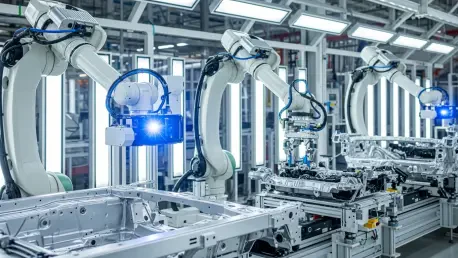
The operational heart of this new manufacturing paradigm lies in a sophisticated three-robot sequence designed to eliminate the latency between error detection and remediation. During the initial inspection phase, a high-precision robotic arm equipped with a specialized camera on its gripper performs a comprehensive 360-degree visual analysis of every part moving through the station. This system verifies labels, validates serial numbers, and checks physical alignment with sub-millimeter accuracy to ensure every component meets the original design specifications. If a discrepancy is identified, the workflow transitions immediately to the marking phase, where a second robotic unit applies specific identifiers to the flagged parts. This coordination ensures that faulty components are never lost in the shuffle of high-speed production, providing a clear visual and digital trail that prevents the propagation of errors down the assembly line.
While visual AI has been utilized in factories for some time, the true breakthrough of agentic systems is found in the final intervention phase where physical labor is performed autonomously. A third robotic arm is tasked with the critical responsibility of either repositioning a misaligned component to salvage it or removing a terminally defective part before it can be integrated into a larger assembly. This level of physical agency represents a departure from traditional automation, as the robot makes decisions based on real-time data processed at the edge rather than following a static, pre-programmed routine. By enabling machines to handle the labor-intensive task of error correction, manufacturers can significantly reduce the risk of damaged goods entering the supply chain. This integrated approach not only accelerates the production cycle but also ensures that the high-tech sensors on the floor are backed by a mechanical force capable of acting on the insights they generate.
Data-Driven Optimization: Root-Cause Analysis and Cloud Integration
Beyond the immediate physical corrections on the assembly line, the integration of agentic AI facilitates a profound shift toward automated root-cause analysis through cloud-based datasets. Every image captured during the inspection process is uploaded to a centralized platform where an AI agent continuously scrutinizes the data for recurring patterns or systemic anomalies. This allows the system to identify the specific source of a production error, such as a miscalibrated upstream machine or a batch of faulty raw materials, before a massive volume of defective units is produced. This proactive strategy represents a significant evolution from the reactive quality control methods of the past, as it provides engineers with the granular insights needed to refine manufacturing processes in real-time. The ability to pinpoint exactly when and where a failure occurred transforms the factory floor into a living laboratory that optimizes its own performance through continuous learning.
The adoption of these sophisticated systems by major U.S.-based automakers signals a broad industry trend toward comprehensive digital transformation among legacy manufacturers. Companies like Ford and other global leaders are increasingly prioritizing these solutions to mitigate the soaring costs of vehicle recalls, which have become a primary concern for executive leadership in recent years. By deploying agentic AI, these organizations are not just replacing human labor but are augmenting their operations with a level of precision and consistency that was previously unattainable. The economic impact is substantial, as the reduction in waste and the avoidance of large-scale quality disasters provide a competitive edge in an increasingly crowded global market. As these technologies become more pervasive from 2026 to 2028, the distinction between digital intelligence and physical execution will continue to blur, creating a more resilient manufacturing ecosystem.
Strategic Implementation: The Evolution of Industrial Quality Assurance
The implementation of agentic AI within the automotive sector established a new benchmark for how digital insights and mechanical execution functioned together as a unified system. Manufacturers that embraced this technology successfully bridged the action gap, allowing their production lines to address defects without human intervention. This shift provided a clear path for reducing the massive overhead associated with product recalls and manual inspections, which ultimately protected the corporate bottom line during periods of intense market volatility. The transition proved that the future of the factory floor depended on the ability of machines to act independently upon the data they gathered. Leadership teams recognized that investing in these physical response units was not merely a technological upgrade but a necessary strategic pivot to ensure long-term viability. By the time these systems reached full operational maturity, the industry moved toward a self-correcting model.