
The architectural foundations of artificial intelligence are undergoing a radical transformation as the industry moves away from general-purpose hardware toward specialized silicon designed for massive scale. With the recent unveiling of its eighth-generation Tensor Processing Units, Google has effectively redefined the limits of what a single computational network can achieve. By engineering a cluster capable of networking over one million chips, the tech giant signaled that the era of minor performance tweaks is over, replaced by a new paradigm of brute-force efficiency.
The Million-Node Milestone and the End of One-Size-Fits-All Silicon
This milestone marks a pivot point where hardware starts operating with surgical precision. Rather than relying on chips that attempt to handle every variety of task, these units are built to dictate the boundaries of machine learning through sheer volume. It is no longer just about faster processing; it is about the logistical capability to run models that were previously considered too massive or too expensive to sustain.
The shift toward million-node clusters represents a fundamental change in how data centers are constructed. When computation reaches this scale, the network itself becomes the bottleneck rather than the individual processor. Google’s latest architecture addressed this by optimizing how data flows across the entire fabric, ensuring that no single node sat idle while others were overloaded.
The Hyperscaler Pivot: Why Proprietary Hardware Is No Longer Optional
Hyperscalers like Google, Amazon, and Microsoft have realized that buying off-the-shelf components is no longer sustainable for global-scale operations. This movement toward vertical integration allows these giants to bypass the supply chain bottlenecks and premium pricing of third-party vendors. As models become more specialized, custom silicon remains the only way to manage escalating energy demands and operational costs.
Furthermore, the transition to proprietary hardware enables a level of software-hardware co-design that was previously impossible. By tailoring the silicon to the specific requirements of the latest Large Language Models, engineers can squeeze every possible drop of performance out of the electricity consumed. This control over the entire stack creates a competitive moat that is difficult for smaller players to cross.
Bifurcating the Brain: Understanding the TPU 8t and 8i Specializations
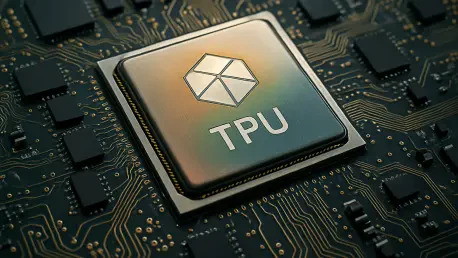
The v8 generation introduces a formal split in architecture to address two distinct phases of the AI lifecycle. The TPU 8t is built specifically for high-intensity training, offering triple the speed of its predecessors to shorten the development cycle of next-generation models. Conversely, the TPU 8i focuses on inference—the stage where a model interacts with users—delivering an 80% improvement in performance-per-dollar.
This specialization allowed developers to choose the right tool for the job rather than wasting expensive training resources on simple response tasks. By separating these functions, Google provided a roadmap for how enterprises can scale their AI services without seeing a linear increase in their cloud bills. The 8i version, in particular, solved the problem of making high-end AI accessible to the average consumer.
The Hybrid Power Dynamic: Why Nvidia Remains Part of the Equation
Despite this aggressive development, Google is not attempting to dethrone Nvidia but is instead choosing a strategy of calculated coexistence. Market reality necessitates a hybrid approach where proprietary TPUs work in tandem with Nvidia’s upcoming architecture. The current infrastructure demands a diverse ecosystem where different chips handle different parts of the neural network’s complex requirements.
The Falcon project, an open-source networking technology, serves as evidence of this collaborative tension. By working together to ensure that high-performance systems can communicate across diverse hardware environments, Google and Nvidia prevented the industry from fracturing into incompatible silos. This interoperability ensures that developers can move workloads between different chip types without losing efficiency.
Frameworks for Integrating Specialized Compute into Enterprise AI
Organizations must now prioritize workload-specific resource allocation to stay competitive in an increasingly automated economy. This process involved auditing AI pipelines to separate training and inference tasks while adopting open-source standards like Falcon to maintain cloud flexibility. By focusing on performance-per-dollar metrics rather than raw power, businesses moved toward building scalable applications that remained financially viable.
Strategic implementation required developers to rethink how they optimized their code for specific hardware profiles. They sought out tools that automated the distribution of tasks across specialized nodes, ensuring that the TPU 8t handled the heavy lifting while the 8i managed user interactions. This shift in development frameworks ensured that the next generation of AI services stayed responsive and cost-effective as global demand surged.