
Price, not perfection, became the sharpest instrument in the frontier-AI toolkit when DeepSeek-V4 landed, compressing costs to levels that forced procurement teams to reopen spreadsheets and redraw playbooks. The model’s open weights, one-million-token native context, and flexible hardware story did more than jolt per-token math; they reframed what counts as “frontier-class” when budgets are capped, vendor risk is real, and agent workloads finally dominate. The question moved from “who is the best on the hardest benchmark” to “who is good enough at scale for a tenth of the price,” and the market noticed.
Market Setup: Why Price Now Dictates Capability Access
The strategic context for evaluating DeepSeek-V4 was straightforward: premium AI had delivered world-class results but at a steep and rising cost, while open-weight efforts had raced to close the gap with smarter architecture and disciplined training. As multi-agent workflows and browsing-heavy tasks matured, the total cost of ownership of long sessions, large-batch analysis, and recurring retrieval became the primary constraint. Decision-makers needed a model that stayed competitive in real tasks without charging frontier premiums for every token.
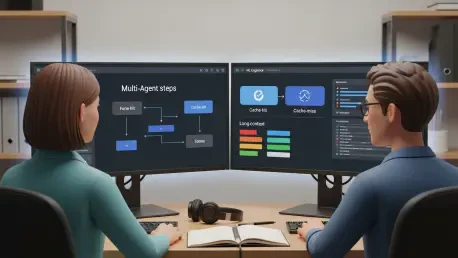
DeepSeek-V4 entered this environment as a near-frontier system whose economics were engineered for scale. The V4-Pro tier priced input at $1.74 per 1M tokens on cache miss and output at $3.48 per 1M tokens, trimming a 1M-in + 1M-out call to $5.22—or about $3.625 with cached input where the input rate fell to roughly $0.145 per 1M. In the Flash tier, the same token mix dropped to $0.42 on miss and near $0.308 with cache, resetting thresholds for what workloads penciled out. The differential versus premium closed models—often $30 to $35 for the same 2M-token cycle—reshaped portfolio math overnight.
This pricing alone did not make a market, but the combination with measured capability did. On tough shared benchmarks, the latest GPT-5.5 and Claude Opus 4.7 still held a lead. Yet agentic browsing, long-context analytics, and many developer workflows saw a compressed gap where DeepSeek-V4 ran “close enough” to justify a switch. That balance created a new procurement play: route the long tail and the long sessions to V4, reserve the peak-difficulty steps for the closed leaders, and bank the savings.
Demand Signals and Competitive Baselines
The market needed evidence that lower prices did not imply brittle quality, and the early data offered a nuanced answer. DeepSeek-V4-Pro-Max, positioned as the strongest open-weight configuration, trailed the newest GPT-5.5 and Claude Opus 4.7 on the hardest academic reasoning sets like GPQA Diamond and on the upper reaches of SWE-Bench Pro. However, the model closed in meaningfully on practical tasks—BrowseComp placed it near GPT-5.5 and ahead of Claude Opus 4.7—creating a bifurcated picture: leaders kept the crown at the top, but near-frontier performance arrived where operations budgets mattered most.
The internal trajectory from DeepSeek V3.2 to V4 reinforced this view. Results improved across MMLU (5-shot), MMLU-Pro, SuperGPQA, FACTS Parametric, Simple-QA verified, LongBench-V2, and HumanEval. These were not marginal deltas; they signaled better factuality, stronger reasoning, and more reliable long-context behavior. The gains also underlined that V4’s economics were not a trick of token counting but the outcome of architectural and training shifts designed to sustain capability while compressing serving costs.
Moreover, the million-token context functioned as a practical feature rather than a demo. With KV-cache reductions to roughly 10% of prior baselines and single-token FLOPs trimmed to about 27% relative to V3.2, DeepSeek positioned long documents, persistent agent memory, and consolidated pipelines as routine rather than exotic. That operational realism mattered to buyers who had been burned by theoretical limits that crumbled under production latencies.
Pricing Dynamics: Elasticity at the High End
Elastic demand at the premium tier was waiting for a credible alternative, and V4 supplied the catalyst. The V4-Pro $5.22 list for a 1M-in + 1M-out call during cache miss, and $3.625 with cached input, introduced room to rethink agent design, retriever budgets, and session length. For teams facing multi-hour crawls, deep research agents, or cross-department batch scoring, shifting even a fraction of traffic produced material savings without torpedoing outcomes.
The Flash tier created a second anchor. At $0.42 for the same 2M-token exchange on miss—and dipping further with caching—Flash unlocked use cases once relegated to keyword search or shallow summarizers. While its capability lagged Pro, the price-performance line moved far enough that low-stakes automation, enrichment at ingest, and pre-filtering could graduate to LLM-driven approaches. As the supply curve shifted outward, premium providers faced pressure to defend feature tiers beyond raw token pricing.
Price competition also nudged architectural choices. If long-context workloads were cheap enough to run, businesses could consolidate tool chains, cut round trips, and simplify orchestration, amplifying effective savings. This system-level effect—spending fewer tokens because the pipeline spent fewer hops—became a quiet multiplier in the TCO calculus.
Performance Reality: Close Enough vs Absolute Best
Capability still mattered, and the scoreboard kept everyone honest. On GPQA Diamond and Humanity’s Last Exam, GPT-5.5 and Claude Opus 4.7 stayed ahead. On SWE-Bench Pro, Claude preserved a notable edge. Yet V4-Pro-Max ran competitively on agentic tasks like BrowseComp and held its own on Terminal-Bench 2.0 and MCP Atlas, even if the closed leaders often posted higher marks. In real decisions, “close enough at a fraction of the price” frequently outweighed “absolute best at any price.”
That trade-off played out most clearly in agentic browsing and long-context analytics. When sessions sprawled across hundreds of thousands of tokens and mixed retrieval, planning, and tool use, V4’s balance of cost and competence put it in the lead for many pipelines. Where correctness stakes spiked—certain coding tasks, rigorous math derivations, or high-stakes legal drafting—buyers continued to route traffic to GPT-5.5 or Claude Opus 4.7. The winning strategy emerged as portfolio design, not single-model bets.
Architecture and Training: Efficiency Without Hollowing Capability
The underlying engineering explained why V4 could drop prices while preserving useful quality. A 1.6T-parameter MoE with approximately 49B active parameters per token concentrated compute while keeping a wide bench of specialists in reserve. Hybrid Attention blended Compressed Sparse Attention and Heavily Compressed Attention to slash memory and compute overhead across long ranges, the key to serving a native 1M context without blowing up KV caches or latency.
Manifold-Constrained Hyper-Connections widened information flow while constraining it enough to stabilize ultra-deep stacks, helping sustain reasoning depth without gradient chaos. The training regimen cultivated specialists through SFT and GRPO-based RL, then unified them with on-policy distillation using reverse KL against teacher experts. Paired with Muon-optimized training and a large, filtered corpus surpassing 32T tokens, the recipe prioritized stability, specialization, and efficiency in equal measure.
On the usage side, explicit reasoning modes—Non-think, Think High, Think Max—gave teams levers to manage costs per request. Think Max, which benefited from 384K+ context for untruncated internal traces, allowed targeted boosts where accuracy returns justified the extra tokens. This mode control turned V4 into a tunable asset rather than a single fixed-cost machine.
Deployment and Hardware: Optionality as a Feature
Hardware flexibility reinforced V4’s market appeal. Official CUDA acceleration via DeepGEMM and the MegaMoE mega-kernel optimized serving on Nvidia GPUs, while validation on Huawei Ascend NPUs provided a second supply lane with reported speedups for certain workloads. For enterprises facing supply constraints or pursuing sovereign AI strategies, interoperability across accelerators removed a classic barrier to open-weight adoption.
Inference pragmatics matched the pitch. DeepSeek aligned defaults with widely used sampling conventions, exposed OpenAI-compatible encoding, and emphasized containerized expert parallelism for predictable scaling. Crucially, one-million-token contexts were not limited to marketing claims—services were engineered to run them with acceptable throughput, making long-context behavior a standard expectation rather than a fringe setting.
Licensing and Developer Experience: Reducing Friction and Lock-In
MIT-licensed weights shifted the governance debate from permission to practice. Commercial use, modification, and redistribution were on the table without royalty, enabling on-prem deployments, private fine-tuning, and strict data-control regimes. That freedom came with responsibility—teams had to own safety filters, telemetry, and prompt governance—but it eliminated lingering licensing gray areas that dogged many “open-weight but restricted” releases.
Developer ergonomics mattered just as much. Clear defaults, compatibility layers, and guidance on reasoning modes lowered switching costs from proprietary APIs. As DeepSeek moved to retire legacy endpoints and consolidate traffic on the V4-Flash architecture, buyers received a clear signal: long-context and MoE-first design were the steady state, not a side branch.
Segment Impact: Where Budgets Moved First
The first adopters leaned into tasks with high token volumes and moderate correctness risk. Search enrichment, knowledge ingestion, and browsing agents saw immediate shifts as V4-Pro undercut premiums by roughly 6–7x on cache-miss pricing, with wider gaps under caching. In software development, V4 handled a large share of assistance and refactoring while tough bug-fix and synthesis steps still justified premium calls. In legal and finance, long-context summarization and exploratory analysis migrated quickly, while final opinions and regulatory filings remained on the closed leaders.
Analytics teams condensed multi-step pipelines into single, long-context prompts, cutting orchestrator overhead and trimming latency variance. Contact centers piloted V4 for knowledge-grounded assistance while keeping escalation responses on top-tier models. Research organizations exploited the 1M window for literature sweeps and cross-corpus synthesis, pairing V4’s economics with retrieval gating to manage hallucination risk.
Forecast and Scenarios: Competitive Compression and System-Level Moats
Looking ahead from this release, three paths stood out. First, premium providers would likely compress prices and segment features—assurance tiers, safety guarantees, and enterprise governance bundles—to defend margins while meeting the new floor. Second, open-weight leaders would push further on context compression, memory mechanisms, and routing to harvest more efficiency, making million-token contexts a baseline across the stack. Third, system-level moats—better orchestration, caching design, and agent state management—would matter more than single-model supremacy.
Policy scrutiny also tightened. With open weights spreading, expectations rose for auditability, provenance, and content safety, especially in regulated sectors. Enterprises prepared to document model lineage, enforce prompt hygiene, and separate internal traces from external outputs. The compliance lift was real, but the licensing clarity and hardware optionality offset the burden for teams that needed control.
Strategic Takeaways: Portfolio Design, Governance, and Spend Reallocation
The analysis pointed to a pragmatic course of action. Organizations benefited from a portfolio model that routed cost-sensitive, long-context, and browsing-heavy tasks to DeepSeek-V4-Pro or Flash, while reserving peak-difficulty reasoning and the hardest coding steps for GPT-5.5 or Claude Opus 4.7. Caching strategies, prompt templates built for reuse, and explicit reasoning-mode policies reduced spend without undermining outcomes. Consolidating multi-document flows into fewer long-context calls cut orchestration waste and stabilized latency.
On infrastructure, the winning move paired Nvidia-serving maturity with pilots on Huawei Ascend or other NPUs to create supply resilience. Containerized expert parallelism, consistent tracing, and real agent-traffic benchmarks ensured that lab gains translated to production. Governance frameworks—content filtering, red-teaming, and telemetry—were treated as first-class features, not afterthoughts, with chain-of-thought-like traces logged internally but never exposed to end users.
As a market event, DeepSeek-V4 marked a decisive shift: near-frontier capability at radically lower cost, a practical 1M-token context, permissive licensing, and credible accelerator optionality. The implication for buyers had been clear—re-cost the AI footprint, re-architect around long context, and de-risk hardware and vendor exposure—while preserving premium capacity for the few steps where top-1 accuracy paid for itself. In short, the competitive frontier had moved from single-model dominance to system efficiency, orchestration quality, and disciplined governance, and the organizations that acted on that shift captured the margin.