


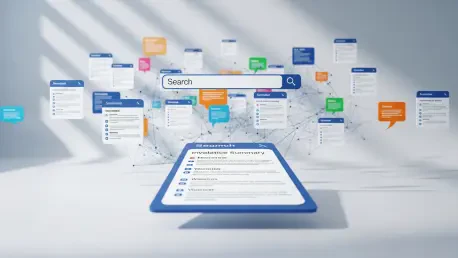

The classic blue hyperlink, once the foundational architecture of digital curiosity, is rapidly fading into the background as synthesized intelligence takes over the steering wheel of the internet. This transition from traditional link-based results toward comprehensive, AI-driven answers marks a definitive era in computing history. As generative systems become the primary interface for navigating the vast ocean of data online, the very nature of how information is indexed and consumed is changing. This shift is not merely a cosmetic update to search bars but a fundamental restructuring of the web’s economic and functional foundations. The following analysis explores the growth metrics, technical breakthroughs, and shifting user behaviors that define this new landscape, alongside the emerging models that seek to sustain the open web in a world governed by synthesis.
Quantifying the Shift to AI-Native Navigation
Accelerated Adoption Metrics and Market Penetration
Market intelligence reports indicate that the expansion of AI-generated search summaries has reached a critical mass, with these features now appearing in approximately 43% of all US-based searches. This surge represents a massive increase in visibility compared to the previous year, suggesting that the era of scanning pages of search results is being replaced by immediate, summarized consumption. The velocity of this change is underscored by a 70% year-over-year increase in traffic toward generative AI platforms. This momentum is further bolstered by the rising dominance of mobile AI applications, which have seen a nearly 60% jump in downloads as users seek sophisticated assistance on the go.
The sheer scale of this penetration suggests that AI is no longer a niche tool for early adopters but a utility for the general public. As these systems become more deeply integrated into the search ecosystems of dominant players like Google and Microsoft, the barrier to entry has vanished. Users who previously relied on simple keyword matching are now finding themselves interacting with complex models that provide answers directly on the search results page. This “zero-click” reality is becoming the standard, creating a environment where the search engine acts as a destination rather than a gateway. Consequently, the metrics of success for digital platforms are being rewritten to prioritize engagement within the AI interface itself.
Technical Innovations Reshaping the User Experience
Technical breakthroughs such as “query fan-out” and specialized AI modes are fundamentally altering how complex inquiries are resolved. In the past, a multi-part question required a user to perform several separate searches and manually piece together the information. Today, modern architectures allow the AI to disassemble a single, intricate prompt into numerous sub-topics, executing simultaneous searches to gather a wide array of data points. This simultaneous processing enables the construction of contextual responses that are both deep and broad, providing a level of detail that traditional algorithms could not achieve.
Furthermore, the implementation of these simultaneous search techniques allows companies like Google and OpenAI to build responses that are not just fast but also highly relevant to the specific intent of the user. By utilizing real-time data fetching alongside pre-trained models, these systems can offer up-to-the-minute information with a conversational tone that mimics human interaction. This evolution has successfully bridged the gap between raw data retrieval and meaningful knowledge transfer. As these technical capabilities continue to mature from 2026 to 2028, the ability of AI to anticipate user needs and provide proactive insights is expected to become the new benchmark for excellence in search technology.
Professional Perspectives on Evolving Search Paradigms
The industry is currently witnessing a significant departure from “keyword-ese” as users move toward long-form, natural-language prompts. As the complexity of search queries grows, the traditional method of typing fragmented phrases is proving insufficient. Users are now providing detailed context, asking questions as they would to a professional assistant, which allows the AI to deliver much more precise outcomes. However, this shift presents a challenge for traditional SEO strategies that were built on the foundation of specific keyword densities. Professionals in the field are now forced to focus on topical authority and the ability to satisfy complex user intents rather than simply ranking for a single phrase.
Researchers have identified a persistent “functional gap” in how users interact with the citations provided by AI tools. While these systems frequently include deep-link citations to specific articles or data points, data suggests that these links often lead to broader brand discovery rather than direct content consumption on the linked page. In many cases, users who do click through are landing on the homepage of a cited brand rather than the specific deep link used to generate the answer. This suggests that the AI is effectively acting as a filter that validates a source’s credibility, leading users to the provider’s main hub once their immediate informational need has been satisfied.
Digital publishers remain deeply concerned about the stability of referral traffic in this synthesized environment. There is a growing anxiety that as AI models become more adept at summarizing proprietary content, the incentive for a user to visit the original source will continue to diminish. While modern citation styles have become more prominent and visually integrated, their effectiveness in driving meaningful traffic remains a subject of intense debate. Publishers are calling for more transparent attribution models and a clearer path to monetization as their high-quality data continues to serve as the fuel for the AI-driven answers that are potentially replacing their audience engagement.
Future Implications and the Economic Frontier of the Open Web
As the tension between content creators and AI developers intensifies, new economic models such as “Pay-per-Crawl” services are emerging to redefine the terms of web scraping. These services utilize specific status codes, such as HTTP 402, to signify that payment is required before an AI bot can index or access a website’s content. This represents a potential shift toward a more transactional relationship where data is treated as a premium commodity. Such mechanisms allow publishers to regain some control over their intellectual property, ensuring that the value they create is not simply extracted without compensation by the models that eventually compete for their audience’s attention.
The long-term sustainability of the open web depends heavily on how these negotiations for intellectual property are resolved. If a middle ground is not found, the digital landscape could see an increase in gated content and “walled gardens,” where high-quality information is hidden behind paywalls to prevent AI exploitation. This could lead to a fragmented internet where only those willing to pay—either in the form of subscriptions or data-sharing agreements—have access to the most reliable information. AI developers and publishers are currently at a crossroads, where the terms of cooperation established now will dictate the health of the content ecosystem for the next decade.
Projecting forward, the digital future likely involves a multi-platform environment where niche AI tools coexist with dominant search engines. User behavior is already showing that people do not necessarily switch entirely from one platform to another; instead, they utilize different tools for different tasks. A user might use a general search engine for local information while relying on a specialized AI for creative writing or coding assistance. This competition is driving rapid iteration across the board, pushing every player to refine their citation methods and user interfaces to maintain relevance in a market that prizes both accuracy and convenience.
Navigating a Synthesized Digital Future
The fundamental contract of the internet was rewritten as the focus shifted from simple discovery toward synthesized clarity. This transformation demanded a new approach to how information was valued, moving away from a reliance on volume and toward the necessity of authority and context. The transition successfully provided users with a more streamlined way to interact with the global knowledge base, although it simultaneously introduced complex questions regarding the survival of independent journalism and creative work. The industry realized that convenience could not come at the total expense of the creators who provided the source material for the AI’s intelligence.
Ultimately, the ecosystem moved toward a balance where the efficiency of conversational discovery was paired with emerging economic safeguards for publishers. The development of transactional crawling and more robust attribution models provided a roadmap for a viable digital landscape where human expertise and artificial synthesis could coexist. By prioritizing a healthy environment for content creators, the digital community ensured that the information powering the AI remained diverse and high in quality. The evolution of search proved that while the methods of finding information changed, the human desire for reliable and meaningful knowledge remained the constant force driving the web forward.







