


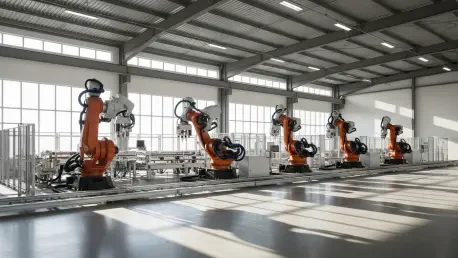

Modern industrial landscapes are currently undergoing a radical transformation as the traditional barriers between conceptual design and physical deployment begin to dissolve under the pressure of software-defined automation. For decades, the implementation of robotic systems was a privilege reserved for elite manufacturers with massive capital and specialized engineering teams, but that era is rapidly closing. Today, the focus has shifted toward creating a unified ecosystem where hardware is modular and software provides the intelligence necessary to adapt to unpredictable market demands. This shift is not merely about adding robots to a floor; it is about reconsidering the entire lifecycle of an automated cell from the first sketch to the final cycle. By integrating advanced artificial intelligence with cloud-connected platforms, companies are finding they can bypass the months of custom integration that once served as a bottleneck for growth. The goal is now a streamlined, accessible model of production.
The Technological Core: Intelligent Motion
Goal-Driven Logic: A Departure From Manual Coding
At the core of this transformation lies MachineMotion AI, a proprietary logic system that fundamentally changes how human operators interact with robotic hardware. Historically, setting up a robot required a tedious process of manual waypoint programming, where every single coordinate had to be painstakingly entered and verified by a specialized technician. This old method is being replaced by a goal-driven logic architecture where the user simply defines the desired starting position and the final objective. The underlying artificial intelligence then takes over, calculating the most efficient path while ensuring that the robotic arm avoids all obstacles within its environment. By removing the need for line-by-line coding of every movement, this system allows for a dramatic reduction in setup time. Engineering teams can now focus on high-level process optimization rather than getting bogged down in the minutiae of basic motion control, representing a massive leap in productivity.
The movement toward this simplified programming environment represents more than just a convenience; it is a fundamental shift in industrial philosophy that prioritizes output over technical complexity. As manufacturers face increasingly shorter product lifecycles, the ability to reconfigure a production line in hours rather than weeks has become a critical competitive advantage. Goal-driven logic ensures that even if the physical layout of a factory changes, the robotic systems can be updated with minimal friction. This adaptability is particularly vital for small and medium-sized enterprises that may not have a dedicated robotics department on staff. By abstracting the complex mathematical calculations required for collision-free motion, the platform empowers a broader range of workers to manage sophisticated automation. Consequently, the reliance on external consultants is diminished, allowing internal teams to maintain full control over their automated assets while responding to real-time production needs.
Spatial Intelligence: Integration With NVIDIA Isaac
Enhancing this intelligent motion is the strategic integration of NVIDIA Isaac technology, which provides robotic systems with a sophisticated 3D understanding of their surroundings. By utilizing advanced stereo cameras and depth estimation algorithms, robots are no longer operating in a blind, pre-programmed vacuum. Instead, they possess a real-time spatial awareness that allows them to perceive changes in their workspace with high precision. This vision capability is essential for creating a high-fidelity digital twin that accurately mirrors the physical environment on the factory floor. When the AI can “see” the world in three dimensions, it can make smarter decisions about path planning and object handling, even when dealing with items that are not perfectly oriented. This level of perception is what enables robots to move beyond simple, repetitive tasks and into more complex roles that require a degree of situational awareness previously impossible without expensive sensors.
This spatial intelligence also facilitates a higher degree of safety and collaboration between human workers and autonomous machinery. When a robot can accurately estimate depth and recognize objects in its path, the risk of accidental collisions is significantly mitigated, fostering a more harmonious industrial environment. Furthermore, the ability to generate a digital twin means that any potential changes to the workflow can be tested and validated in a virtual space before any physical movement occurs. This predictive capability saves companies from costly errors and hardware damage that often occur during the calibration of traditional robotic systems. As the hardware and software become more tightly coupled through these vision-based AI models, the distinction between a static machine and an intelligent assistant continues to blur. The resulting systems are not only more capable but also more resilient to the variabilities that are inherent in modern manufacturing processes.
Strategic Alliances: Expanding Industrial Reach
The FANUC Partnership: Bridging Expertise Gaps
Addressing the persistent labor shortages that continue to impact global supply chains is a primary driver behind the alliance with FANUC America. This partnership aims to bridge the gap between high-performance industrial hardware and the user-friendly software interfaces that the modern workforce expects. While FANUC has long been recognized for producing some of the most reliable and powerful robotic arms in the industry, the technical barrier to entry for these machines was once quite high. By integrating these robust industrial tools into a no-code and Python-based programming environment, the collaboration makes heavy-duty automation accessible to a wider demographic of workers. This approach ensures that even facilities without deep-rooted robotics expertise can deploy world-class hardware to maintain their production targets. The focus is on empowering the existing workforce by providing them with tools that are intuitive enough to master quickly without sacrificing any industrial capability.
The scope of this integration is notably broad, encompassing several of FANUC’s most capable industrial families, such as the versatile LR Mate and the high-capacity M-710iD series. This inclusion signifies that software-defined automation is no longer restricted to small-scale collaborative tasks but is fully ready for heavy-duty industrial applications. Whether a facility is engaged in high-speed welding, complex machine tending, or heavy palletizing, the unified platform provides the necessary tools to scale production rapidly. By offering a standardized interface for a variety of robot models, the system allows enterprise manufacturers to maintain a consistent operational look and feel across their entire fleet. This consistency is vital for scaling, as it reduces the training burden on staff and ensures that best practices can be easily replicated across different production lines. The synergy between reliable hardware and agile software creates a formidable solution for modern industry.
Universal Robots Collaboration: Streamlining Deployment
Building on the success of collaborative robotics, the partnership with Teradyne’s Universal Robots unit focuses on refining the digital experience to eliminate deployment risks. Through the MachineBuilder platform, users can engage in a comprehensive simulation of their robotic cells, validating every aspect of reach, kinematics, and structural framing before a single component is shipped. This “build-ready” approach is designed to remove the uncertainty that often plagues new automation projects, ensuring that the physical assembly works exactly as it did in the virtual model. By providing a seamless transition from the digital design phase to the physical installation, the platform helps companies avoid the common pitfalls of mismatched components or insufficient workspace. This level of pre-validation is a major step forward in making robotics a predictable investment, allowing businesses to plan their production schedules with a much higher degree of confidence and accuracy.
To further accelerate the deployment process, the integrated workflow for Universal Robots includes a vast library of pre-configured templates for high-demand tasks. Applications such as palletizing and linear-axis movement can be set up using vetted designs that have already been optimized for maximum efficiency and safety. These templates are complemented by a curated marketplace of specialized grippers, sensors, and structural components that are guaranteed to be compatible with the UR ecosystem. This ecosystem-wide validation significantly lowers the financial risk for companies, as they no longer need to worry about the interoperability of various third-party parts. By providing a “plug-and-play” experience for complex robotic cells, the partnership enables manufacturers to go from an initial concept to a fully operational production line in a matter of days. This speed is essential for companies looking to capitalize on sudden market opportunities or urgent supply needs.
Practical Evidence: Operational Success and Scaling
Demonstrating Real-World Value: Lessons From Chicago
The tangible benefits of these technological advancements were recently demonstrated with great success during live exhibits at the Automate event in Chicago. Industry professionals witnessed FANUC robots performing high-precision CNC machine tending, while Universal Robots executed intricate bin-picking tasks using real-time AI decision-making. These demonstrations provided empirical evidence that the era of unified, cloud-connected automation has arrived, offering a clear path forward for industrial scaling. The ability of these systems to handle varying parts and unpredictable orientations in real-time showcased the power of the MachineMotion AI and NVIDIA vision integration. Observing these robots navigate complex tasks with minimal human intervention highlighted the reliability and sophistication of the current platform. Such real-world examples serve to validate the theoretical advantages of software-defined automation, turning high-level concepts into proven industrial results.
Beyond the specific robot models, the integration of cloud-connected software environments proved to be the most critical factor in achieving scalable results. Manufacturers observed that having a unified platform for both design and operation allowed for a continuous flow of data that informed future optimizations. This connectivity ensured that every robotic cell was not an isolated island but part of a larger, intelligent network that could be managed remotely. The success of the Chicago demonstrations highlighted how this digital thread reduces the complexity of managing large-scale automation projects across multiple locations. By providing a centralized repository for configurations and performance metrics, the system allowed for a level of oversight that was previously unattainable. These exhibits made it clear that the future of the industry depends on the synergy between physical capability and digital intelligence, offering a sustainable model for the next generation of smart manufacturing.
The Path Toward Resilient Manufacturing Systems
Manufacturers who successfully navigated this transition realized that the key to scaling was not simply purchasing more hardware, but rather investing in the software infrastructure that unified their operations. These companies moved away from isolated robotic cells and toward a holistic factory model where every machine was connected to a central, cloud-based platform. By doing so, they enabled real-time monitoring and rapid reconfiguration, which allowed them to stay ahead of shifting consumer preferences. This strategic pivot was supported by a cultural shift within the engineering departments, where the focus changed from maintenance to continuous innovation. The integration of AI-driven path planning meant that downtime during product changeovers was virtually eliminated, providing a significant boost to the overall equipment effectiveness. These pioneers set a new standard for industrial agility that others soon followed.
Ultimately, the most successful organizations recognized that the future of manufacturing was software-defined and took proactive steps to secure their positions in the market. They established robust partnerships with technology providers who offered modular, pre-validated components, thereby reducing the time spent on custom engineering. By leveraging high-fidelity digital twins and simulation-ready environments, these businesses were able to prototype and deploy new automation solutions with unprecedented speed and accuracy. The adoption of no-code interfaces empowered a broader range of employees to participate in the automation journey, democratizing the technical processes that were once the domain of a few. These collective efforts resulted in a resilient production ecosystem that was capable of withstanding global economic volatility and labor constraints. These lessons provided a clear roadmap for any manufacturer seeking to scale their operations.







