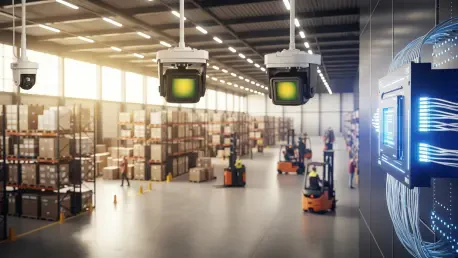

The global security landscape is currently undergoing a fundamental transformation as artificial intelligence transitions from an optional feature to the central nervous system of modern video surveillance systems. Recent industry valuations indicate that the global market for AI-driven monitoring is poised for an extraordinary surge, climbing from a current baseline to an estimated forty-nine billion dollars by 2035. This trajectory represents a compound annual growth rate of over twenty-two percent during the next decade, signaling a departure from traditional closed-circuit television models. Organizations are increasingly abandoning the old method of reviewing grainy footage after a breach has occurred, opting instead for intelligent systems that provide instant situational awareness. This shift is not merely a technical upgrade but a philosophical change in how public and private spaces are managed. By leveraging automated detection, security teams can now preemptively address potential hazards, significantly reducing response times and improving safety outcomes for citizens and assets alike across the globe.
Drivers of the Surveillance Evolution
Urban Trends: Shaping the Smart City Framework
The rapid acceleration of global urbanization has created a pressing need for sophisticated monitoring frameworks that can manage high-density populations with minimal human intervention. As metropolitan areas expand, city planners are integrating AI video surveillance into the broader “smart city” infrastructure to handle complex tasks like traffic management, crowd control, and public transport safety. These systems are no longer isolated security tools but are instead part of a unified data network that analyzes urban movement in real time. For instance, municipal authorities in major global hubs are using visual analytics to identify congestion patterns and automatically adjust signal timings to prevent gridlock. This level of automation is essential because human operators can no longer effectively monitor the thousands of camera feeds required for a modern city. The integration of high-resolution sensors and intelligent algorithms allows for a level of oversight that ensures public order while optimizing the efficiency of essential services.
Building on these urban developments, the demand for “smart policing” has become a primary catalyst for market expansion within the public sector. Law enforcement agencies are increasingly utilizing behavioral analysis tools to identify suspicious activities before they escalate into serious incidents. These tools can recognize specific patterns, such as an individual lingering in a restricted area or a vehicle traveling the wrong way on a one-way street, triggering immediate alerts to patrol officers. This proactive stance is particularly valuable in high-stakes environments like international airports and busy subway terminals where the margin for error is extremely thin. By automating the mundane aspects of surveillance, AI allows human responders to focus their energy on high-value decision-making and direct intervention. As these technologies become more accessible and reliable, they are setting a new standard for public safety that prioritizes prevention over investigation, fundamentally altering the way that governmental bodies allocate their annual security budgets and personnel.
Technical Innovations: Deep Learning and Connectivity
The technical foundation of this market growth rests upon significant breakthroughs in deep learning and computer vision that allow machines to interpret visual data with human-like precision. Unlike older motion-detection systems that were frequently triggered by wind or shadows, modern AI models can distinguish between a stray animal and a person attempting to scale a perimeter fence. This accuracy is made possible by neural networks that have been trained on millions of images to recognize objects, faces, and even specific gestures. Furthermore, the miniaturization of powerful processors has allowed for “edge computing,” where the AI processing occurs directly on the camera rather than on a remote server. This capability is crucial for latency-sensitive applications, such as identifying a weapon in a crowded stadium or detecting a fall in a healthcare facility. By processing data at the point of capture, these systems can deliver alerts in milliseconds, providing the critical time needed to save lives.
Complementing these algorithmic advancements is the widespread rollout of high-speed 5G connectivity, which provides the necessary bandwidth for streaming high-definition video data across vast networks. The synergy between 5G and AI enables the deployment of mobile surveillance units and autonomous drones that can monitor large, remote areas without the need for extensive physical cabling. This level of connectivity ensures that high-quality visual intelligence is available to decision-makers regardless of their location, facilitating a more coordinated and effective response to emergencies. Moreover, the evolution of these technologies has led to the development of “multispectral” imaging, allowing cameras to see in total darkness or through smoke, which adds another layer of reliability to the security infrastructure. As connectivity continues to improve, the barriers to implementing comprehensive, real-time surveillance are disappearing, paving the way for a more integrated and responsive global security environment that can adapt to emerging threats.
Market Dynamics and Ethical Integration
Segment Analysis: Software and Deployment Strategies
While the hardware segment currently accounts for a substantial portion of the market revenue due to the high costs of specialized AI cameras, the software sector is emerging as the most dynamic area of investment. The true intelligence of modern surveillance resides in the sophisticated analytics platforms that interpret raw video feeds, turning them into actionable insights for facility managers and security directors. These software solutions are increasingly offered through modular architectures, allowing users to add specific capabilities like license plate recognition or thermal tracking as their needs evolve. This flexibility is driving a shift toward “Surveillance-as-a-Service” models, where companies pay for the intelligence they use rather than just the physical equipment. This software-centric approach ensures that security systems remain relevant even as hardware ages, as remote updates can introduce new AI models and security patches, effectively future-proofing the investment for many years.
Deployment strategies are also diversifying to meet the specific requirements of different industries, with a notable split between on-premises and cloud-based architectures. Government entities and defense contractors often favor on-premises solutions because they provide maximum control over sensitive data and ensure that surveillance remains operational even during network outages. Conversely, commercial enterprises and retail chains are rapidly adopting cloud-integrated systems that allow for centralized management of multiple locations through a single interface. The cloud offers unparalleled scalability, enabling a business to expand its storage capacity or add new camera sites without the logistical burden of installing physical servers at every location. This trend is particularly evident in the retail sector, where AI is used not only for loss prevention but also for analyzing customer behavior to improve store layouts. The ability to access high-level analytics through a web browser or mobile app has democratized advanced security for smaller organizations.
Strategic Outlook: Balancing Security with Privacy
The successful expansion of the AI video surveillance market was ultimately dependent on the industry’s ability to navigate the complex landscape of data privacy and ethical responsibility. As systems became more capable of identifying individuals and tracking their movements, the development of privacy-preserving technologies became a top priority for manufacturers and regulators alike. Innovative features like automated face blurring and metadata-only tracking allowed organizations to gather essential security data without compromising the anonymity of the general public. These tools ensured that the benefits of high-tech monitoring were realized in a manner that respected individual rights and complied with increasingly stringent data protection laws. By embedding privacy into the core design of the software, developers were able to build public trust, which remained a critical factor in the widespread adoption of AI tools in sensitive environments like schools and local neighborhoods.
Market leaders also recognized that the future of the industry lay in the creation of comprehensive security ecosystems rather than isolated products. Companies that integrated video analytics with access control systems and environmental sensors provided a more holistic view of safety, allowing for automated responses such as locking doors or triggering fire suppression systems based on visual cues. This unified approach reduced the complexity of security management and allowed for more sophisticated threat detection strategies. For example, the emergence of weapon detection software as a standard feature in public facilities demonstrated the industry’s commitment to addressing urgent social challenges through technological innovation. Organizations that prioritized the ethical deployment of these powerful tools and focused on transparent data policies were the ones that thrived. This strategic focus on responsible AI practices ensured that the massive growth projected for the next decade served to enhance the safety and well-being of societies across the world.