
The arrival of the Samsung Galaxy XR represents a definitive moment in the evolution of spatial computing, signaling that the era of experimental prototypes has finally given way to a high-stakes battle for the digital living room. This device marks the formal debut of the Android XR operating system, a joint venture between Google and Samsung designed to offer a cohesive alternative to Apple’s visionOS and Meta’s Horizon OS. While Meta continues to dominate the high-volume, entry-level market and Apple maintains a firm grip on the ultra-premium luxury tier, the Galaxy XR attempts to occupy a strategic middle ground. By offering top-tier hardware specifications paired with the massive reach of the Google Play Store, Samsung is betting that consumers are looking for a device that provides high-end performance without the prohibitive four-figure price tag of its closest rival. This entry is not just a hardware launch; it is a declaration of intent for the future of the Android ecosystem in a three-dimensional space.
Priced at $1,800, the Galaxy XR positions itself as a premium enthusiast product that is significantly more accessible than the $3,699 Apple Vision Pro. This pricing strategy allows Samsung to appeal to a broader segment of the professional and early-adopter market while still maintaining the cachet of a high-end electronic device. Despite the relative price gap, the build quality and internal components do not suggest a compromise in quality. The device enters a market where software utility is the primary differentiator, and Samsung is leveraging its long-standing partnership with Google to ensure that the user experience is familiar yet transformative. As the first major flagship for the Android XR platform, the success of this headset will largely depend on its ability to convince the average smartphone user that spatial computing is a necessary upgrade rather than an expensive novelty.
Engineering Luxury and Ergonomic Comfort
Premium Material Selection: Aesthetic Excellence
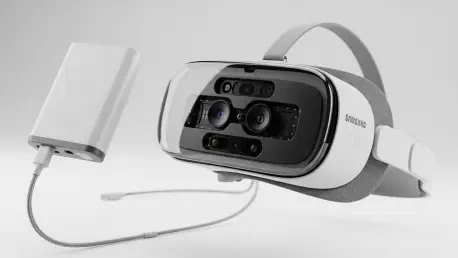
Samsung has utilized its extensive history in manufacturing high-end mobile hardware to ensure the Galaxy XR feels like a luxury object from the moment it is handled. The construction features a sophisticated blend of aerospace-grade aluminum, high-quality faux leather, and soft-touch polymers that contribute to a futuristic yet approachable aesthetic. The metal frame is not just for visual appeal; it serves as a structural backbone that houses a dense array of twelve high-performance sensors and cameras behind a sleek, curved black glass front. These sensors are meticulously integrated to handle critical tasks such as six-degree-of-freedom head tracking, high-fidelity hand recognition, and full-color passthrough with minimal latency. The choice of materials reflects a deep understanding of consumer electronics trends, moving away from the “plastic-heavy” feel of budget headsets toward something that looks at home in a professional office or a high-end living room.
Beyond the external shell, the tactile experience of the Galaxy XR is designed to feel substantial without being cumbersome. The facial interface is lined with a breathable, moisture-wicking fabric that prevents heat buildup during intensive processing tasks. This focus on premium materials extends to the internal cooling system, which uses the aluminum frame as a massive heat sink, allowing the internal fans to run at lower speeds and reducing the audible noise that can often break immersion in virtual environments. This attention to detail ensures that the headset does not just perform like a flagship, but also ages like one, resisting the wear and tear associated with daily use. By prioritizing a “Sci-Fi” look that prioritizes both form and function, Samsung has successfully created a piece of wearable technology that users will feel comfortable wearing in public spaces or during professional video conferences.
Weight Distribution: Optimizing User Comfort
One of the most significant engineering hurdles in spatial computing is managing the physical weight of the hardware, and Samsung has addressed this by opting for an external battery pack. This design choice offloads a substantial portion of the device’s weight from the head-mounted unit to a pocketable power source, allowing the headset itself to weigh in at a manageable 545g. The separate battery pack adds another 302g, but because it is carried on the body rather than the face, the overall strain on the neck is drastically reduced. This separation is paired with a well-balanced headband that features a rear adjustment dial for precise fitment, ensuring that the pressure is evenly distributed across the forehead and the back of the skull. The result is a “cosseting” fit that remains stable even during sudden head movements, making it one of the most comfortable high-end headsets available in the current market.
The ergonomic design also includes specific accommodations for individuals who wear prescription glasses, a group often underserved in the early days of virtual reality. Samsung utilized adjustable forehead cushions that suspend the lenses at an optimal distance from the face, creating a natural gap that allows for better airflow and accommodates most frame styles without requiring expensive custom lens inserts. This design also provides a functional advantage for augmented reality tasks, as it allows the wearer to maintain a degree of peripheral awareness of their physical surroundings. For those moments when absolute immersion is required, such as watching a movie or playing a high-fidelity game, the device comes with magnetic light blockers that can be easily snapped into place. These blockers seal out the external environment, transforming the headset from an open AR device into a fully isolated VR experience in a matter of seconds.
Cutting-Edge Visuals and Display Technology
Unmatched Resolution: The Micro-OLED Standard
The display system serves as the centerpiece of the Galaxy XR experience, utilizing industry-leading micro-OLED technology to provide a visual experience that is nothing short of spectacular. Each eye is treated to a staggering resolution of 3552×3840 pixels, which provides a level of sharpness and pixel density that effectively eliminates the “screen-door effect” common in lower-resolution headsets. This high-density display allows for incredibly crisp text rendering and intricate detail in 3D models, making it a viable tool for professional designers, engineers, and digital artists. To maintain a slim and lightweight profile, Samsung employs advanced pancake lenses that fold the light path, allowing the screens to sit closer to the eyes without sacrificing the focal depth or the expansive clarity required for professional-grade media consumption.
These displays are not just about raw resolution; they are calibrated to meet rigorous color accuracy standards. The high pixel-per-degree count ensures that even the smallest UI elements remain legible, which is essential for a device that aims to replace traditional multi-monitor setups. When viewing high-definition content, the clarity rivals that of high-end dedicated monitors, providing a sense of scale that physical screens simply cannot match. The optical stack is designed to minimize distortions at the edges of the frame, ensuring that the user has a consistent and clear view across the entire horizontal field of view. This technological leap forward represents a significant investment in display engineering, placing Samsung at the forefront of the industry alongside Apple, and setting a high benchmark for what users should expect from premium spatial computing visuals.
Color Reproduction: Immersive Visual Fidelity
The micro-OLED panels utilized in the Galaxy XR offer perfect black levels and an incredibly wide color gamut, mimicking the visual performance of the company’s highest-rated television sets. With a 90Hz refresh rate and a generous horizontal field of view of 109 degrees, the device provides a smooth and expansive window into digital environments that feels natural to the human eye. The high refresh rate is particularly important for reducing the risk of motion sickness, as it ensures that the virtual world updates in near-instant sync with the user’s physical movements. Whether navigating through a virtual art gallery or watching a cinematic blockbuster in a simulated theater, the vibrancy and contrast of the screens create a powerful sense of presence that is difficult to achieve with standard LCD technology. This fidelity is crucial for maintaining the illusion of reality, which is the primary goal of any high-end mixed-reality platform.
However, while the internal displays are nearly flawless, the passthrough cameras present a slight limitation when it comes to interacting with the physical world. Although the sensors provide a clear and color-accurate view of the user’s surroundings, they lack the extreme crispness required to easily read small text on secondary physical devices, such as a smartphone screen or a high-resolution laptop monitor. This means that while the passthrough is excellent for safety, spatial awareness, and interacting with large physical objects, it is not yet a perfect replacement for the human eye in high-detail hybrid environments. This technical constraint suggests that the Galaxy XR is currently optimized for purely digital interactions or augmented reality experiences that overlay graphics onto the world, rather than tasks that require constant, high-detail switching between virtual windows and physical documents.
Interaction Models and Software Integration
Controller-Free Navigation: Precision and AI Tracking
Interaction with the Galaxy XR is designed to be as intuitive as possible, relying primarily on a combination of sophisticated hand and eye tracking rather than physical controllers. This system is powered by the advanced AI processing capabilities of the internal chipset, which can interpret subtle movements of the fingers and the precise direction of the user’s gaze. Navigating the interface feels like a natural extension of one’s intent; users can aim a virtual cursor simply by looking at an icon or a button and then perform an action by performing a quick pinch gesture with their thumb and forefinger. This “look-and-tap” methodology removes the learning curve associated with traditional gaming controllers, making the device accessible to people who may not be familiar with immersive technology but are comfortable with modern touchscreen interfaces.
Despite the elegance of this controller-free approach, the system is not without its occasional frustrations, particularly when dealing with complex or dense user interfaces. While the tracking is generally rock-solid, the software can sometimes struggle with precision when small icons or buttons are placed too close together, leading to accidental selections. This highlights a broader challenge in the industry: designing a UI that is both visually rich and easy to navigate using only biological inputs. To mitigate this, Samsung has implemented several software “magnifiers” that enlarge elements as the user’s gaze lingers on them, but there is still room for improvement in the fine-tuning of these interactions. As the AI models that drive this tracking continue to evolve through 2026 and 2027, the gap between intent and action is expected to close, eventually making physical controllers unnecessary for everything but the most competitive gaming scenarios.
The Android XR Ecosystem: Integration With One UI
The software experience on the Galaxy XR will feel immediately familiar to any longtime user of the Samsung ecosystem, as it adopts the “One UI” aesthetic that has defined the company’s smartphones and tablets for years. This familiarity is a strategic advantage, as it lowers the barrier to entry for millions of existing customers who already understand the layout of app drawers, notification systems, and settings menus. The Android XR operating system allows users to open multiple standard 2D Android applications simultaneously and “pin” them to specific locations in their physical environment. This means a user can have a browser window floating over their desk, a messaging app pinned to their wall, and a video player hovering in mid-air, effectively creating a persistent, three-dimensional workspace that transcends the limitations of a physical screen.
Google has further deepened this integration by optimizing several of its core applications specifically for the spatial environment, ensuring they offer more than just a flat window. Google Photos, for example, allows for the viewing of 3D spatial images and videos with lifelike depth, while the YouTube app includes a dedicated immersive section for 360-degree content played on a massive, curved virtual screen. Additionally, the integration of Gemini Live provides a sophisticated conversational AI assistant that can help users navigate the interface, search for information, or even control smart home devices using voice commands. One current limitation, however, is that these complex spatial arrangements cannot yet be saved as persistent “scenes” that reappear automatically when the device is powered back on. This means users must manually rearrange their virtual windows at the start of each session, a software hurdle that will likely be addressed in future firmware updates.
Performance, Content, and Practical Utility
Processing Power: The Snapdragon XR2+ Gen 2
At the heart of the Galaxy XR lies the Qualcomm Snapdragon XR2+ Gen 2 chipset, a specialized processor designed specifically to handle the immense computational demands of high-resolution spatial computing. Paired with 16GB of high-speed RAM, this hardware configuration ensures that the device remains snappy and responsive even when running multiple high-resolution applications at once. The chipset is capable of processing data from all twelve sensors simultaneously with sub-20ms latency, which is the threshold required to maintain a seamless connection between the user’s movements and the digital display. This raw processing power is what enables the headset to render complex 3D environments with high-fidelity lighting and shadows, providing a level of graphical detail that was previously reserved for high-end PC-tethered virtual reality systems.
To address the initial shortage of native spatial content that often plagues new hardware platforms, Samsung has included the “Explorer Pack” as a standard bundle with the headset. This package provides over $750 in value through a variety of curated subscriptions and exclusive applications, ranging from professional creative tools to premium gaming services. By offering immediate access to a library of high-quality content, Samsung is attempting to justify the $1,800 investment from day one, giving early adopters a reason to keep the headset on for more than just a few minutes of experimentation. This strategy also serves as a bridge for developers, providing them with a ready-made audience and a platform that is already populated with high-utility software. The inclusion of cloud gaming services further expands the device’s utility, allowing users to stream AAA titles to a giant virtual screen without needing a separate gaming console.
Battery Logistics: Strategic Value and Longevity
In real-world usage scenarios, the external battery pack typically provides around two hours of continuous operation on a single charge, which is standard for the current generation of high-end spatial computers but remains a point of friction for power users. This duration is perfectly adequate for a standard movie, a series of productivity tasks, or a focused gaming session, but it limits the device’s utility for long-haul travel or all-day work environments without being tethered to a wall outlet. Furthermore, there is a notable issue with standby battery drain, where the unit continues to consume power when not in active use, requiring users to be diligent about charging or fully powering down the device between sessions. These logistical challenges are representative of the current state of battery technology, where the high energy demands of micro-OLED screens and AI processing quickly deplete portable power cells.
The market ultimately shifted toward a model where hardware prowess was secondary to software utility and ecosystem integration. Users who prioritized the Google ecosystem found the Galaxy XR to be the most logical choice for their existing workflows, especially when compared to more closed or more expensive alternatives. Prospective buyers should carefully evaluate their specific needs for high-fidelity passthrough against the lower cost of entry, while developers must continue to focus on creating native spatial versions of popular productivity suites to ensure the platform’s longevity. Moving forward, the most effective way to maximize the value of this headset was to treat it as a supplemental tool for focused immersion rather than a total replacement for the traditional laptop. As the Android XR ecosystem matures, the Galaxy XR will likely be remembered as the device that proved spatial computing could be both high-end and commercially viable for the broader professional market.