


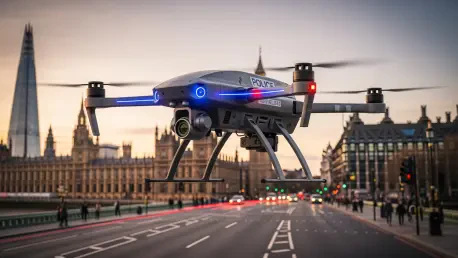

Metropolitan Police Commissioner Sir Mark Rowley has introduced a transformative roadmap for London law enforcement that shifts the department from traditional patrolling toward a sophisticated, tech-centric model of public safety. This strategic redirection prioritizes the intensive exploitation of data and artificial intelligence to stay ahead of increasingly complex criminal networks that operate in the digital and physical shadows of the capital. By integrating these advanced tools, the Metropolitan Police Service intends to overhaul its fundamental operational capabilities, ensuring that the city remains secure against modern threats. The proposed plan focuses on three specific technological pillars: the widespread deployment of unmanned aerial systems, the installation of permanent facial recognition infrastructure, and the utilization of machine learning to analyze massive volumes of video evidence. This evolution marks a decisive turning point for the force, moving away from reactive methods toward a proactive intelligence-led model.
Scaling Drone Operations: Rapid Incident Response
A major component of this modern policing strategy involves a significant expansion of unmanned aerial systems, commonly known as drones, across every corner of the capital. Following a successful pilot program that demonstrated these aerial units could consistently arrive at emergency scenes faster than traditional ground-based vehicles, the department plans to provide comprehensive drone coverage to every London borough within the next twelve months. These units currently boast an average response time of under two minutes, giving frontline officers a critical tactical advantage when tracking fleeing suspects or assessing high-risk situations from an elevated vantage point. This rapid deployment capability is not merely about speed; it provides a real-time situational awareness that was previously impossible without expensive helicopter support. By placing these tools in the hands of local units, the force ensures that every neighborhood benefits from high-tech surveillance.
Beyond individual police work, the Metropolitan Police Service intends to build a unified drone network in partnership with the London Fire Brigade and the London Ambulance Service. This collaborative approach among first responders aims to establish shared launch sites and manage the city’s complex, high-density airspace with unprecedented efficiency and safety. By pooling resources and technical expertise, emergency services can significantly reduce operational costs and avoid redundant responses to the same incident, ensuring that the most effective aerial tools are always available for any crisis. This integrated network will function as a digital eye in the sky for all emergency personnel, allowing for a synchronized response to large-scale disasters or public disturbances. Furthermore, the shared infrastructure permits more robust maintenance schedules and training programs, fostering a culture of inter-agency cooperation that enhances the overall resilience of London.
Leveraging Facial Recognition: a Tool for Public Safety
The Metropolitan Police is also transitioning live facial recognition technology from a temporary investigative tool into a permanent fixture within high-crime hotspots like the West End. This move follows a series of successful trials that demonstrated a measurable decrease in retail crime, shoplifting, and general antisocial behavior in areas where the technology was actively deployed. By placing static facial recognition cameras in busy commercial corridors and transit hubs, the police intend to create a continuous and visible deterrent against repeat offenders and individuals who pose a documented threat to public safety. This permanent infrastructure allows for the instant identification of persons of interest against a curated watchlist, alerting nearby officers to their presence within seconds. This proactive stance is designed to clear the streets of chronic offenders who often evade detection in dense crowds, thereby restoring a sense of security to shoppers and local business owners.
Data from recent deployments shows that facial recognition technology has already helped officers locate and arrest over 2,000 high-risk individuals, including fugitives wanted for serious violent crimes and sexual offenses. Despite the inherent privacy concerns that often accompany high-tech surveillance, recent polling indicates that a vast majority of Londoners support the use of these tools when they are applied to catch dangerous criminals. This public backing provides the necessary social license for the force to fully integrate facial recognition into its daily toolkit for identifying and apprehending fugitives who might otherwise remain at large. The system functions by comparing faces in a crowd against specific databases of wanted suspects, ensuring that law-abiding citizens are not the focus of the investigation. As the technology continues to mature, its accuracy rates have reached levels that significantly minimize the risk of misidentification, providing a reliable asset for modern urban policing.
Processing Digital Evidence: the Role of AI Video Analytics
With approximately one million CCTV cameras scattered throughout the city of London, investigators often face an overwhelming and nearly insurmountable amount of digital footage when solving complex crimes. To tackle this massive data bottleneck, the Metropolitan Police is doubling down on AI-powered video analytics, which can scan thousands of hours of video in a mere fraction of the time a human detective would require. This advanced technology can be programmed to identify specific vehicle makes and models, clothing colors, or even distinct behavioral patterns, allowing detectives to pinpoint crucial leads that might otherwise be missed during manual reviews. The transition to automated scanning allows the force to process evidence from surrounding areas much more broadly than before, capturing movements that occurred hours or days before a crime was committed. This comprehensive digital net ensures that no piece of visual evidence remains unexamined due to a lack of human resources.
The efficiency gains from integrating artificial intelligence into the investigative workflow have already proven substantial in several high-stakes investigations, including recent homicides and counter-terrorism operations. In one detailed analysis involving 23 major cases, the use of AI to process 16,000 hours of footage saved the department over 450 officer days, allowing those investigators to focus on high-level strategy rather than screen monitoring. By automating these labor-intensive tasks, the department can significantly speed up the judicial process and ensure that violent offenders are identified and removed from the streets with much greater speed. This rapid turnaround not only helps in securing early confessions but also provides grieving families with quicker resolutions to their cases. As the volume of digital evidence continues to grow, these AI tools are becoming indispensable, transforming what was once a weeks-long manual search into a streamlined process that delivers results in a matter of hours.
Integrating Advanced Systems: Future Governance and Oversight
Commissioner Rowley emphasized that this significant technological leap required a fundamental shift in how policing was funded and governed at both the local and national levels. During this period of transition, the Metropolitan Police Service addressed a profound structural imbalance in its budget, as it previously spent significantly less on technology per employee than other major government agencies or private security firms. To sustain this ambitious modernization program, the force advocated for national reforms that established a consistent and reliable framework for technology investment and usage. This fiscal realignment was treated as an essential step for maintaining a competitive edge in an environment where criminal activities were increasingly facilitated by digital means. By moving away from ad-hoc grants and toward a sustainable financial model, the department ensured that technology became a core utility rather than an optional luxury, supporting long-term operational stability.
Ultimately, the Metropolitan Police Service ensured that these advancements were subject to strict oversight from the London Policing Board and the Deputy Mayor for Policing and Crime. These bodies were tasked with monitoring the integration of new technologies to ensure they remained transparent and aligned with legal standards. This oversight helped strike a balance between increased investigative efficiency and the preservation of civil liberties, maintaining public confidence in the department’s use of surveillance tools. Furthermore, the force invested in specialized training to help officers interpret AI-generated data, ensuring that technology served as a complement to human judgment rather than a replacement. These strategic steps allowed the department to evolve into a more proactive organization, setting a new standard for urban law enforcement. The focus on ethical governance and community engagement ensured that London remained at the forefront of safe, technologically integrated cities.







