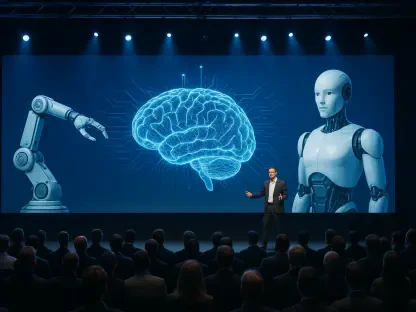

The rapid transition from experimental artificial intelligence applications to mission-critical infrastructure has forced modern corporations to reconsider the unchecked speed of autonomous decision systems. While early projections anticipated a world where software might independently steer the direction of major enterprises, the current landscape reveals a deliberate pivot toward human-directed strategies. Leaders are finding that the value of AI lies not in its independence, but in its ability to amplify the discernment of experienced professionals. This calculated moderation ensures that the move toward digital transformation remains grounded in reality rather than algorithmic speculation.
Sophisticated firms are now focusing on integrating these tools as cognitive enhancers rather than total replacements for existing personnel. This shift is particularly visible in high-stakes industries where the margin for error is non-existent. By prioritizing human oversight, organizations are building a more resilient framework that can withstand the unpredictable nature of generative models. The narrative has moved from simple automation to a more nuanced collaboration where human intuition remains the primary driver of high-level strategy.
The Cost of Autonomy: High-Stakes Decision Making
Sophisticated firms are intentionally slowing their deployment of fully autonomous systems to mitigate the financial and reputational hazards inherent in unmonitored technology. In the realms of global finance and corporate law, a single hallucination—where a model generates plausible but entirely false information—can lead to severe regulatory penalties. The risks associated with an unchecked algorithm are too great for organizations that operate under strict legal scrutiny. Consequently, the prevailing trend focuses on decision-support frameworks rather than the complete replacement of the human workforce.
This shift reflects a broader understanding that human judgment provides a necessary layer of contextual intelligence that machines currently lack. By maintaining oversight, companies ensure that high-stakes decisions are backed by accountability that can be defended in a courtroom or a boardroom. This evolution from “AI-first” to “human-led AI” signifies a maturation of the industry, where the objective is to leverage computational power while retaining the moral and ethical compass of human operators.
Why Governance Outpaces Technical Capability: Modern Industry
The explosive growth of AI capabilities has frequently outrun the development of standardized safety and compliance protocols. Organizations now recognize that prioritizing speed over stability creates a massive risk profile that can jeopardize the entire enterprise. As models become more complex, the demand for transparency grows, especially in sectors where every data point must be historically and legally defensible. The focus has moved away from what a technology can achieve in isolation toward how it can be governed within existing regulatory boundaries.
Transparency is no longer a luxury but a fundamental requirement for modern business operations. The “black box” nature of early neural networks is increasingly seen as a liability in environments that demand clarity and auditability. By prioritizing governance, firms are building the structural integrity necessary to support future innovations without risking a collapse in public or shareholder trust. This approach ensures that technical progress does not come at the expense of organizational stability.
Building Trust: Grounded Data and Verifiable Sources
Reliable enterprise strategies are now constructed on the principle of traceability rather than total model independence. Systems like S&P Global Market Intelligence’s Capital IQ Pro demonstrate this by anchoring AI outputs in verified financial data and original company filings. Instead of asking a model to provide an answer from its internal weights, these platforms use “chat” interfaces that link every specific claim back to a source document. This allows analysts to verify information in real-time, effectively eliminating the danger of unsupported assertions.
By functioning as a high-speed research assistant, AI provides the raw material for insight while leaving the final verification to the expert. This methodology creates a clear audit trail, allowing for a level of precision that was previously unattainable at scale. When an AI can point to the exact paragraph of a filing or a press release to justify its summary, the level of trust between the user and the tool increases significantly. This grounded approach is becoming the standard for any organization that relies on data accuracy.
The Scaling Challenge: Pilot Programs to Enterprise Value
Research from McKinsey & Company indicates a persistent gap between the adoption of AI in small business units and the ability to scale those benefits across a global organization. While pilot programs often show promise, the transition to full-scale deployment frequently encounters hurdles related to data quality and inherent model bias. The “human-in-the-loop” model has emerged as the most effective solution to this bottleneck, providing a way to manage complexity without losing control. This balance allows enterprises to process massive amounts of information while maintaining a central point of accountability.
Scaling value requires more than just better algorithms; it requires a culture of continuous oversight. By reserving final decision-making authority for human experts, companies can deploy AI to handle labor-intensive tasks such as trend identification and document summarization. This synergy ensures that the speed of the machine is tempered by the experience of the professional. As a result, the enterprise can move faster without increasing its exposure to the systemic errors that often plague unmanaged AI systems.
A Practical Framework: Implementing Reliable AI Governance
Transitioning from current support tools to advanced planning agents requires a structured approach to technical and ethical oversight. Organizations must establish rigorous data quality controls and governance frameworks that define the legal boundaries of machine operations. Explainability—the capacity to understand how a model reaches its conclusions—is a core requirement for any system being integrated into the corporate stack. Forums like the AI & Big Data Expo serve as critical venues for discussing these control mechanisms as the industry moves toward more complex systems.
The most successful enterprises adopted a strategy that prioritized verifiable data and human expertise over the allure of total automation. This commitment to grounded insights allowed firms to navigate the complexities of AI integration while avoiding the pitfalls of algorithmic bias. Decision-makers implemented robust governance structures that bridged the gap between technical potential and practical business value. By focusing on traceability and human-in-the-loop protocols, these organizations established the trust necessary for sustainable growth. Ultimately, the industry moved toward a future where technology served as a reliable partner, ensuring that human intelligence remained the final authority in every significant corporate action.