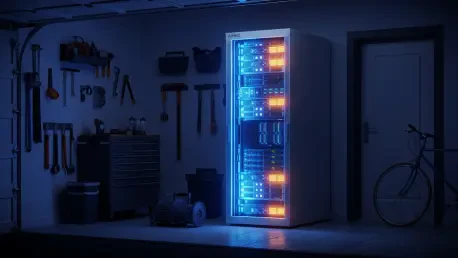

The quiet hum emanating from a neighbor’s garage might no longer signal a standard home improvement project but rather the operation of a high-performance decentralized AI node integrated into the global computing fabric. This transformation represents a fundamental shift in how digital infrastructure is deployed, as developers increasingly move powerful processing units into private living spaces to circumvent the high costs and energy constraints of traditional centralized facilities. While marketing materials often frame these systems as democratic, efficient, and decentralized solutions for an AI-driven economy, the reality is that they effectively turn suburban family homes into commercial extensions of the global data center network. This integration erodes the long-standing boundary between the private domestic sphere and the high-stakes world of corporate infrastructure. Homeowners are now inviting a level of risk into their residences that standard home security protocols are simply not equipped to handle or mitigate effectively.
Cyber Attack Surfaces: The Expansion of Digital Risk
Enterprise data centers operate under the constant vigilance of dedicated security operation centers and specialized incident response teams that utilize sophisticated monitoring tools to detect threats throughout 2026. In contrast, residential environments are notoriously under-protected, relying on consumer-grade routers and personal firewalls that offer little resistance against professional adversaries. By distributing critical AI workloads across thousands of disparate homes, technology providers have inadvertently created a massive, geographically dispersed network of weak points that can be exploited by hackers or state-sponsored groups. These nodes become attractive targets for weaponization, similar to how the Mirai botnet previously co-opted unsecured IoT devices to launch devastating attacks. Homeowners typically lack the advanced technical expertise required to maintain the rigorous security protocols necessary for high-value hardware, making these installations highly vulnerable.
The systemic risk inherent in this decentralized model is further amplified by its potential for triggering cascading failures across multiple industries and critical sectors. Just as the SolarWinds and MOVEit breaches demonstrated the fragility of the modern software supply chain, a single vulnerability in the centralized platform managing these residential nodes could serve as a primary vector for large-scale compromises. Because these grids lack uniform governance and consistent security standards, they represent a significant digital back door for malicious actors. The industry standards evolving from 2026 to 2028 must address these structural flaws to prevent attackers from moving from a single compromised residential node into broader corporate environments. The absence of a centralized perimeter means that once a breach occurs within the home environment, containing the lateral movement of an adversary becomes an incredibly complex and nearly impossible task.
Legal Liabilities: Privacy Challenges for Homeowners
Participants in these decentralized compute programs frequently face a troubling lack of clarity regarding legal liability and the ownership of digital actions performed on their hardware. Modern business models in this sector often fail to provide robust legal frameworks that define who exactly holds responsibility when a residential node is used for illegal routing or is implicated in a cybercrime. This ambiguity places homeowners at significant personal risk of becoming involuntary participants in complex forensic investigations, which could lead to the sudden seizure of personal hardware and extensive digital evidence by law enforcement. Authorities attempting to distinguish between legitimate resident activity and malicious exploitation may delve deep into the private lives of the participants, resulting in a severe invasion of privacy. Without clear contractual protections, the homeowner remains the primary entity accountable for the physical and digital behavior of a machine they do not fully control.
Beyond the immediate threat of a digital intrusion, these integrated AI systems introduce a pervasive surveillance risk through the continuous collection of operational telemetry and remote monitoring data. Even in scenarios where no malicious intent is present from the service provider, the granular data generated by an active AI node can be analyzed to reveal sensitive information about the household. Power consumption patterns, internet traffic characteristics, and hardware usage cycles allow companies or intercepting hackers to build detailed behavioral intelligence about the residents. This allows interested parties to infer occupancy schedules, lifestyle habits, and even the presence of specific smart home devices, effectively turning a functional computing appliance into a tool for unintentional domestic monitoring. The constant stream of data required to manage these nodes ensures that the privacy of the home is consistently compromised for the sake of maintaining a high-performance decentralized grid.
Strategic Risks: National Infrastructure and Supply Chains
The overall security of a residential AI grid is ultimately only as robust as the weakest link within its global supply chain, which involves a complex array of manufacturers and operators. Remote management tools are essential for performing necessary firmware patching and system diagnostics, yet these very tools are frequently targeted by sophisticated attackers seeking to establish long-term persistence. In a typical home environment, the compromise of these privileged access tools provides an attacker with a strategic foothold to move laterally across the internal network. Once inside, an adversary can easily gain control over personal computers, sensitive financial data, and residential security cameras that are often connected to the same unsegmented local network as the AI node. This creates a scenario where the pursuit of decentralized computing power directly facilitates the theft of personal identity and the compromise of a family’s physical safety through their own connected infrastructure.
On a macro scale, the widespread adoption of these nodes effectively elevates them to the status of critical national infrastructure, bringing significant geopolitical risks directly into the living room. Hostile foreign actors could potentially map these dense concentrations of compute nodes to identify regional dependencies or target the decentralized grid during times of strategic conflict to disrupt national capabilities. What begins as a consumer-facing initiative to monetize spare electricity or processing time could eventually evolve into a high-value target for state-sponsored cyber operations. This shift places private citizens on the front lines of global digital warfare, where their personal residences could be subjected to digital sieges intended to paralyze the nation’s broader AI processing capacity. The transition of private homes into strategic assets happens without the requisite defense budgets or intelligence support that traditionally accompany the management of vital national resources.
Technical Safeguards: Physical Security and Future Solutions
Physical security challenges are equally daunting, as residential AI nodes often house expensive and rare components like high-end GPUs that have become primary targets for organized theft rings. Most residential properties are not designed with the reinforced access controls, fire suppression systems, or environmental monitoring equipment required to safely host enterprise-grade hardware. This deficiency significantly increases the risk of physical sabotage or accidental fire due to the extreme heat generated during intense AI training workloads. Furthermore, the common practice of using flat network architectures within homes means that a single breach of the AI node can instantly compromise every other connected device in the household. Without physical and digital isolation, these powerful machines remain a constant threat to the structural and data integrity of the home, transforming a potentially lucrative asset into a liability that could have catastrophic real-world consequences.
Addressing these looming threats required a fundamental shift in how the governance and management of residential compute sharing were approached by regulators and providers. The industry transitioned toward treating these installations as commercial-grade infrastructure rather than simple consumer appliances, necessitating the implementation of mandatory technical controls. Effective solutions involved the deployment of full network segmentation and dedicated hardware firewalls to ensure that the AI node remained isolated from the rest of the household’s personal data. Comprehensive security audits and adherence to SOC 2 compliance standards became essential benchmarks for any provider operating within the domestic space. Transparent contractual protections and clear liability waivers ensured that homeowners were no longer left legally vulnerable to the actions of the machines in their care. These proactive steps allowed the push for AI innovation to continue without compromising the fundamental right to personal security.