


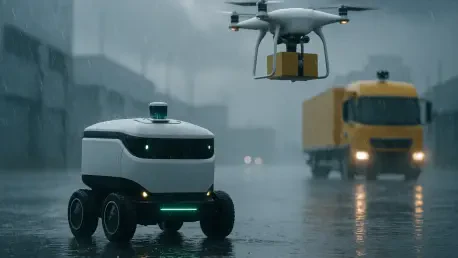

The relentless pursuit of operational efficiency has pushed modern industry toward a landscape where autonomous systems are no longer a novelty but a core component of global logistics and infrastructure. As of 2026, the transition from human-operated machinery to sophisticated delivery robots and unmanned aerial vehicles has accelerated, yet this progress reveals a significant vulnerability: the unpredictability of the natural world. While engineers have made massive strides in internal sensor technology and machine learning algorithms, the physical environment remains a volatile factor that can abruptly compromise even the most advanced hardware. This hidden dependency creates a scenario where a system may function perfectly in a simulated environment but fail catastrophically when faced with real-world atmospheric conditions. Consequently, integrating weather intelligence into the foundational architecture of these systems has become a non-negotiable requirement for any organization aiming to achieve true autonomy. Without a deep understanding of the environment, automation remains brittle, capable only of operating within narrow, controlled parameters that do not reflect the complexity of the outdoors.
Navigating the Physical and Logical Boundaries of Autonomous Systems
The fundamental struggle for automated systems operating in the “wild” is the inherent lack of environmental awareness that persists despite high-resolution cameras and sensors. In a controlled warehouse or factory setting, every variable is managed, but the external world introduces constant physical challenges that can “blind” a machine’s perception. For instance, sophisticated LiDAR and ultrasonic sensors, which are the eyes of autonomous units, often struggle to distinguish between a solid object and heavy particulate matter like dense fog, driving rain, or falling snow. This creates a high-noise environment where the system’s software may perceive a clear path as obstructed or, more dangerously, miss an actual obstacle due to atmospheric interference. When a robot cannot clearly see its surroundings, its primary directive of safe navigation is compromised, leading to forced shutdowns, navigational errors, or collisions that result in costly hardware damage and operational downtime.
Beyond the immediate challenges of perception, weather conditions fundamentally alter the physics governing the operation of electric fleets and aerial units. Drastic temperature fluctuations are known to impact battery chemistry, significantly reducing the operational range and efficiency of autonomous delivery vehicles during extreme cold or heat. Similarly, wind speed and gusts create unpredictable drag for drones, requiring them to expend more energy to maintain stability and flight paths. Even a light rain can change the friction coefficient of the ground surface, causing autonomous ground vehicles to lose traction or experience increased braking distances. If the internal logic of a system is programmed with “ideal” conditions as the baseline, it becomes incapable of making the necessary adjustments to its motor torque, braking pressure, or flight speed when conditions deviate. This logic gap ensures that without real-time environmental data, the system will eventually make suboptimal or dangerous decisions that jeopardize the mission.
Overcoming Technical Hurdles in Weather Data Integration
One might assume that merely adding a weather report to an automation framework would solve these issues, but the reality of raw weather data presents its own set of technical barriers. Raw meteorological information is notoriously fragmented, often gathered by thousands of disparate sensors that utilize inconsistent formats, units, and reporting intervals. For a machine that requires structured and predictable inputs to function at peak performance, this lack of normalization is a massive hurdle for developers. Instead of dedicating all its computational power to its primary task, an autonomous unit’s processor may become heavily bogged down just trying to clean, parse, and interpret inconsistent data streams. This inefficiency is particularly detrimental for mobile robots that rely on high-speed processing to react to their immediate surroundings in real-time, making a unified data structure essential for industrial-scale deployment.
Latency and granularity issues further complicate the integration of raw weather feeds into high-stakes robotics operations. Most public weather services update their reports at irregular intervals, providing information that is often thirty minutes to an hour old, which is functionally “stale” for a drone navigating a wind-prone urban canyon. Furthermore, traditional forecasting is designed for humans and covers broad geographic regions, whereas an autonomous robot operating on a specific street corner requires hyper-local data specific to its exact GPS coordinates and altitude. Without this level of precision, a system cannot distinguish between a safe operating environment and a localized micro-storm or a sudden gust that could flip a small delivery unit. The gap between regional forecasts and the specific atmospheric conditions at the robot’s location represents a critical failure point that raw data simply cannot address without sophisticated refinement.
Leveraging Specialized APIs for Operational Decision Making
To bridge the gap between simple atmospheric measurements and the actionable logic required for automation, organizations have turned to specialized weather intelligence APIs. These platforms function as a sophisticated middleware layer that normalizes and validates data from a multitude of global sources, providing a single, standardized “version of the truth” for the entire fleet. By offloading the heavy lifting of data processing to these specialized services, developers can focus their efforts on the core functionality of the machine rather than building complex data-cleaning pipelines. This ensures that every automated unit, whether it is a ground-based courier or a long-range drone, receives a clean and reliable feed that is specifically optimized for high-speed industrial applications. This standardization is the backbone of reliability, allowing for a seamless transition as a company scales from a pilot program to a global operation.
These advanced intelligence layers do more than just report raw numbers; they translate meteorological variables into direct operational context for the machine’s decision-making engine. Instead of providing a wind speed value of 25 miles per hour and leaving the system to interpret the risk, the intelligence layer can trigger a “Stability Risk” alert or a “High Energy Consumption Warning” based on the specific payload and hardware profile of the unit. This level of translation is vital for maintaining safety and efficiency across diverse geographical locations where a robot in London and a robot in Los Angeles must operate under the same high-quality data standards. By turning atmospheric data into binary triggers or weighted variables in a machine learning model, these APIs allow for a level of precision that was previously unattainable, ensuring that the machine understands not just what the weather is, but how it will specifically impact its current task.
Analyzing Industry-Specific Responses to Atmospheric Volatility
The necessity of sophisticated weather awareness is perhaps most evident in the rapidly expanding drone and UAV sector, where atmospheric conditions dictate every aspect of flight. For operations that occur Beyond Visual Line of Sight (BVLOS), reliable intelligence is the only way to ensure that aerial assets do not encounter destructive turbulence or sudden pressure drops that their onboard cameras cannot detect. By integrating real-time weather intelligence, these systems can anticipate changes in air density and wind patterns before they become a threat, allowing for proactive flight path adjustments that conserve battery and protect the airframe. This foresight is what separates a experimental drone project from a commercially viable delivery service, as it allows for a much higher level of mission success and safety in increasingly crowded urban and industrial airspaces.
In the sectors of ground logistics and heavy industrial automation, weather intelligence serves as a critical safeguard for both personnel and expensive infrastructure. Automated cranes at large-scale construction or mining sites are now frequently programmed to enter a “lockdown” mode automatically the moment wind speeds exceed predetermined safety thresholds. This automation removes the element of human error and reaction time, ensuring that equipment is secured before a hazard occurs. Similarly, logistics platforms have begun utilizing weather-adjusted estimated times of arrival (ETAs) to better manage customer expectations and dynamically reroute autonomous vehicles away from areas prone to flash flooding or icy conditions. By proactively managing these risks, companies have significantly reduced their insurance premiums and minimized the high costs associated with weather-related accidents, proving that environmental awareness is as much a financial strategy as it is a technical one.
Implementing Event-Driven Architectures for Enhanced Resilience
The paradigm of modern system design has shifted toward “event-driven” architectures, where specific weather thresholds act as immediate triggers for automated responses. This approach moved away from the outdated method of checking a periodic forecast and instead favored a model where the system responded instantly to environmental shifts as they occurred. For example, if a sensor network detected a sudden increase in wind speed beyond a drone’s stability limit, the architecture immediately sent an instruction to the flight controller to increase motor torque or seek an emergency landing spot. This proactive management style allowed machines to mimic a form of human intuition, where the system “felt” the environment changing and adjusted its behavior before the situation reached a critical failure point. This integration of short-term “nowcasts” allowed for smoother operation and a significant reduction in the mechanical stress placed on hardware during volatile weather events.
Designing for resilience also required a focus on “graceful degradation,” a concept where a system understood how to maintain a baseline of safety even if its primary data feeds became unavailable. Organizations that successfully implemented these strategies ensured that their robots could switch to a “cautious mode” or utilize the last known good data to reach a safe state during atmospheric disruptions. By combining predictive AI with high-fidelity weather intelligence, engineers created systems that did not merely react to the world but anticipated its changes. This evolution ensured that as automation moved deeper into public spaces like sidewalks and shared roads, the technology operated in harmony with the atmosphere rather than in constant conflict with it. The transition to this intelligent autonomy ultimately depended on closing the communication gap between the digital logic of the machine and the relentless physical reality of the weather, providing a foundation for the next generation of reliable, self-sufficient technology.







