
A solar-powered camera for detecting elk needed its vision model reduced by a factor of 250 before it could fit the device’s constraints. A University of Washington research team used AI agents to tackle that deployment problem, connecting model changes to measurements from actual hardware. In the team’s tests, that feedback loop allowed the agent to outperform human experts within seven rounds.
Small Devices Need a Different Optimization Workflow
For businesses considering embedded AI, model capability is only part of the deployment decision. Memory, energy use and heat determine whether a workload can operate on a small chip. Those constraints create engineering work: the model must be compressed, and the device software must be adjusted around it.
Zhihan Zhang, a PhD student in the Allen School of Computer Science & Engineering, presented the project that won the Madrona Prize at the Allen School’s annual Research Showcase. The research asks whether agents can take on optimization work that specialists currently perform manually. Its practical contribution is a workflow that tests proposed changes against the equipment that must eventually run them.
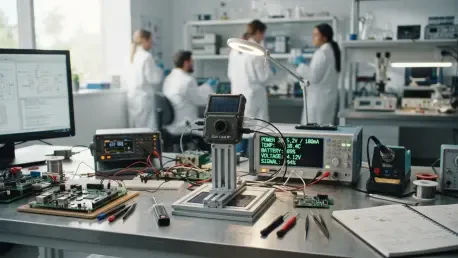
Leading AI models failed at the task when they lacked feedback from physical hardware, the researchers found. Giving an agent access to the device changed the result. Rather than treating generated code or a compressed model as a finished deliverable, the system made measured performance part of the next decision.
The team’s workflow followed a repeatable deployment cycle:
- The agent prepared an optimization and loaded it onto the target hardware.
- Measurements showed how that attempt performed on the device.
- The agent used those results to revise its work and test again.
Within seven rounds, the agent exceeded the human experts’ results in the team’s tests. That finding supports hardware-connected optimization under the tested conditions; it doesn’t establish that agents can replace embedded engineers across every chip or workload. A deployment still needs access to representative equipment and a clear definition of acceptable performance.
Two Applications Put the Feedback Loop to Work
The researchers applied the approach to an elk-detection camera trap and a wearable that records children’s speech for developmental research. These are useful deployment examples because both place AI-related workloads inside constrained devices rather than treating compute capacity as freely expandable. The camera’s 250-fold model reduction makes the integration challenge particularly concrete.
For an organization evaluating this approach, the practical starting point would be a bounded device workload with measurable requirements. Hardware access must sit inside the development loop, rather than appearing only during final validation. Reducing specialist optimization effort while preserving a way to check whether each change actually works is the commercial opportunity.
The team made Embedded Arena, its benchmark, available as open-source code. That provides a basis for evaluating this kind of optimization rather than relying solely on an agent’s proposed solution. Allen School faculty members Shwetak Patel, Vikram Iyer, Natasha Jaques and Kurtis Heimerl contributed, alongside Alexander Metzger, Jiuyang Lyu, Chun-Cheng Chang, Jiayi Shao, Yujia Liu, Emmanuel Azuh Mensah, Edward Wang and Gregory D. Abowd.
Custom Serving Software Extends the Infrastructure Approach
Keisuke Kamahori received the People’s Choice award for VibeSys, which applies agents to another infrastructure bottleneck: software built for a particular chip and workload. Instead of depending on broadly applicable tools, the project generates specialized software and continues refining it. The business question is whether that specialization can extract more capacity from the installed hardware.
Its first application, VibeServe, builds the software layer that accepts user requests and executes them through an AI model. On Amazon’s Trainium2 chips, the researchers reported throughput of up to 2.7 times that of an existing system. That result concerns the serving layer, so it should be evaluated separately from improvements to the underlying model.
The two agent projects address different parts of the deployment stack:
| Project | Optimization target | Reported result |
|---|---|---|
| Embedded Arena research | Model and software fit on constrained devices | Agent exceeded expert results within seven rounds when using hardware feedback |
| VibeServe | Chip-specific model-serving software | Up to 2.7 times the throughput of an existing system on Amazon’s Trainium2 chips |
For infrastructure teams, the distinction affects integration planning. Embedded optimization starts with device limits; serving optimization starts with how requests move through a compute system. Neither reported result should be assumed to transfer unchanged to other hardware. Shihang (Vic) Li and Allen School faculty members Simon Peter and Baris Kasikci also contributed to VibeSys.
Capability and Security Remain Deployment Gates
Higher throughput won’t resolve a model’s inability to understand a specialized task. Tanush Yadav, the Madrona Prize’s first runner-up, presented VideoNet, which evaluates recognition of detailed video actions, including particular bouldering moves and surgical stitches. Its coverage spans more than 1,000 actions in 38 fields.
The researchers found that leading AI models struggled relative to ordinary people. After viewing three examples, people gained about 14 percentage points in accuracy; models gained about 3 percentage points. For a proposed video workflow, the implication is to test the specific action vocabulary before investing in production infrastructure. General model capability offers limited assurance for these fine-grained tasks.
VideoNet’s collaborators included Allen School faculty members Ali Farhadi, Hanna Hajishirzi and Ranjay Krishna, plus former Allen School faculty member Yejin Choi, now at Stanford University. Mohammadreza Salehi, Jae Sung Park, Vivek Ramanujan and Rohun Tripathi also contributed.
Security introduces a separate system boundary. Second runner-up Henry Wong examined benchtop DNA synthesizers, which produce synthetic DNA, focusing on the screening software intended to block dangerous pathogen production. His project concluded that even completely secure hardware would leave part of the problem unresolved. The deployment lesson is to assess software controls alongside the physical equipment they govern.
Allen School faculty member Jeff Nivala and former Allen School faculty member Tadayoshi Kohno, now at Georgetown University, contributed to that work. All the presenters were Allen School PhD students. Madrona, a Seattle venture capital firm, has awarded its prize since 2006 to student research combining technical strength with commercial promise.
Taken together, these projects put deployment evidence ahead of broad capability claims. Agents are showing potential to optimize device workloads and serving infrastructure, while specialized recognition and software security still require separate validation. For organizations planning AI investments now, the practical path is to connect development to measurable hardware results, verify task-level performance and assess the controls around the complete system before scaling it.