
By focusing on the mathematical complexities of tensor operations, semiconductor firms are moving away from the legacy of PC-centric processing toward high-performance computing. This fundamental shift has redefined the competitive landscape of the semiconductor industry, propelling Advanced Micro Devices (AMD) into a direct confrontation with long-standing market leaders. As generative AI models and massive neural networks become the backbone of the global digital economy in 2026, the demand for specialized silicon has transitioned from a niche requirement to a critical matter of national and corporate infrastructure. AMD has navigated this transition by aggressively pivoting its research and development toward the Instinct accelerator line and EPYC server processors, positioning itself as the primary alternative to the proprietary ecosystems that have historically dominated the field. This strategic redirection is not merely about matching raw clock speeds but about architecting a cohesive environment where hardware and open-source software converge to solve the most pressing bottlenecks in machine learning and data processing.
The Shift Toward Specialized AI Hardware
Developing Next-Generation AI Accelerators
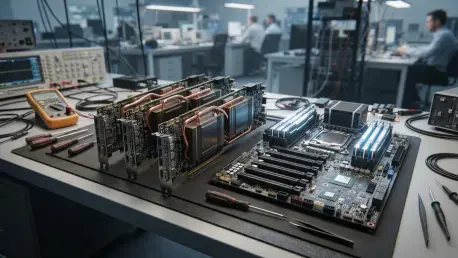
The current technological climate in 2026 emphasizes the necessity for hardware that can keep pace with the exponential growth of large language models. AMD’s approach focuses on the integration of high-bandwidth memory and massive parallel processing capabilities, which are essential for the training and deployment of sophisticated AI agents. By prioritizing the MI325X and MI350 series, the company has managed to offer a compelling architectural choice for engineers who require extreme throughput for matrix-heavy calculations. These accelerators are designed to alleviate the data movement bottlenecks that often plague traditional computing setups, ensuring that the vast amounts of information required for real-time inference can flow seamlessly between memory and processing cores. This focus on the physical limits of data transfer reflects a deep understanding of the current requirements for building scalable AI systems that can handle trillions of parameters without prohibitive latency.
Furthermore, the engineering philosophy behind these accelerators has moved toward a modular chiplet design, allowing for greater flexibility in manufacturing and performance scaling. This strategy enables the production of specialized silicon that can be tailored for specific enterprise needs, ranging from massive model training in centralized clusters to high-efficiency inference at the network edge. As the industry moves further away from the general-purpose CPU era, the emphasis on specialized tensor cores has allowed AMD to claim a significant portion of the performance-per-dollar conversation. The ability to execute complex mathematical operations with greater energy efficiency has become a deciding factor for firms looking to scale their AI operations while managing the significant operational costs associated with modern high-performance computing environments. Consequently, the hardware is no longer viewed as a static component but as a dynamic engine capable of evolving alongside the software it supports.
Fostering a Multi-Vendor Ecosystem
The push toward a multi-vendor environment has become a central theme for cloud service providers and enterprise leaders who are wary of being locked into a single proprietary hardware stack. AMD has capitalized on this sentiment by championing open standards and interoperability, particularly through the continued refinement of the ROCm software platform. This open-source approach allows developers to port their workloads from other environments with increasing ease, reducing the friction that previously prevented many organizations from diversifying their hardware portfolios. In 2026, the maturity of these software tools has reached a point where performance parity is no longer a distant goal but a present reality for many mainstream machine learning frameworks. By providing a credible alternative to existing monopolies, the company has positioned itself as a vital partner for organizations that prioritize supply chain resilience and competitive pricing in their long-term infrastructure planning.
In addition to software compatibility, the strategic emphasis on building a broad ecosystem involves deep collaboration with independent software vendors and system integrators. These partnerships ensure that the hardware is supported across various deployment models, from on-premises private clouds to the largest hyperscale environments. The industry’s growing preference for diverse computing solutions stems from a desire to mitigate the risks associated with hardware shortages and proprietary licensing fees. By offering a platform that integrates smoothly with existing industry-standard tools like PyTorch and TensorFlow, AMD has effectively lowered the barrier to entry for firms that were previously hesitant to move away from the dominant market leader. This commitment to an open architectural philosophy not only benefits the immediate consumer but also drives innovation across the entire semiconductor sector by forcing a more competitive and transparent marketplace for high-performance silicon.
Data Center Expansion and the Role of Hyperscalers
Powering the Cloud Through Server Innovation
The explosion of digital services has necessitated a massive expansion of global data center capacity, placing a premium on server processors that can deliver high density and low power consumption. AMD’s EPYC processor family has become a cornerstone of this expansion, particularly as hyperscalers look to maximize the efficiency of every square foot in their facilities. These processors are specifically designed to handle the multi-tenant environments of modern cloud computing, providing the security features and virtualization capabilities required by the world’s largest service providers. The transition to advanced process nodes has allowed for higher core counts and improved thermal characteristics, which are essential for maintaining stable performance in the high-density server racks that power 2026’s digital economy. As electricity costs and carbon footprint concerns become integral to corporate strategy, the performance-per-watt metrics of these server chips have become a primary competitive advantage.
Beyond raw core counts, the integration of specialized instructions for AI and data analytics directly into the server CPU has blurred the lines between general processing and acceleration. This allows for a more holistic approach to data center architecture, where the CPU can handle complex orchestration and lighter inference tasks while delegating the most intensive workloads to dedicated GPUs. This balanced architecture is particularly attractive to organizations that need to support a wide variety of workloads on the same physical infrastructure. By focusing on the total cost of ownership, including the long-term expenses related to cooling and power distribution, the industry has recognized that the efficiency of the underlying silicon is the most significant factor in the profitability of cloud services. The resulting shift in market share reflects a broader realization that the next generation of computing must be as sustainable as it is powerful.
Supporting Global Infrastructure Investment
Capital expenditure in the technology sector has reached unprecedented levels as firms race to build the physical foundations for an AI-centric future. This massive investment is being directed toward the construction of next-generation data centers that act as the neural centers for global commerce and communication. AMD’s role in this build-out is characterized by its ability to provide the volume and reliability required by Tier-1 hyperscalers who are deploying hundreds of thousands of nodes annually. The company’s focus on scalability ensures that its hardware can be integrated into the complex fabric of global cloud networks, supporting everything from autonomous vehicle processing to complex financial modeling. This infrastructure is not just a collection of servers but a globally distributed system that requires hardware capable of operating at peak performance under constant load, a challenge that has defined the engineering priorities of the current era.
The strategic alignment with these infrastructure giants has also led to the development of custom and semi-custom silicon solutions that address the unique requirements of the world’s largest data centers. By working closely with partners like Microsoft and Meta, the company has been able to influence the direction of server architecture, ensuring that future hardware is optimized for the specific software stacks used by these platforms. This collaborative approach to infrastructure development has fostered a sense of stability in a market that is often characterized by rapid and disruptive change. As these hyperscale firms continue to invest in the “physical layer” of AI, the hardware that powers their operations becomes a fundamental part of the global economic fabric. The scale of these investments suggests that the demand for high-performance infrastructure will remain a dominant force in the semiconductor industry for years to come, providing a consistent tailwind for those capable of meeting the rigorous standards of the cloud.
Navigating Competitive Dynamics and Industry Relationships
Challenging the Dominance of Established Leaders
The competitive landscape in 2026 is defined by a relentless race for technological supremacy, where even incremental gains in processing power can lead to significant market advantages. While one major player has historically held a near-monopoly on the software and hardware for AI training, the market has matured into a more balanced ecosystem where different architectures excel in specific domains. AMD has strategically targeted the inference market, which has grown to represent a massive portion of the total AI hardware demand as more models move from the training phase to live deployment. By offering specialized hardware that excels in low-latency processing and high-throughput content generation, the company has managed to carve out a dominant position in the “ready-to-use” AI sector. This shift highlights a transition in industry priorities, moving from the raw brute-force power required for initial model development to the efficiency and speed needed for daily enterprise applications.
This competition has also sparked a wave of innovation that has benefited the entire technology sector, as firms are forced to iterate more quickly and offer more aggressive pricing models. The presence of a strong second player prevents the stagnation that often occurs in monolithic markets, ensuring that advancements in chip packaging and interconnect technology are brought to market as fast as possible. Organizations now have the leverage to choose hardware based on specific workload requirements rather than being forced into a single ecosystem due to a lack of alternatives. This dynamic has led to the emergence of specialized clusters where different brands of hardware operate side-by-side, each optimized for a specific part of the machine learning lifecycle. The resulting diversity in the data center is a testament to the maturing nature of the industry, where performance, price, and availability are the primary drivers of adoption rather than historical brand loyalty.
Partnering with Tech Giants for Scale
Strategic partnerships with major technology firms have played a pivotal role in validating the performance and reliability of new hardware architectures. By securing significant design wins with companies that manage the world’s most critical digital services, AMD has demonstrated that its technology can perform at the highest levels of scale and complexity. These relationships often involve extensive co-engineering efforts, where hardware designers and software developers work in tandem to optimize the entire stack for maximum efficiency. In the context of 2026, these alliances are essential for ensuring that new AI features and services are available to millions of users on the day of launch. The ability to meet the massive supply requirements of these giants is a logistical feat that has required a complete overhaul of global supply chains and manufacturing partnerships, further solidifying the company’s status as a top-tier semiconductor provider.
The influence of these partnerships extends beyond simple sales figures, as they often set the standard for the rest of the industry to follow. When a major cloud provider adopts a new architecture for its flagship AI services, it sends a powerful signal to the broader enterprise market that the technology is ready for mission-critical applications. This “trickle-down” effect has accelerated the adoption of alternative hardware in sectors like healthcare, finance, and telecommunications, where reliability is the most important metric. Furthermore, these collaborations provide a valuable feedback loop that informs future hardware designs, ensuring that the next generation of silicon is built with a clear understanding of real-world operational challenges. This virtuous cycle of innovation and deployment has made the relationship between chip designers and their largest customers one of the most important dynamics in the modern technology world.
Strategic Imperatives for the AI Infrastructure Era
The transformation of the semiconductor market into a diverse ecosystem driven by high-performance computing reflected a significant departure from the centralized monopolies of the past. As the industry successfully integrated advanced AI accelerators and energy-efficient server processors into the core of global infrastructure, the reliance on single-vendor proprietary systems decreased dramatically. Organizations discovered that a multi-vendor approach provided the flexibility needed to navigate the rapid shifts in generative AI and large-scale data analytics without being tethered to a single provider’s roadmap. This evolution was supported by the maturation of open-source software platforms, which allowed for seamless transitions between different hardware architectures and encouraged a new level of competitive innovation.
The path forward required a sustained focus on performance-per-watt and the physical optimization of data centers to manage the massive energy demands of 2026’s digital services. Decision-makers in the enterprise space realized that the total cost of ownership was the most critical metric in scaling their machine learning capabilities, leading to a broader adoption of modular and specialized silicon designs. By prioritizing interoperability and energy efficiency, the technology sector established a more resilient and sustainable foundation for the future of global computing. The strategic expansion of hardware alternatives ensured that the “physical layer” of the AI revolution remained robust, providing the essential computational power that allowed for the continued growth of the modern digital economy. This period of rapid advancement proved that healthy competition was the most effective catalyst for solving the complex technological challenges of the era.