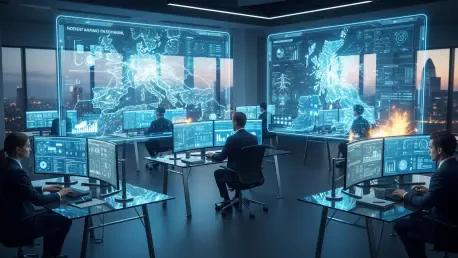

The landscape of national security is currently undergoing a radical transformation as the speed of cyberattacks transitions from human-directed maneuvers to autonomous, machine-led offensives that bypass traditional defenses in milliseconds. This fundamental shift has rendered historical security protocols nearly obsolete, necessitating a move toward an “AI-first” security operating system that can react at the pace of the threat. In the United Kingdom, the deployment of sovereign AI technologies like e2e-assure’s Cumulo platform represents a pivotal change in how the nation protects its most vital assets. By prioritizing defense that operates at the same velocity as the aggression it faces, organizations are finally moving away from the delay-prone human triage of the past and toward a proactive, unified defense mechanism.
Beyond Human-Speed: The Shift Toward an AI-First Security Operating System
The traditional reliance on human-centric security models has become a liability in an era where malicious actors use agentic AI to automate every stage of a cyberattack. These modern threats do not wait for a human analyst to log into a console or review a ticket; they move through networks with a fluidity that exploits the natural latency of human decision-making. To counter this, a transition toward autonomous “machine-speed” defense is required, where the primary response mechanism is as intelligent and rapid as the attack itself. This methodology ensures that detection and mitigation occur simultaneously, effectively neutralizing threats before they can cause cascading failures across interconnected systems.
The emergence of high-speed, AI-driven threats requires a fundamental change in cybersecurity methodology, moving from a supportive toolset to a core operating philosophy. This shift aligns perfectly with the United Kingdom’s national defense priorities, specifically the concept of the “AI Cyber Shield.” By hardwiring advanced intelligence into the fabric of the Security Operations Center, the defense becomes a living entity capable of learning and adapting in real-time. This alignment ensures that national resilience is not just a reactive posture but a constant, active state of readiness that can withstand the most sophisticated digital onslaughts.
Why Reactive Security Models Can No Longer Protect Critical Infrastructure
Reactive security models, which depend on sequential triage and retrospective investigation, are increasingly unable to keep pace with the complexities of modern digital environments. In a standard Security Operations Center, the time between a breach occurring and a human analyst identifying the event can be long enough for an adversary to exfiltrate sensitive data or disable critical controls. This delay is an inherent limitation of human-driven processes that require manual verification of every alert. When dealing with national infrastructure, where every second of downtime has significant consequences, this retrospective approach is no longer a viable strategy for protection.
A major challenge in securing energy, water, and utility sectors is the persistent visibility gap between Information Technology (IT) and Operational Technology (OT) environments. These systems often operate on different protocols and timelines, making it difficult for security teams to have a unified view of the entire estate. Without a sovereign cyber capability that bridges this divide, organizations remain vulnerable to cross-domain attacks that start in a corporate network and migrate to industrial control systems. Ensuring national resilience against geopolitical disruptions requires a security architecture that treats the entire ecosystem as a single, interconnected whole, removing the blind spots that adversaries frequently exploit.
The “Zero-Day SOC”: Bridging the IT-OT Divide with Digital Twin Intelligence
The “Zero-Day SOC” framework introduces a transformative way of managing security by instantly converting threat intelligence into active detection rules. This approach eliminates the waiting period that typically follows the discovery of a new vulnerability or indicator of compromise. Instead of a sequential process of research, testing, and deployment, the framework allows for the immediate application of defensive context as security data is generated. This ensures that the defense is always up to date with the latest global threat landscape, providing a level of protection that matches the “zero-day” nature of modern exploits.
Digital Twin technology plays a central role in this framework by creating a continuously updated, passive replica of the entire organizational environment. This allows security experts to perform safe attack simulations and stress tests without risking the physical delivery of services. By running AI as a parallel predictive capability alongside a deterministic “system of truth,” organizations can identify vulnerabilities and rank necessary fixes before a threat actor ever finds them. This dual architecture preserves the integrity of security logs while providing the foresight needed to manage the interconnected assets of a nation’s critical infrastructure with total confidence.
Securing Digital Borders with Sovereign AI and Layered Intelligence
Strategic importance is now placed on GCHQ’s vision for integrated machine-speed defense mechanisms that ensure national operational independence. To achieve this, a sovereign AI approach is necessary, moving away from a reliance on global cloud-based models that may be subject to external jurisdictions or connectivity failures. By utilizing customer-dedicated, local Large Language Models, organizations can process sensitive security data within their own borders. This ensures that the intelligence used to defend the UK’s infrastructure remains a private, national asset that cannot be intercepted or disabled by foreign entities during a period of geopolitical crisis.
The implementation of a layered AI architecture—consisting of Local, Security Intelligence, and Frontier models—allows for a balance between extreme privacy and high-performance processing. The Local model handles the most sensitive reasoning within the customer’s infrastructure, while the higher layers provide broader context and enrichment for non-sensitive data. This structure ensures that the defensive capability remains fully functional even during significant connectivity outages or broader global infrastructure failures. By keeping the “brain” of the security system local, the United Kingdom ensures that its critical services can defend themselves regardless of the state of the global internet.
A Practical Framework for Resilient Defense: Human-in-the-Loop Implementation
While AI provides the speed, a resilient defense still requires the judgment of human experts through a “human-in-the-loop” implementation. This framework empowers SC-cleared experts with tools like the Cumulo Analyst Helper, which automates the high-volume, low-value data triage that often overwhelms traditional security teams. By offloading these repetitive tasks to AI, human analysts are free to focus on high-value strategy and complex problem-solving. This synergy between human intuition and machine speed creates a more effective defense than either could achieve alone, ensuring that every alert is handled with the appropriate level of scrutiny and expertise.
To maintain the highest standards of accuracy, the platform incorporates anti-hallucination layers that validate AI findings against deterministic detection engines. This ensures that the results presented to human experts are grounded in hard data and verified threat intelligence, preventing the errors that can occur with general-purpose AI models. Furthermore, tiered service models allow organizations to scale their capabilities from proactive monitoring to a full enterprise-level predictive powerhouse. Continuous passive discovery further enhances this framework by identifying and remediating vulnerabilities in real-time, turning the defense into a dynamic shield that grows stronger as the environment evolves.
The adoption of these sovereign AI frameworks effectively redefined the standards for protecting the nation’s most critical assets. Security teams that integrated these systems successfully moved beyond the limitations of manual triage, creating a more resilient environment that responded to threats in milliseconds. It became evident that prioritizing local intelligence and digital twin simulations provided the only reliable path to safeguarding industrial and corporate networks. Leaders across the utility and government sectors recognized the value of operational independence, ensuring that their defensive capabilities remained robust during periods of external instability. Ultimately, the shift toward a machine-speed, sovereign defense established a new foundation for national security that focused on foresight rather than reaction.