


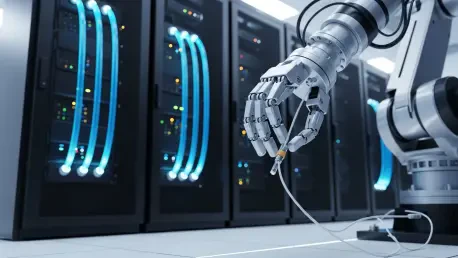

The chasm between a digital large language model and a robot capable of folding laundry is not merely a software gap but a monumental physical challenge involving heat, latency, and material science. While the last several years focused heavily on the refinement of generative algorithms, the current technological pivot emphasizes the physical infrastructure required to manifest intelligence in the tangible world. This review examines the convergence of high-performance silicon with advanced mechanical systems, a movement often termed Physical AI. This transition moves beyond screen-based interactions into a reality where autonomous systems must navigate the unpredictable entropy of human environments. The emergence of this sector signifies a shift from isolated digital tools toward a unified ecosystem where hardware and software are inextricably linked.
The Convergence of Hardware and Intelligence
The transition toward Physical AI represents the most significant architectural evolution since the mobile computing revolution. At its core, this technology relies on the seamless synthesis of massive computational power and reactive physical hardware. Unlike digital AI, which operates within the clean confines of structured data, Physical AI must process sensory input from the real world, make a decision, and execute a physical action in milliseconds. This requirement has forced a rethinking of how systems are built, moving away from centralized cloud processing toward decentralized, high-performance edge architectures.
This evolution is fundamentally driven by the need for embodied intelligence—AI that understands physics as well as it understands language. The relevance of this shift in the broader technological landscape cannot be overstated; it marks the end of the “digital-only” era. As systems begin to inhabit physical forms, the infrastructure supporting them must accommodate the brutal realities of the physical world, such as gravity, friction, and the relentless generation of thermal energy.
Critical Components of the Physical AI Ecosystem
High-Density Thermal Management Systems
Modern Physical AI relies on high-density server racks that generate heat at levels previously unseen in traditional data centers. As NVIDIA and its partners push the boundaries of GPU performance, the necessity for liquid cooling and advanced HVAC solutions has moved from a niche requirement to a foundational necessity. Traditional air-cooling methods are often insufficient to prevent hardware throttling, which occurs when a processor slows its clock speed to avoid permanent damage. Such performance drops are unacceptable when training the complex models required for real-world autonomy.
LG and other industrial leaders have introduced integrated cooling hardware that interfaces directly with compute nodes. This implementation is unique because it treats the data center not as a collection of separate machines, but as a single, thermally optimized organism. By managing heat at the source, facility operators can achieve higher power density, ensuring that the return on investment for high-end silicon is not lost to thermal inefficiency.
Edge Inference and Robotic Actuation
In the context of autonomous machines, the “inference pipeline” refers to the speed at which a device processes environmental data and translates it into movement. For a robot to operate safely near humans, it requires local processing power that eliminates the lag inherent in cloud-based systems. This is where edge inference becomes critical; it allows for real-time robotic actuation, enabling machines to react to a falling object or a sudden obstacle without waiting for a signal from a distant server.
The performance of platforms like LG’s CLOiD illustrates how high-degree-of-freedom hardware demands extreme computational precision. If the actuation logic is delayed by even a fraction of a second, the resulting physical interaction can become hazardous or clumsy. Consequently, the industry is moving toward “on-device” intelligence, where the most critical safety and navigation functions are handled by specialized local chips designed specifically for low-latency physical interaction.
Digital Twin Simulation Frameworks
Training a robot in the real world is both slow and prohibitively expensive. This has led to the rise of digital twin simulation frameworks, such as NVIDIA Omniverse, which serve as virtual proving grounds. These environments use high-fidelity physics engines to simulate billions of interactions—ranging from a robot grasping a glass of water to a vehicle navigating a rain-slicked highway—before a single physical motor is ever turned on.
This approach is unique because it allows for “synthetic data” generation, filling the gaps that real-world testing cannot cover. By testing thousands of edge cases in a virtual space, developers can ensure that when a model is deployed to a physical robot, it has already “experienced” the equivalent of several lifetimes of training. This framework significantly lowers the barrier to entry for complex robotics and accelerates the deployment of reliable autonomous systems.
Emerging Trends in Autonomous Infrastructure
A notable shift is currently occurring in how autonomous systems interact with their users, moving toward what is increasingly called “Affectionate Intelligence.” This trend marks a departure from the cold, structured automation seen on factory floors toward more nuanced, emotionally aware systems designed for domestic use. Instead of merely performing tasks, these new infrastructures are built to recognize human intent and adjust their physical behavior accordingly, creating a more harmonious cohabitation between humans and machines.
Furthermore, the industry is transitioning from highly structured industrial environments to the high-entropy world of the home. Factories are designed for robots, with marked paths and predictable obstacles, whereas domestic settings are chaotic and ever-changing. The move toward unpredictable domestic automation requires sensors and algorithms that can generalize from past experiences to handle new, messy situations. This shift is driving the development of more robust, versatile sensor suites that can interpret a child’s toy or a pet’s movement with high accuracy.
Real-World Applications of Physical AI
Domestic robotics has become a primary testing ground for these technologies, with platforms such as LG’s CLOiD demonstrating the potential for sophisticated manual labor in the home. These robots are no longer simple vacuum cleaners; they are multi-purpose assistants with five-fingered hands capable of complex tasks. The success of such platforms depends on their ability to integrate seamlessly into existing home ecosystems, leveraging smart-home data to better understand the user’s needs and environment.
In the automotive sector, Physical AI is unifying the previously separate worlds of in-cabin infotainment and autonomous driving architectures. Historically, a car’s entertainment system and its safety systems operated on different hardware. Modern infrastructure, however, is moving toward a unified “computer on wheels” approach. This unification allows the vehicle to use its internal sensors for both driver monitoring and passenger comfort, creating a holistic environment where the car understands the state of its occupants as well as it understands the road ahead.
Technical and Operational Challenges
Despite significant progress, the “physics problem” of heat dissipation remains a primary technical hurdle. As compute nodes become more powerful, the energy required to cool them often rivals the energy used to run the computations themselves. This creates a sustainability challenge and a hard limit on how much power can be packed into a single device or data center. Solving this requires not just better fans, but a complete reimagining of hardware architecture and material science at the chip level.
Operational challenges are also prevalent in the high-entropy environment of the modern home. Unlike a factory, where every variable is controlled, a home presents a nearly infinite variety of lighting, obstacles, and human behaviors. Standardized reference architectures are being developed to help mitigate these issues, providing a common framework for how robots should perceive and act. However, acquiring enough high-quality data to train models for every possible domestic scenario remains a significant bottleneck in the road to mass adoption.
Future Outlook and Scalability
Looking ahead, the long-term impact of integrated hardware-software ecosystems will likely lead to the mass adoption of humanoid robots. These machines, built to operate in environments designed for humans, represent the pinnacle of Physical AI. As manufacturing costs decrease and simulation techniques improve, the scalability of these humanoid platforms will transform from a scientific curiosity into a commercial reality. This will likely disrupt industries ranging from elderly care to retail and logistics.
The automotive industry will continue to evolve, eventually transforming vehicles into fully autonomous mobile spaces. As driving tasks are fully offloaded to the AI, the interior of the vehicle will be redefined as a lounge, office, or entertainment hub. This transformation will require even deeper integration between the vehicle’s mechanical actuators and its cognitive software, as the system must provide a smooth, safe ride while managing complex in-cabin requests.
Final Assessment of Physical AI Integration
The review of current Physical AI infrastructure demonstrated that the success of autonomous systems relied on a symbiotic relationship between high-performance silicon and sophisticated mechanical hardware. It became clear that software alone could not bridge the gap to physical reality, as the constraints of heat, latency, and environmental entropy required a more holistic engineering approach. The collaboration between computational leaders and hardware manufacturers provided a necessary blueprint for overcoming the bottlenecks that previously limited AI to digital screens.
The integration process showed that neither software nor hardware could solve these challenges in isolation. Instead, a deeply integrated infrastructure—spanning from the cooling systems in a data center to the sensors on a household robot—enabled the next generation of autonomous technology. This technological convergence successfully redefined the boundaries of human-machine interaction, moving society closer to a future where intelligence is a tangible and helpful presence in every aspect of daily life. The verdict remains clear: the future of intelligence is not just digital; it is physical.







