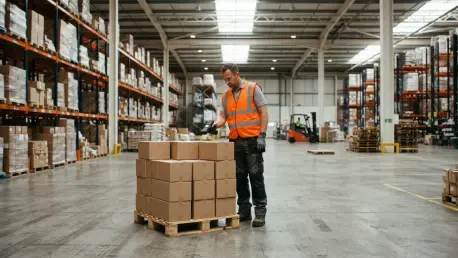

The New York-based startup Vessel has emerged from stealth to tackle the $163 billion annual crisis of usable goods being discarded by manufacturers and retailers. This immense volume of waste represents a fundamental failure in global supply chain logistics, where the default response to overproduction or seasonal shifts is often incineration or disposal in landfills. Vessel identifies a critical gap between corporate surpluses and the unmet needs of community-driven organizations. By deploying a sophisticated artificial intelligence framework, the company seeks to reposition excess inventory as a strategic asset rather than a liability. This transition requires more than just goodwill; it necessitates a technological overhaul of how goods move through the secondary market. Through its innovative approach, the startup aims to prove that environmental stewardship can be seamlessly integrated into the operational core of major industrial and commercial entities, providing a scalable solution to a long-standing economic drain.
The Financial Friction: Why Destruction Prevails
The economic burden of surplus inventory is not merely a matter of lost revenue but a structural inefficiency that defines the modern retail landscape. For decades, manufacturers and distributors have relied on disposal contracts that prioritize speed and simplicity over sustainability. When a product cycle ends or a warehouse reaches capacity, the logistical effort required to donate those items often outweighs the perceived benefit. Identifying legitimate nonprofit partners, organizing complex freight routes, and ensuring that donated goods do not cannibalize existing sales channels through unauthorized resale creates a massive administrative barrier. Consequently, destruction has become a predictable line item in corporate budgets, viewed as a necessary cost of doing business. Vessel’s entrance into the market challenges this status quo by demonstrating that the perceived ease of disposal is actually a missed opportunity for significant tax recovery and brand equity enhancement.
Beyond the immediate logistical challenges, the regulatory and compliance landscape surrounding large-scale donations adds another layer of difficulty for multinational corporations. Every donation requires meticulous documentation to satisfy Internal Revenue Service standards and various state-level accounting mandates. For many internal supply chain teams, the labor hours required to track a shipment from a distribution center to a verified charity are simply too expensive to justify. Furthermore, the risk of “gray market” leakage—where donated items are illicitly resold for profit—frequently deters high-end brands from engaging in mass philanthropy. This environment has effectively locked billions of dollars in usable goods into a cycle of waste. By addressing these systemic friction points, technology providers are now able to offer a transparent and secure alternative that finally makes the circular economy a viable operational reality for sectors ranging from consumer packaged goods to specialized manufacturing.
Intelligent Matching: The Architecture of GoodOS
At the center of this logistical revolution is GoodOS, a proprietary platform designed to replace manual coordination with high-precision artificial intelligence. The software functions by analyzing an expansive database of over 160 million unique data points, encompassing a network of more than 550,000 vetted nonprofit organizations across the globe. This massive dataset allows the AI to perform complex matching tasks that would be impossible for human teams to execute at scale. For instance, if a distributor has a surplus of medical supplies or hygiene products, the platform identifies organizations with the exact capacity and geographic proximity to receive them. This granular approach ensures that the redistribution process is not just a dump of unwanted items, but a targeted delivery that meets specific, verified needs. By digitizing the entire matching lifecycle, the platform removes the guesswork that historically plagued corporate donation programs, replacing it with a data-driven system of record.
Maintaining the integrity of the donation stream is paramount, particularly for brands that must protect their market positioning and pricing power. The GoodOS framework incorporates a rigorous, multi-layered vetting process where every participating organization must achieve a “Vessel Certified” designation. This certification involves not only automated background checks but also a human review element to verify the operational legitimacy and social impact of the recipient. Crucially, the donor companies maintain ultimate control over the process, retaining final approval authority for every suggested match. This level of oversight provides corporations with the confidence that their products are reaching intended beneficiaries while simultaneously generating automated reports for financial audits and sustainability disclosures. The platform further streamlines operations by integrating freight coordination and real-time shipment tracking, effectively turning a manual process into a seamless digital workflow.
Industrial Impact: Turning Surplus Into Social Value
The practical application of this technology has already yielded impressive results across diverse industries, proving that AI-driven redistribution is a functional reality. Since its initial pilots, the platform has successfully moved over $83 million worth of essential products to approximately 5.5 million individuals. These figures represent more than 2,000 tons of material that would have otherwise ended up in landfills, showcasing a massive reduction in the environmental footprint of participating companies. Early adopters, including premium beauty icons like Sol de Janeiro and Smashbox, have utilized the platform to manage seasonal inventory shifts and brand transitions without resorting to destructive practices. This success demonstrates that the model is particularly effective for high-margin consumer goods where brand protection is a top priority. The ability to track the social impact of these donations in real-time allows these companies to communicate tangible environmental successes to stakeholders.
The initial deployment of this AI-driven infrastructure provided a clear roadmap for organizations seeking to reconcile their financial performance with environmental accountability. By establishing a system where donation costs consistently undercut disposal fees, the startup effectively removed the primary economic barrier to sustainable inventory management. Industry leaders who participated in these early phases discovered that the automation of compliance and logistics allowed their teams to refocus on core business growth rather than waste mitigation. These results indicated that the integration of sophisticated matching algorithms was not merely a technical upgrade but a necessary evolution in how global supply chains functioned. For businesses looking to scale, these findings suggested that auditing current disposal contracts and prioritizing automated redistribution was the most effective way to secure long-term operational viability and social impact.