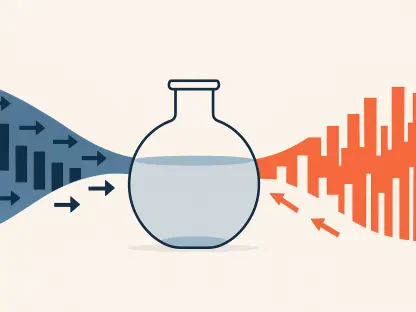

The modern corporate ecosystem is currently witnessing a total departure from traditional decision-making strategies as quintillions of bytes of information redefine the boundaries of what is possible in every industrial sector. As organizations navigate the landscape of 2026, the reliance on big data has shifted from being a specialized luxury for tech giants to becoming the absolute prerequisite for any entity attempting to maintain market relevance. This radical transformation is not merely a byproduct of increased storage capacity but is the result of a powerful convergence between high-speed cloud computing, sophisticated generative artificial intelligence, and the urgent demand for real-time operational processing. Businesses are no longer just passive collectors of information; they have become active architects of data-driven ecosystems that overhaul customer experiences, optimize supply chains, and catalyze innovation at a pace previously thought impossible. This shift represents a fundamental change in the global economic fabric, where the ability to interpret complex data sets serves as the primary differentiator between industry leaders and those left behind in the digital wake.
The financial trajectory of this industry illustrates a profound expansion that shows no signs of decelerating as we move further into the decade. While the market was valued at roughly $35 billion in 2017, it has rapidly escalated, with current trajectories placing the valuation of the broader big data analytics sector at approximately $261.89 billion by 2032. This growth is sustained by a robust compound annual growth rate of 13.5%, reflecting a deep-seated institutional commitment to digital infrastructure. Looking toward the 2034 horizon, the global market is anticipated to exceed a staggering $1.17 trillion, suggesting that the current period is merely the early stage of a multi-decade economic cycle driven by information equity. This massive valuation is fueled by the integration of software and services that allow for the seamless ingestion of unstructured data, turning raw noise into high-value strategic assets. As investment continues to pour into these systems, the economic impact is felt through increased productivity and the creation of entirely new revenue streams that were inconceivable just a few years ago.
Strategic Adoption and Regional Dominance: The New Geography of Data
The United States continues to exert a dominant influence over the global big data landscape, with its domestic industry projected to reach a valuation of $248.89 billion by 2032. This regional hegemony is clearly reflected in the fact that the U.S. currently maintains a 51% share of the worldwide market, a position bolstered by its dense concentration of tech-heavy clusters and significant venture capital activity. However, this dominance is being challenged by emerging powerhouses that are adopting data-driven strategies with remarkable speed. South Korea, for example, currently leads OECD nations with a 40% adoption rate of big data analytics, demonstrating how smaller, tech-focused economies can leverage high-speed infrastructure to gain a competitive edge. Similarly, India is rapidly emerging as a critical global hub, with its technology and services market expected to hit $3.38 billion by 2030, driven by a young, tech-literate workforce and a massive push toward national digitalization efforts that integrate data into the very core of public and private services.
Despite the near-universal adoption of these technologies among large-scale organizations, a persistent internal challenge remains regarding how these tools are actually utilized within the corporate structure. While 97% of major companies are allocating significant financial resources to data initiatives in 2026, only about 23.9% of these entities describe their internal operations as truly data-driven. This discrepancy highlights a substantial “culture gap” where the acquisition of expensive technology has outpaced the organizational change required to make that technology effective. Leaders are finding that buying the latest analytics software is only half the battle; the real hurdle is fostering a workforce that can intuitively interact with data to solve complex problems. Nevertheless, for the organizations that manage to bridge this gap, the rewards are quantifiable and immediate, with many reporting profitability and operational performance improvements of up to 20%. This suggests that the next phase of regional growth will depend less on who has the most data and more on which cultures can best translate that data into action.
Industry-Specific Impact: Revolutionizing Traditional Sectors through Analytics
The telecommunications sector has emerged as the vanguard of this movement, showing an integration rate of 87% as providers leverage massive data sets to manage everything from network traffic to customer churn. In an era where connectivity is a commodity, these companies use analytics to create hyper-personalized engagement strategies, with 93% of firms utilizing big data for customer acquisition and 85% focusing on retention. By analyzing real-time usage patterns, telecom giants can predict when a customer is likely to switch providers or when a specific node in their network is nearing failure. This proactive approach has redefined the industry standard, moving the focus from reactive maintenance to a predictive model that ensures seamless service. This high level of integration serves as a blueprint for other service-based industries, demonstrating how granular data can be used to maintain a constant, evolving relationship with a massive global user base.
In the high-stakes world of healthcare and finance, the application of big data is literally a matter of life and death, or at least extreme fiscal stability. Approximately 92% of medical organizations now rely on analytics to forecast hospital intake and manage staffing, while 60% use complex data sets to develop personalized care plans that account for a patient’s unique genetic profile and lifestyle. This shift toward precision medicine is mirrored in the financial sector, where banks are utilizing AI-driven analysis to reduce fraud losses by 20% and optimize cash reserves by 15%. Even the entertainment industry has undergone a radical transformation; companies like Netflix save billions of dollars annually by employing algorithmic recommendation engines that keep users engaged and significantly reduce customer churn. These diverse applications illustrate that big data is not a monolithic tool but a versatile resource that adapts to the specific stressors and opportunities of each unique industry, providing a tailored path toward efficiency and growth.
Infrastructure Evolution: The Shift to Cloud and Distributed Systems
The physical and virtual architecture supporting the data explosion is undergoing a decisive shift toward cloud-based environments, fundamentally changing how information is stored and processed. By the end of 2025, it was estimated that nearly half of the world’s stored data would reside in the public cloud, a market that is now projected to surpass $824.76 billion. This migration is driven by the need for scalability and the ability to process massive workloads without the overhead of maintaining on-premise hardware. Microsoft Azure currently leads the cloud business intelligence market with a 69% share, followed by Amazon Web Services and Google Cloud, creating a competitive ecosystem that continuously drives down costs while increasing computing power. This infrastructure is the silent engine of the big data revolution, allowing even mid-sized companies to access the kind of processing power that was once reserved for government agencies or elite research institutions.
While the virtual space is expanding, the physical backbone of the internet remains a critical component of national strategy, with the United States maintaining its lead by housing over 5,400 data centers. These facilities are the local anchors for the global digital economy, providing the low-latency connections required for real-time data processing and AI training. The evolution of these centers is increasingly focused on energy efficiency and sustainable cooling, as the power demands of massive server farms become a central concern for both regulators and corporate boards. Software tools have also matured to meet the demands of this infrastructure; Apache Kafka and MATLAB have become industry standards for managing high-volume data streams and performing advanced scientific analysis. This synergy between massive physical hardware and sophisticated, distributed software ensures that the global data pipeline remains robust enough to handle the 394 zettabytes of information projected to be in circulation by 2028.
Human Capital: Navigating the Talent Shortage and the Skills Gap
The unprecedented demand for human capital in the big data sector has made data scientists some of the most sought-after professionals in the global economy, yet a profound talent shortage continues to hamper industry growth. With an average annual salary of $103,000 and nearly 18,000 new job openings every year, the competition for skilled individuals is fierce, leaving many companies unable to fill critical roles. Approximately 77% of businesses report a lack of internal analytics expertise, a deficit that leadership teams cite as one of the primary barriers to achieving their strategic objectives. This is not just a problem for tech companies; it affects every sector that relies on data to function. The reality is that while the tools have become more accessible, the ability to derive meaningful, ethical, and accurate insights from those tools remains a rare and specialized skill set that the current educational pipeline is struggling to provide at scale.
Even small and medium-sized enterprises are feeling the pressure to adapt their workforces, with 59% of small business owners expressing a desire to hire for data literacy despite many lacking the budget for full-scale analytics departments. This trend suggests a democratization of data skills, where basic proficiency in interpreting information is becoming as fundamental as literacy or numeracy in the modern workplace. Organizations are increasingly turning to internal upskilling programs to bridge the gap, attempting to turn their existing subject matter experts into data-capable employees. This focus on human capital emphasizes that the big data revolution is not just a technological event but a profound shift in labor dynamics. As firms compete for top-tier talent, the organizations that prioritize a “people-first” approach to data—focusing on training, ethics, and intuitive interfaces—will be the ones that truly unlock the value of their digital investments over the next decade.
Economic Risks: The Staggering Cost of Poor Data Integrity
While the potential for profit in the big data era is immense, the financial risks associated with poor data quality are becoming a significant drain on the global economy. In the United States alone, the cost of inaccurate or low-quality data is estimated at a staggering $3.1 trillion annually, as businesses make critical decisions based on flawed information. Roughly 91% of organizations admit to losing revenue specifically because of integrity issues within their data sets, ranging from duplicate records to outdated customer information. This “dirty data” problem creates a ripple effect of inefficiency, leading to wasted marketing spend, inventory errors, and damaged customer relationships. For many executives, the challenge is no longer just about getting more data; it is about ensuring that the data they already have is reliable enough to act upon with confidence.
Beyond immediate financial losses, there is a strategic risk that failing to implement a robust data strategy could lead to permanent market obsolescence. Approximately 79% of corporate leaders believe that ignoring big data trends puts their company at a competitive disadvantage from which they may never recover. The pressure to “go digital” has led to a shift in investment priorities, with over half of modern data budgets being directed toward long-term organizational transformation rather than quick-fix cost reductions. However, a significant trust issue remains; while 76% of companies aim to be data-driven, only 67% of leaders actually trust the output of their analytics systems. This lack of confidence often leads to “analysis paralysis,” where decisions are delayed or ignored because the underlying data is viewed with skepticism. Solving this trust and quality puzzle is perhaps the most urgent task for the industry as we move toward the 2030s.
Future Milestones: Consolidation and the Rise of Integrated Ecosystems
The industry is entering a phase of rapid consolidation as massive capital infusions and strategic mergers create unified data environments that simplify the complex pipeline of storage and analysis. High-profile moves, such as Databricks raising $1.6 billion and Salesforce’s $15.7 billion acquisition of Tableau, signal a trend toward “one-stop-shop” ecosystems where visualization, processing, and storage are seamlessly integrated. This evolution is designed to reduce the friction often found in fragmented data stacks, allowing information to flow more freely from raw ingestion to the final executive dashboard. As these platforms become more intuitive and interconnected, the barriers to entry for complex analytics continue to fall, enabling a wider range of industries to participate in the data economy. This trend toward unification is not just about convenience; it is a necessary step in managing the sheer complexity of the modern digital landscape.
As we look toward a future defined by data, it is clear that big data will eventually cease to be a standalone department and will instead become the fundamental operating system for all modern enterprises. The projected transition to a trillion-dollar industry by 2034 reflects a world that has fully embraced complexity as a manageable resource. To succeed in this environment, organizations must move beyond the collection phase and focus on the refinement phase, where data is turned into actionable, ethical, and accurate insights. The next decade will reward those who can bridge the gap between technology and culture, ensuring that the hundreds of zettabytes being generated are used to build more efficient, transparent, and innovative societies. The journey toward a data-driven future is no longer a matter of if, but how quickly and effectively a company can adapt its human and digital assets to this new reality.