


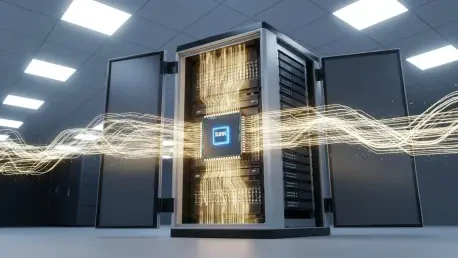

The seismic shift currently rocking the foundations of global technology is no longer defined by the mere ability to train a model, but by the relentless speed at which that model can respond to a human prompt. Nvidia recently stunned the market with a quarterly revenue of $81 billion, yet the real intrigue lies in a piece of silicon that does not carry the famous GPU moniker. This newcomer, known as Vera, represents Jensen Huang’s calculated gamble to dominate a specific $200 billion frontier that exists entirely outside the company’s traditional graphics processing stronghold. As the industry moves into a high-velocity future, this chip is the cornerstone of a “second front” designed to ensure that Nvidia remains the heartbeat of the modern data center.
The High-Stakes Gamble: Beyond the GPU
The massive financial milestones recently posted by Nvidia were not just celebrations of past success; they were a signal that the AI era has moved past its experimental phase and into a period of industrial utility. While the world focused on the $91 billion revenue projections, the internal strategy at Nvidia shifted toward a silicon contender that addresses the vulnerabilities of a one-product company. Huang is betting that the infrastructure war is no longer guaranteed to be won by GPUs alone, especially as the sheer scale of the market demands specialized solutions for varied workloads.
Vera is designed to be the versatile partner to the heavy-lifting processors that built Nvidia’s empire, acting as a bridge between massive data sets and immediate user interaction. This strategy acknowledges that the competitive landscape is changing, with infrastructure dominance now requiring a holistic approach to the server rack. By moving beyond the GPU, Nvidia is attempting to lock in its relevance for the next decade of computing, ensuring that no matter how the software evolves, the underlying hardware remains synonymous with its brand.
The Great Pivot: From Training to Inference
For the last several years, the AI narrative was dominated by “training”—the computationally expensive and time-consuming process of teaching models how to process information. However, the market is now maturing, and the focus is shifting rapidly toward “inference,” which is the actual delivery of AI services to millions of end-users in real-time. While the Blackwell and Rubin architectures are designed to crush the training side of a $1 trillion market, the Vera chip is specifically engineered to capture the inference sector, where speed, latency, and cost-efficiency are the only metrics that truly matter.
This transition is a critical survival move because Nvidia’s largest customers, the cloud titans like Google and Amazon, are no longer content to simply write checks for premium hardware. These hyperscalers are increasingly building their own custom silicon to bypass Nvidia’s pricing power, forcing the company to innovate or risk being sidelined in the very data centers it helped build. The Vera chip aims to offer a level of performance and integration that makes in-house efforts look sluggish and expensive by comparison, effectively raising the bar for what a standard AI server must achieve.
Decoding the Vera Strategy: Architecture, Licensing, and Growth
The Vera chip represents a fundamental evolution in how Nvidia views the data center, transitioning the company from a component provider to a full-stack platform architect. By leveraging a $17 billion licensing agreement with the high-speed startup Groq, Nvidia is optimizing Vera to handle the specific, high-velocity demands of serving massive language models. This move isn’t just about speed; it’s about creating a new revenue pillar that can stand independently of the volatile gaming and traditional graphics markets.
Current projections suggest that Vera will generate $20 billion by the end of the current fiscal year, quickly becoming the company’s second-largest revenue engine. By pairing the Vera CPU with the upcoming Rubin GPU architecture, Nvidia has created a “superchip” ecosystem that eliminates the data bottlenecks that typically plague high-end servers. This hardware synergy is a direct strike against the internal chip-design initiatives of Microsoft and AWS, offering a level of cohesive performance that fragmented, in-house silicon cannot yet match in a production environment.
Navigating Supply Chains and Market Skepticism
Despite the technical prowess of the Vera platform, Nvidia faces external pressures that no amount of engineering can fully solve on its own. CEO Jensen Huang has already issued pragmatic warnings regarding supply constraints for the Vera-Rubin lifecycle, highlighting the inherent fragility of the global memory chip market. The demand for these advanced systems is so high that the bottleneck has shifted from the design phase to the fabrication and assembly lines, creating a precarious balance for global logistics.
To fortify its position, Nvidia has increased its supply commitments to a staggering $119 billion, a move intended to corner the market on essential components before competitors can secure their own pipelines. However, a paradox exists among investors; even with an $80 billion share buyback program and record-setting dividends, the stock market’s reaction has remained somewhat muted. This suggests that “perfection” is already priced into the company’s valuation, leaving little room for error as analysts look toward 2028 and wonder if the infrastructure boom is a permanent shift or a cyclical peak.
Strategies for Assessing the AI Infrastructure Shift
Navigating the next phase of the AI race required a shift in perspective for both organizations and investors, moving away from raw power toward operational efficiency. The success of the Vera chip suggested that in the inference era, the speed at which a model responds to a query became more valuable than the sheer volume of data it could process during its initial training phase. Companies that prioritized low-latency performance found themselves better positioned to provide the seamless user experiences that consumers began to demand as a baseline.
Looking forward, the industry trend toward “co-processor” architectures became the new standard, where specialized CPUs like Vera took over tasks previously handled by generic chips to maximize system-wide efficiency. This evolution forced a reevaluation of supply chain resilience, as success in the AI sector was determined as much by procurement strategy as by architectural brilliance. Stakeholders had to keep a close eye on Nvidia’s ability to fulfill its massive supply commitments, as the ability to deliver physical hardware became the ultimate arbiter of who would lead the $200 billion inference market.







