
Aigen has reduced the time needed to train its weeding robots for a new crop from three to four years to about a week, said Richard Wurden, co-founder and CTO. The change comes from Alchemy, its system for generating synthetic plant images. For the Redmond, Wash., startup, that shorter training cycle is expanding the range of growers it can serve and creating a separate business selling data.
At FIRA USA, an agricultural robotics expo in Yakima, Wurden said Aigen secured several sales, including from growers whose crops had previously been outside its capabilities. Asparagus, hops, flowers and lettuce are now among the opportunities he described. Aigen says its robot supply for the 2027 season is almost fully booked following the event.
Synthetic Data Changes the Economics of Crop Expansion
Agricultural automation has a specific recognition problem: a machine must distinguish a plant worth protecting from one it should remove. Adding another crop means teaching the system a new set of visual distinctions. Under Aigen’s previous approach, that required years of gathering field photographs and having them labeled.
Alchemy shifts much of that work into simulation. Wurden said digitally generated plants arrive with complete labels, avoiding the manual effort needed to identify objects in real photographs. Overlapping vegetation makes that work particularly difficult, as does changing daylight.
The commercial consequence is straightforward. A crop that takes years to support can remain outside a young company’s addressable market for years. Reducing that preparation to roughly a week gives Aigen a way to respond to grower demand without repeating the same lengthy data-collection cycle.
| Training consideration | Earlier approach | Alchemy approach |
|---|---|---|
| Plant imagery | Photographs collected in the field | Plants generated in simulation |
| Labeling work | Manual image annotation | Labels supplied with generated plants |
| Time to support a new crop | Three to four years, Wurden said | About a week, Wurden said |
Those figures describe training speed, not a published measure of recognition accuracy. Faster preparation doesn’t, by itself, establish how reliably a robot will perform across every crop or field condition. The practical test remains whether the resulting system can protect crops while removing weeds in working fields.
Aigen’s experience offers some deployment context. Wurden said the company has produced more than 100 machines and accumulated over 15,000 field hours across California, Minnesota and North Dakota. Its customers include North Dakota organic soybean farmers and California tomato growers. An existing pilot with an unnamed Fortune 500 company is also being expanded.
Element Connects Recognition to Physical Weed Removal
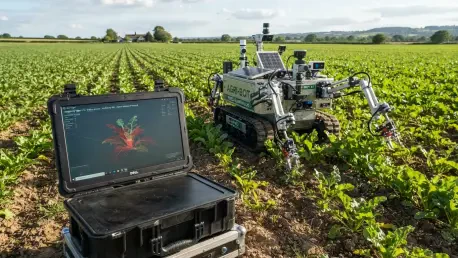
Alchemy’s immediate application is Element, Aigen’s autonomous weeding robot. Cameras supply the visual input, AI separates crops from weeds, and mechanical arms extract unwanted plants by their roots. Recognition errors therefore have physical consequences, making the quality of the training data central to the product.
Each machine spans about 6 feet and carries a solar panel rated at roughly 400 watts. Wurden said the robots operate entirely on solar energy, supported by batteries, without artificial lighting. That last detail gives the synthetic imagery a concrete job: helping recognition work under variable natural light rather than relying on controlled illumination.
The energy design also puts Aigen in a different operating category from weed-control equipment pulled by diesel tractors, which Wurden described as common among competitors. EIA data puts U.S. diesel prices roughly 70% above their year-earlier level, while AAA’s monthly average approached $6.30 per gallon. Rising fuel costs make solar-powered field equipment more commercially relevant, although those figures alone don’t establish a robot’s total cost advantage.
Purchase price remains a substantial consideration. Wurden put Element at $50,000 to $70,000 per unit, depending on configuration, and said Aigen generally sells five at a time. Buyers still need to assess whether the machines fit their crops and operations; a shorter model-training cycle doesn’t eliminate the capital commitment.
Aigen’s next deployment steps extend both geography and machine design:
- The company expects robots to reach Washington farms early next year.
- An orchard model under development would use outward-reaching arms to remove weeds between trees.
- A further generation of the robot is also being developed.
Those plans broaden the engineering task. Supporting another crop through software and training data is one kind of expansion. Reaching between orchard trees also requires changes to the machine that acts on the model’s decisions.
Alchemy Becomes a Product Beyond Aigen’s Robots
Large agribusinesses already use Aigen’s synthetic data, Wurden said. That gives Alchemy relevance beyond Element: the same capability that removes a bottleneck in Aigen’s development workflow can become an input for other agricultural technology businesses.
Wurden said the system emerged because the startup couldn’t afford human image-labeling work. Resource constraints pushed Aigen toward a tool it can now sell. With about 15 employees and approximately $26 million raised, by his account, a reusable training pipeline offers a way to extend the company’s reach without tying every sale to robot assembly.
Access has limits. Wurden said Aigen would supply precision-spraying businesses that reduce herbicide use, but would decline customers that spray entire fields indiscriminately. Its data business therefore follows the founders’ broader objective of reducing chemical use rather than pursuing every available buyer.
Wurden and CEO Kenny Lee established Aigen in 2020 after connecting through a climate-focused Slack group. Their backgrounds combine battery engineering and cybersecurity: Wurden worked at Tesla and Pure Watercraft, while Lee co-founded Weblife.io, acquired by Proofpoint in 2017. Both also bring personal health concerns that Wurden associated with herbicide exposure.
Different Weed-Control Tools Compete on Different Workflows
Other Washington startups illustrate how varied AI-assisted weed control has become. TerraClear identifies individual weeds so growers can target them with existing spraying equipment. Carbon Robotics uses lasers and trained its system with 150 million labeled photographs of actual plants.
Aigen’s distinction combines mechanical removal, solar power and simulated training material. Its bet is that generating plant data can make crop expansion faster than collecting and annotating real imagery. That approach could widen access to automation, but field performance and purchase economics will still determine adoption.
The immediate significance is a change in what a small robotics company can offer. Aigen can pursue growers it previously couldn’t support while selling the training resource behind that expansion. With fuel prices elevated and orders approaching its stated 2027 capacity, the next test is converting rapid crop training into dependable deployments across a broader range of farms.