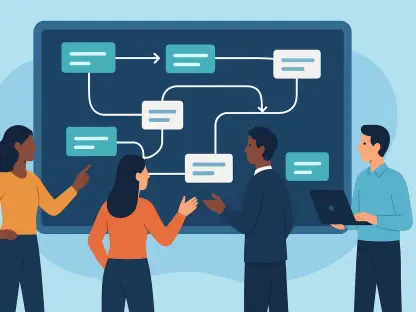

The transition from solitary large language models toward networked ecosystems of autonomous specialized agents represents a fundamental departure from the simple prompt-and-response interfaces that initially defined the generative era. In this new paradigm, artificial intelligence is no longer a singular oracle but a collaborative workforce where the value lies in the orchestration rather than the individual model. This structural evolution addresses the limitations of single-model interactions, which frequently struggle with the deep reasoning and multi-step execution required for enterprise-grade tasks. By distributing cognitive load across a network of specialized agents, engineers have created systems capable of self-correction, task delegation, and sustained logic. However, this architectural complexity introduces a new set of risks, as the probabilistic nature of each agent can lead to cascading errors that were previously unseen in traditional software development. The shift toward multi-agent systems necessitates a fundamental reimagining of what it means to build, evaluate, and monitor artificial intelligence in a production environment.
The Architectural Shift to Multi-Agent Systems
The movement toward multi-agent AI engineering marks a definitive pivot away from the pursuit of a single “god model” that can solve every problem in isolation. Instead, the industry has embraced a networked environment where specialized agents collaborate on complex workflows, mirroring the division of labor found in human organizations. While a single-agent setup focuses primarily on the accuracy of a single response to a user prompt, multi-agent systems prioritize the seamless orchestration of multiple Large Language Models (LLMs) working in a deliberate sequence. This change is driven by the realization that a standalone model often loses track of its primary objective when forced to navigate sophisticated, long-horizon tasks. By breaking a problem down into modular components, developers can assign specific agents to handle planning, execution, and review, thereby increasing the overall reliability and depth of the final output.
However, this transition introduces a layer of nondeterministic complexity that defies traditional debugging techniques. In a linear software program, a function produces a predictable output for every input, but in a multi-agent network, the “handoff” between agents is probabilistic. An error in reasoning from an upstream agent can propagate and amplify as it moves through the system, eventually leading to a complete collapse of logic or a departure from the original user intent. Understanding this technology requires looking past the performance of individual models and focusing instead on the systemic engineering controls that govern how these agents interact. The focus has moved from “prompt engineering” to “interaction engineering,” where the boundaries and communication protocols between agents are the primary drivers of success.
This evolution has also necessitated a change in how we perceive the role of the developer. In the early days of generative AI, the developer acted as a facilitator between a user and a model, but now the developer acts as an architect of a complex social structure of digital entities. They must manage not just the code that triggers the models, but the semantic flow and the shared state that keeps these models aligned. The multi-agent landscape is essentially a distributed system where the nodes are capable of reasoning, which creates a unique set of challenges regarding latency, cost, and coherence. As these systems become more prevalent, the mastery of agentic coordination is becoming the most sought-after skill in the artificial intelligence sector, overshadowing the simple ability to write a effective prompt.
Core Components of Multi-Agent Infrastructure
Interaction Evaluation and Handoff Mechanics
In any multi-agent environment, the “handoff”—the moment information passes from one specialized agent to another—is the most critical point of failure. Engineering these systems requires treating each of these interactions as a measurable event, much like a Retrieval-Augmented Generation (RAG) pipeline. When an orchestrator agent passes a sub-task to a worker agent, there is a risk that the context will be distorted or that critical instructions will be lost in the transfer. To combat this, engineers utilize context precision and recall metrics to measure whether the information being transferred is both relevant and complete. Without these metrics, a system might appear to be functioning while subtly drifting away from its objective over multiple iterations, a phenomenon known as semantic drift.
Furthermore, the concept of faithfulness has become a cornerstone of handoff mechanics, ensuring that a downstream agent’s response is strictly supported by the context provided by its predecessor. This prevents hallucinations during the transition, where an agent might “fill in the gaps” of a poorly defined handoff with its own invented data. To achieve this, many organizations are implementing “LLM-as-a-judge” techniques, where a secondary, highly capable model verifies that the meaning and intent of a task remain intact as it moves through the workflow. This meta-evaluation layer acts as a quality control gate, catching logic errors in real-time before they can affect the final outcome of the operation.
Beyond simple accuracy, semantic validation ensures that the “intent” of the user is preserved across the agent chain. For instance, if a user requests a financial report with a specific focus on risk, the validation layer must ensure that every agent in the chain—from the data retriever to the visualizer—maintains that specific risk-centric lens. If an agent shifts the focus toward general profitability, the validation layer flags the interaction as a failure. This granular level of control is what separates an experimental prototype from a production-grade multi-agent system, as it allows developers to build “guardrails” that are just as flexible as the models themselves.
Execution Tracing and System Observability
Because multi-agent workflows are inherently complex and often opaque, total visibility is a prerequisite for reliability in the modern engineering stack. Execution tracing provides the “ground truth” for how a system arrived at a specific conclusion, allowing developers to replay and analyze every step of a logic chain. By capturing the exact data exchanged during every handoff—a process known as payload recording—engineers can diagnose exactly where a reasoning error occurred. This is particularly important when an agent makes a “tool call” to an external database or API, as the interaction between the semantic model and the deterministic code is a frequent source of friction.
Resource monitoring has also evolved to track token costs and latency at each individual step of the agentic workflow. In a multi-agent system, a single user request can trigger dozens of internal model calls, leading to exponential growth in operational costs if not managed carefully. By mapping these costs to specific agents, companies can identify “expensive” reasoning paths and optimize them, perhaps by replacing a heavy reasoning model with a smaller, faster model for simple routing tasks. Logic visualization tools have also become essential, mapping the sequence of agent invocations and tool calls in a way that allows humans to identify bottlenecks or infinite loops that occur behind the scenes without direct user supervision.
Moreover, observability is not just about identifying errors; it is about understanding the emergent behavior of the system. In a network of agents, sometimes the “correct” individual actions lead to an “incorrect” systemic output. For example, three different agents might each decide that they need more information from the user, leading to a repetitive and frustrating user experience. Through deep execution tracing, developers can see these patterns and adjust the orchestration logic to ensure a more coherent and unified front. This shift from monitoring individual API calls to monitoring the entire “trace” of a thought process is perhaps the most significant advancement in AI observability over the last few years.
Emerging Trends in Agent Coordination
The latest developments in agent coordination emphasize a move away from “black box” processes toward transparent, graph-based architectures. A significant trend in this space is the rigorous identification of workflow pathologies, such as “deadlocks” and “livelocks.” A deadlock occurs when agents enter a state of circular dependency, where Agent A is waiting for a response from Agent B, while Agent B is simultaneously waiting for a confirmation from Agent A. These stalls can consume massive amounts of compute time without ever reaching a conclusion. To mitigate these issues, the industry has shifted toward monitoring “Progression” and “Coordination” metrics, which track whether the agent network is actually converging on a solution or simply spinning its wheels in a semantic loop.
Another critical trend involves the conscious avoidance of “model monoculture,” where all agents in a system are powered by the same underlying model family. If every agent uses the same reasoning engine, they are likely to share the same inherent biases and blind spots, making them incapable of effectively reviewing each other’s work. To create a more robust system, developers are increasingly using diverse model families—for example, using a reasoning-heavy model for planning and a faster, more concise model for execution and formatting. This diversity ensures that agents have complementary strengths, much like a human team where different specialists provide unique perspectives and checks on each other’s assumptions.
Additionally, we are seeing the rise of “dynamic orchestration,” where the system itself determines which agents are necessary for a specific task on the fly. Rather than a rigid, pre-defined path, the orchestrator evaluates the user’s request and “hires” the necessary specialized agents from a library. This approach allows for much higher efficiency, as simple tasks do not trigger the overhead of a complex, multi-stage workflow. This move toward modularity and dynamic assembly is making multi-agent systems more scalable and adaptable to a wider variety of use cases, from simple document processing to complex, multi-week research projects that require constant iteration and state management.
Real-World Applications and Sector Deployment
Multi-agent engineering is being deployed across industries that require high-stakes decision-making and multi-step processing, where the cost of failure is high but the potential for automation is immense. In software development, we have seen the emergence of “coding swarms,” where different agents take on the roles of architect, coder, security reviewer, and deployment manager. This setup allows for a continuous feedback loop where code is written, immediately tested for vulnerabilities, and then refined by the architect agent to ensure it fits the broader system design. This has significantly reduced the time it takes to move from a feature request to production-ready code, while actually increasing the security and stability of the final product.
In the financial services sector, multi-agent systems are managing complex risk assessment workflows that involve disparate data sources and shifting regulatory landscapes. One agent might specialize in scanning real-time market data, another in analyzing historical volatility, and a third in ensuring that every proposed trade complies with current international regulations. By working in parallel and then synthesizing their findings through a central “risk orchestrator,” these systems can provide a level of nuance and speed that was previously impossible for human analysts. The ability of these agents to maintain a “shared state” of the market’s health allows for more agile responses to sudden economic shifts.
Customer support has also been transformed by tiered agentic systems that maintain a long-term memory of customer history. A routing agent directs incoming queries to specialized agents focused on billing, technical support, or account retention, while a background “state manager” agent ensures that the context of the conversation is never lost as it passes between departments. This eliminates the common frustration of customers having to repeat their problem multiple times. These systems are moving beyond simple chatbots into true “digital employees” capable of executing complex tasks, such as processing refunds or troubleshooting hardware issues, by interacting with internal company databases and APIs autonomously.
Challenges and Technical Hurdles
Despite the immense potential, multi-agent engineering faces significant obstacles that continue to hinder widespread adoption in the most sensitive sectors. The primary challenge remains deterministic validation; because LLMs are inherently probabilistic, it is difficult to guarantee that a multi-step chain will produce the same result every time. This lack of consistency is a major hurdle for industries like healthcare or legal services, where precision is not just a preference but a requirement. Developers are constantly fighting “hallucination cascades,” where a single invented fact in an early stage of the workflow is treated as an absolute truth by every subsequent agent in the chain.
State management presents another significant hurdle, as keeping a “shared memory” clean and relevant is remarkably difficult. As a conversation or workflow progresses, the shared state can become cluttered with outdated or “noisy” data, which confuses the agents and leads to systemic failure. Managing this memory requires sophisticated “pruning” algorithms that can distinguish between a critical user constraint and a minor piece of conversational filler. Furthermore, using natural language for agent-to-agent communication is often inefficient and prone to misinterpretation. The industry is currently struggling to define a “universal language” for agents that is as flexible as human speech but as precise as computer code.
There are also looming regulatory and security risks associated with cascading automated actions. If a multi-agent system is given the authority to execute trades or move data between servers, an error in the logic chain could lead to catastrophic financial loss or data breaches before a human even realizes something is wrong. Enforcing “hard” boundaries through traditional, deterministic code is essential, but finding the right balance between the flexibility of AI and the safety of rigid code is a complex engineering task. Ensuring interface integrity and preventing “prompt injection” attacks that could hijack an entire agentic workflow remains a top priority for security researchers as these systems become more deeply integrated into enterprise infrastructure.
Future Outlook and Breakthrough Potential
The trajectory of multi-agent AI suggests a move toward “Hybrid Architectures” that combine the semantic flexibility of LLMs with the rigid reliability of deterministic software logic. We are quickly moving past the era where agents are allowed to operate in a purely natural language environment. Instead, future breakthroughs are expected in automated “Control Layers,” where systems will automatically trigger fallbacks or retries based on structured data validation and pre-defined safety protocols. These control layers will act as the “nervous system” for the agentic workforce, providing the necessary constraints to ensure that the “brain” of the LLM stays within the bounds of safe and productive behavior.
As these systems become more refined, they will likely shift from being experimental tools to foundational enterprise infrastructure. We can expect to see “Self-Optimizing Workflows,” where the system analyzes its own execution traces to identify inefficiencies and automatically reconfigures its agent network to improve performance. For example, a system might realize that a certain type of request is better handled by a direct API call rather than a reasoning agent, and it will rewrite its own routing logic accordingly. This level of meta-autonomy will allow companies to manage entire departments’ worth of digital operations with minimal human intervention, shifting the human role from “doer” to “supervisor.”
Furthermore, the integration of multi-modal agents—those that can see, hear, and interact with the physical world through robotics—will expand the reach of multi-agent engineering into manufacturing and logistics. A planning agent in a central office could coordinate with a fleet of specialized robotic agents on a warehouse floor, each handling a different part of the supply chain. The breakthroughs in communication protocols and state management that we are seeing today in the digital realm will provide the necessary foundation for these physical multi-agent systems. This convergence of digital reasoning and physical execution will likely be the defining technological shift of the late twenties.
Summary and Final Assessment
The evolution of multi-agent AI engineering represented a fundamental change in how artificial intelligence was integrated into the professional world. By shifting the focus from the individual model to the overarching system architecture, developers successfully moved beyond the limitations of standalone LLMs. This investigation into the sector showed that the most successful implementations were those that prioritized the “engineering of the boundaries” rather than the “magic” of the models themselves. The reliance on interaction-centric evaluation and mandatory observability provided the necessary framework to turn unpredictable agents into a coherent and reliable workforce. The transition toward structured communication through JSON schemas and Pydantic models served as a vital bridge between the probabilistic nature of AI and the deterministic requirements of enterprise software.
The analysis determined that while the challenges of state management and hallucination cascades remained persistent, the development of hybrid architectures provided a viable path forward. The engineering community realized that the goal was not to eliminate the unpredictability of AI, but to build a system that was resilient enough to manage it. This involved using diverse model families to prevent correlated reasoning errors and implementing rigorous “Control Layers” to enforce safety and consistency. As these systems matured, they moved from being experimental curiosities to becoming the foundational infrastructure for complex decision-making in finance, software development, and customer service. The era of the “single prompt” was replaced by the era of the “engineered workflow,” marking a new level of maturity for the entire artificial intelligence industry.
Looking back, the progress made in agent coordination and execution tracing proved that a disciplined engineering approach could overcome the inherent chaos of large language models. The verdict for multi-agent systems was clear: they were the only viable solution for high-stakes, multi-step automation. The next logical step identified by the industry was the total automation of the “Control Layer,” allowing systems to self-correct and self-optimize without constant human oversight. This shift was not just an incremental improvement but a complete reimagining of the digital workspace, where the synergy between specialized agents created a whole that was far greater than the sum of its parts. The lessons learned during this period established the protocols that would govern the next several years of autonomous technological advancement.