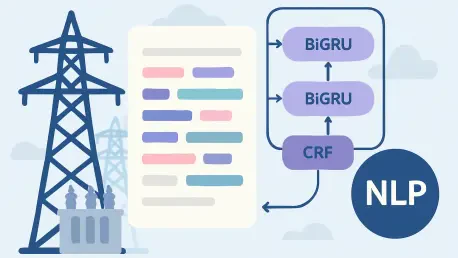

Semi-Markov conditional random fields improve the recognition of long equipment names by modeling complete entity fragments rather than decoding each label independently and in isolation. This sophisticated technological approach was the centerpiece of a 2026 experimental study conducted by M. Gao and L. Wang, focusing on the automated extraction of data from Chinese power-grid documentation. Reaching a headline accuracy of 96.52 percent, the research successfully addressed the chronic difficulties associated with domain-specific terminology, irregular entity lengths, and imbalanced data distributions in technical maintenance logs. By establishing a high-precision pipeline, the system transforms unstructured inspection records into valuable digital assets, ensuring that critical information is no longer trapped in static files. This advancement represents a significant leap forward in power-grid management, enabling operators to leverage massive datasets for real-time decision-making and long-term infrastructure planning within a highly complex industrial ecosystem.
Linguistic Complexity: The Challenge of Power Systems
The modern power grid operates on a foundation of massive, heterogeneous data streams, ranging from handwritten inspection notes to automated dispatch reports. Historically, these documents have remained underutilized because traditional Natural Language Processing tools struggle with the extreme specificity of electrical engineering terminology. Many existing models fail to account for the unique way technical Chinese characters are combined, leading to frequent segmentation errors that compromise the integrity of the data. Furthermore, the sheer volume of operational data—such as specific voltage fluctuations or specialized circuit breaker states—is often drowned out by more common entities like timestamps or geographical locations. This imbalance creates a significant hurdle for standard machine learning models, which tend to over-optimize for frequent tags while ignoring the critical, low-frequency events that often signal impending equipment failures or systemic grid instabilities.
Addressing these linguistic hurdles requires more than just raw computing power; it demands a deep understanding of the semantic relationships inherent in power-sector communication. Technical logs often feature equipment names that span multiple characters and include alphanumeric codes, making standard word-boundary detection highly unreliable. When a model incorrectly segments a long-form equipment identifier, the resulting entity recognition becomes fragmented, losing the context required for effective maintenance scheduling. To overcome this, the 2026 methodology emphasizes a holistic approach that treats the identification of technical entities as a structured sequence task rather than a series of isolated classification events. By integrating domain knowledge into the earliest stages of the processing pipeline, the system ensures that the inherent logic of the power grid—its nomenclature and reporting conventions—is preserved throughout the transformation from unstructured text to structured database entries.
Optimizing the Dictionary: Hashing and Retrieval
The first critical component of this advanced recognition system is a highly optimized domain-specific dictionary constructed from national grid standards and internal enterprise repositories. To facilitate the rapid retrieval required for real-time applications, the researchers implemented an improved cuckoo-hashing structure that effectively maps technical terms to fixed-length MD5 hashes. This architectural choice addresses the limitations of traditional Trie trees, which often suffer from excessive memory consumption and slower query times as the dictionary grows. In rigorous testing conducted on modern server hardware, the cuckoo-hashing approach demonstrated a construction speed of 98.7 milliseconds and a memory footprint of just 5.6 megabytes, even when handling thousands of specialized terms. With a collision rate consistently below 0.5 percent, this indexing mechanism provides the foundational speed necessary for processing large volumes of technical documentation without the bottlenecks typical of older indexing methods.
Building upon this robust dictionary, the system employs a bigram probabilistic language model to execute forward maximum matching during the word segmentation phase. This specific stage is vital for disambiguating Chinese character sequences that could be interpreted in multiple ways depending on the surrounding context. By training the model on a massive 500,000-word corpus of professional electrical engineering literature, the system gains a statistically grounded intuition for common phrasing and terminology usage. To ensure that rare n-grams or previously unseen equipment names do not cause the system to crash or output errors, the researchers applied Kneser-Ney smoothing techniques. This refinement allows the system to estimate probabilities for unknown words based on their context, effectively transforming raw text into an ordered sequence of Begin, Inside, and Outside labels. This structured output then serves as the high-quality input required for the subsequent neural network layers to perform final classification.
Neural Innovation: The BiGRU-CRF Framework
At the heart of the sequence labeling process is a Bidirectional Gated Recurrent Unit (BiGRU) paired with a Conditional Random Field (CRF) layer. The decision to utilize BiGRU over the more traditional Long Short-Term Memory (LSTM) architecture was driven by the need for computational efficiency in industrial environments. By merging the reset and update gates, the BiGRU model reduces the total number of parameters to approximately 8.7 million, which significantly lowers the hardware requirements for deployment. Despite this leaner profile, the bidirectional nature of the network allows it to capture context from both the preceding and following words in a sentence, which is essential for identifying the start and end of complex equipment names. This dual-directional vision ensures that the model understands not just the word itself, but its functional role within a technical description, leading to a much more nuanced interpretation of how different entities interact within a given log entry.
To further refine the model’s performance, the researchers introduced two significant modifications to the final CRF layer: inverse-frequency weights and semi-Markov modeling. The inverse-frequency weights are particularly ingenious, as they dynamically adjust the significance of different entity tags during training to counteract the natural imbalance in the dataset. By assigning higher importance to rare operational data categories, the model is prevented from becoming biased toward frequently occurring entities like dates or generic location markers. Meanwhile, the semi-Markov variant of the CRF layer allows the system to evaluate entire candidate entity fragments as a whole. Unlike standard CRFs that decode each label independently, this approach considers the entire span of a potential equipment name, evaluating its internal consistency and length. This fragment-based modeling is the primary reason the system excels at identifying long-form technical identifiers that usually confuse more generic, token-based recognition systems.
Empirical Results: Performance and Accuracy
The efficacy of this specialized architecture is supported by a robust dataset of 6,000 text samples, meticulously labeled through a three-step process involving initial annotation, cross-checking, and final audits by power-grid experts. This high-quality training data, containing nearly 100,000 entities, allowed the model to reach a headline accuracy of 96.52 percent in exact-match scenarios. Experimental results indicate that the system is particularly proficient at identifying structured categories, with equipment and time entities reaching F1 scores of 99.2 percent and 98.6 percent, respectively. However, the data also highlighted the inherent difficulty of parsing operational data, which achieved a lower F1 score of 90.6 percent. Much of this discrepancy was attributed to the complex ways numerical values are intertwined with units of measurement in technical reports, suggesting that even with advanced modeling, some linguistic structures remain resistant to automated extraction.
Beyond raw accuracy, the 2026 study placed a significant emphasis on the operational efficiency of the model compared to contemporary alternatives like Transformer-based architectures. While Transformers are often lauded for their performance in general NLP tasks, the research found them to be significantly slower in both training and inference when applied to these specific industrial datasets. In a direct comparison, the BiGRU-CRF model maintained a training speed of 125 samples per second, while the Transformer-CRF was 45 percent slower due to its much higher parameter count. In an optimized laboratory environment using GPU acceleration, the BiGRU-CRF system was able to process 10,000 entities in just 28.35 milliseconds. This high throughput is critical for the future of grid management, as it enables the near-instantaneous processing of vast streams of data, allowing human operators to focus on high-level decision-making rather than manual data entry or document review.
Operational Impact: Deployment and Future Steps
The integration of BiGRU-CRF and specialized NLP techniques represented a significant shift in how technical documentation was managed within the power sector. By successfully bridging the gap between unstructured maintenance logs and high-precision digital records, the 2026 framework established a new standard for industrial information extraction. The researchers confirmed that the use of lightweight, optimized architectures provided the necessary balance between speed and accuracy for real-world applications. This success was not limited to theoretical metrics but translated into practical improvements for dispatch centers, where the speed of information retrieval directly impacted the stability of the grid. The development of these tools paved the way for more automated, data-driven maintenance strategies, allowing utilities to move away from reactive repair cycles toward more predictive, analytical approaches that significantly reduced the likelihood of large-scale systemic failures.
Moving forward, the successful deployment of this entity recognition system suggests several actionable pathways for the broader utility industry. Organizations should consider the implementation of domain-specific dictionary structures and hashing algorithms as a prerequisite for any large-scale NLP initiative, as these foundational elements provide the necessary speed for high-volume processing. Furthermore, the use of semi-Markov modeling should be prioritized when dealing with the long-form nomenclature common in engineering fields. Future research will likely focus on enhancing the transferability of these models to other sectors, such as water or natural gas grids, which share similar documentation challenges. While the current laboratory performance was exceptionally strong, ongoing validation across diverse hardware configurations ensured that these systems remained robust in the face of evolving data characteristics. The 2026 study ultimately provided a clear roadmap for utilizing optimized neural networks to solve high-precision tasks.