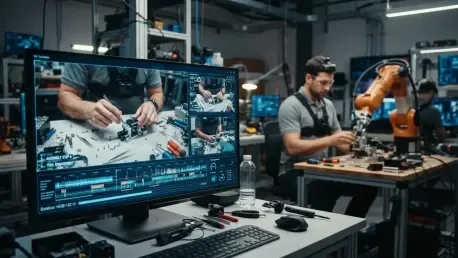

TwelveLabs prices Pegasus 1.6 at $1.75 for each hour of video input, placing a concrete price on one part of robot development: converting recorded work into usable training material. Its latest model specializes in first-person footage, where the sequence of a worker’s movements can reveal more than a finished task. The business opportunity is to make those recordings easier to label and evaluate, while leaving robot control to the teams building it.
First-Person Video Becomes a Training-Data Product
TwelveLabs is extending a business built around video search and description into robotics infrastructure. Entertainment, media, advertising and sports were among its earlier areas of focus, said TwelveLabs co-founder and CEO Jae Lee. Those customers needed to navigate video collections; robotics developers need to extract examples of physical behavior.
That shift changes what a useful description must contain. Knowing that a recording shows an assembly task is less useful than knowing when a component was picked up, which hand held it and how the other hand used a tool. The product must capture the order of those actions and their boundaries to serve as training material.
Pegasus 1.6 converts recordings into text descriptions and metadata tied to particular moments. Customers specify the fields and categories they want, and the model structures its output around those requirements, Lee and TwelveLabs’ technical materials explain. A developer could therefore request distinct annotations for grasping, positioning and fastening rather than accept a general summary of the recording.
The underlying capability predates this release. Pegasus 1.5 already supported timed segmentation and structured descriptions. TwelveLabs says Pegasus 1.6 adds dedicated training for egocentric footage, which gave its earlier models trouble. Buyers should examine what that specialization delivers beyond video-to-text conversion alone.
TwelveLabs positions the Pegasus family around temporal reasoning: following changes and relationships across a sequence. TwelveLabs distinguishes Pegasus from general-purpose multimodal LLMs by how it follows events through video, rather than relying on assembled still frames or basic questions about clips. In robotics, that difference could determine whether an annotation captures the relationship between an action and its result.
Consider a hypothetical assembly recording. A useful annotation would separate picking up a part from aligning it, identify the supporting hand and mark a recovery after the part slips. Those details could help a development team select relevant demonstrations. They would still need to verify that the descriptions accurately reflect what happened.
Collection Can Expand Without Putting a Robot in Every Recording
Lee sees first-person recordings as a way to broaden access to demonstrations. Teleoperation captures useful examples because a person controls a robot directly, but he said scaling that approach requires equipment and trained operators. A worker-worn camera offers a different collection route: recording activity without having a machine perform every demonstration.
The economics shift toward interpreting footage. Collecting more recordings helps only if a team can identify what objects appear, what actions occur and when they happen. Pegasus targets this preparation work, potentially allowing data suppliers and robotics developers to process footage that would otherwise take substantial effort to annotate.
TwelveLabs groups the uses into five areas: labeling actions, writing detailed captions, screening footage quality, detecting unusual events and duplicates, and flagging sensitive content. Quality checks can pick out obstructed views, unstable camera footage or actions that are hard to tell apart. Such screening helps teams decide which recordings deserve further review before spending effort on training.
The release also supports still-image analysis through the API used for video and improves recognition of objects and people, TwelveLabs says. Those changes broaden its relevance to existing video-analysis customers. For enterprise buyers, they also create the possibility of handling related visual material through one interface rather than maintaining separate processing routes.
Adoption is likely to follow different paths depending on a company’s robotics maturity. An organization still exploring automation could document a bounded workflow and assess whether the footage is usable. A team already developing robots could test automated annotation and quality review against its existing process.
Neither route establishes that recorded human behavior transfers directly into reliable machine performance. Lee described the near-term opportunity as training infrastructure, with current deployments generally focused on narrow tasks or collecting field data. His longer-range view is that human footage could provide broad behavioral knowledge, while teleoperated examples help adapt it to robots. That remains a development hypothesis.
Describing Motion Leaves a Control Gap
Pegasus can describe limb movement and approximate trajectories, Lee said, but pressure, touch and precise control require other information. Robotics developers must connect visual observations to sensors, movement representations and execution systems. A detailed caption does not supply the full set of instructions needed to manipulate an object reliably.
That boundary determines where the service belongs in an enterprise architecture. It could help select demonstrations, organize datasets and reduce some manual labeling. It should be evaluated as a component feeding robot development, with success ultimately tested in the downstream system.
Evidence for the latest model’s performance remains limited. TwelveLabs’ technical materials describe internal assessments of action recognition, identification of the acting hand and understanding of sequences. They provide neither numerical results nor a reproducible competitor comparison. The release materials also do not identify a robotics customer with independently verifiable operational outcomes.
Lee offered a processing example: approximately 17 years of first-person recordings handled in roughly 18 hours, with no video failing. He did not disclose the computing setup or test conditions. That account indicates the scale TwelveLabs wants to support, but it cannot establish accuracy, repeatable throughput or the cost of achieving it.
For procurement teams, the distinction is practical. Processing large volumes of footage says little about how often reviewers have to correct action boundaries or whether mislabeling a hand compromises a training example. Evaluation needs to measure the usefulness of the output alongside processing volume.
Competing Products Cover Different Parts of the Workflow
Competing offerings range from data preparation to task reasoning and action generation. Some of those functions overlap, though they serve different purposes. Selecting annotation infrastructure is a different enterprise decision from choosing a system that coordinates or executes robot movements.
| Offering | Role in the workflow | Buying consideration |
|---|---|---|
| TwelveLabs Pegasus 1.6 | Converts video into configurable descriptions and timed annotations, with first-person specialization | Managed API; customers remain responsible for training and control |
| Nvidia Cosmos Curator | Supports filtering, annotation and duplicate removal | Open tooling requires teams to operate their own processing infrastructure |
| Encord with Cosmos Reason 2 and Embed | Combines preliminary labels, human review and searches by action | Hosted annotation and curation platform |
| Google Gemini Robotics ER 2 | Interprets task progress and supports planning and coordination | Movement execution depends on separate action models or interfaces |
| BFL/mimic FLUX-mimic | Turns video-based representations into robot actions | Focuses on downstream deployment, beyond dataset preparation alone |
With Nvidia Cosmos Curator, the data pipeline becomes a build-versus-buy decision. Curator carries no software license charge; teams still cover computing, storage and engineering costs, while model licenses vary. The comparison with a managed service needs to account for that full operating burden.
Encord competes more directly for annotation and curation budgets. Its integration of Nvidia Cosmos Reason 2 and Embed hosts the models, produces initial labels for review and enables searches based on behavior. Public dollar pricing is unavailable; buyers must request a quote covering the platform and model consumption.
Google Gemini Robotics ER 2 sits closer to planning and coordination. Its standard API pricing is $1 per million input tokens and $5 per million output tokens, including thinking, through Dec. 31, 2026. Those rates become $2/$10 from Jan. 1, 2027, and a free tier is available. These token-based charges cannot be compared directly with video-duration pricing.
Black Forest Labs and mimic report testing and deployment of FLUX-mimic at Audi, including industrial manipulation. Their system illustrates a potential destination for better-prepared training material, although no TwelveLabs integration is established. No public FLUX-mimic price was provided in its announcement, and it is not marketed as a free open model.
These vendor-described capabilities establish functional differences, not a performance ranking. Available evidence does not show that Pegasus 1.6 leads the alternatives in annotation quality, total cost or robot outcomes. Lee views action-model developers as possible customers, making the commercial opportunity broader than direct competition alone.
Billing Structure Will Shape Deployment Choices
TwelveLabs lists video input at $1.75 per hour, image input at $3 per million tokens and generated output at $7.50 per million tokens. Lee’s company has kept output-token pricing roughly aligned with the previous generation. Enterprise terms are custom, while private or self-managed arrangements require a sales discussion.
At the listed video rate, a single pass over 1,000 hours costs $1,750 before generated output and any other applicable charges. Detailed descriptions add output tokens. The cost of a useful dataset will therefore depend on the requested annotation depth as well as the amount of footage.
Segment requests introduce another material variable: TwelveLabs bills the submitted duration separately for every segment definition. Asking for several definitions multiplies the duration charged. Buyers should model the actual request design before projecting costs from the headline hourly rate.
The published pricing comparison was checked October 6, 2026. Different billing units and product responsibilities prevent a simple cheapest-provider conclusion. An API service, an operated open-source pipeline and a robotics deployment system place different costs on the customer.
Lee also said TwelveLabs may seek extended licensing and bespoke research agreements with a limited number of larger partners. Such agreements could accommodate specialized requirements. They also leave deployment terms to be settled before a buyer commits to a production workflow.
A Pilot Should Connect Annotation Quality to Robot Results
Start with one tightly defined activity, such as packing a particular item or assembling a defined component. Keeping the scope narrow makes it easier to compare generated descriptions with expert judgment and measure the corrections they need.
A pilot should establish:
- Whether the recording clearly shows the relevant objects and hand movements.
- How accurately the model identifies actions and locates their start and end points.
- How much time reviewers need to correct or reject annotations.
- What the complete processing cost becomes after segment definitions and output are included.
- Whether the resulting data improves performance on held-out tasks, reduces demonstration collection or shortens development.
Recording permission and process confidentiality also need explicit treatment. Flagging sensitive imagery can assist reviewers, but it doesn’t grant permission to record employees or use their footage for training. Companies need those questions resolved before they collect more footage.
With robotics teams seeking more usable demonstrations, Pegasus 1.6 makes video preparation a plausible infrastructure purchase in that market. The value depends on how much work its first-person specialization removes from turning collected footage into useful material. Enterprises should measure correction effort and downstream robot performance to test that connection before expanding the pipeline.