
The pursuit of autonomous systems has long been stalled by the astronomical costs of human-labeled data and the inability of rigid algorithms to adapt to the unpredictable messiness of the physical world. For years, the industry operated under the assumption that more miles driven equaled more intelligence, yet this brute-force approach often hit a performance ceiling when encountering rare scenarios. Physical AI foundation models have emerged as the corrective force to this stagnation, replacing human-intensive labeling with systems that learn the underlying laws of geometry and motion. By internalizing how the world works rather than just memorizing what it looks like, these models are bridging the gap between digital simulation and physical reality.
Defining Physical AI and the Foundation Model Paradigm
The shift toward Physical AI represents a departure from traditional rule-based autonomy that relied on specific “if-then” commands. These older systems were inherently fragile, often failing when a sensor encountered a situation slightly different from its training set. Foundation models, however, utilize unsupervised learning to build a spatial awareness that is remarkably similar to human intuition. They do not need a person to label every stop sign; instead, they observe patterns of light, depth, and movement to understand that a solid object occupies a specific space in a three-dimensional environment.
This paradigm addresses the data bottlenecks of previous iterations, allowing for a more robust understanding of the environment without exhaustive human intervention. Because these models are built to understand physical laws, they can predict how objects will move or how a scene will change over time. This foundational knowledge allows them to function in diverse settings, moving beyond the restricted “geofenced” areas that limited earlier versions of autonomous technology.
Core Pillars of Scalable Physical Intelligence
Deep Teaching and Unsupervised Training Methodologies
At the heart of this revolution is the Deep Teaching methodology, which bypasses the data bottlenecks that have historically slowed autonomy progress. Traditional methods require thousands of human workers to hand-annotate video frames, a process that is both slow and prone to error. In contrast, unsupervised training allows a model to ingest raw sensor data and identify the structure of the physical world autonomously. This results in a system that generalizes better across unfamiliar environments, as it understands the “why” of physics rather than just the “what” of a pixel arrangement.
This methodology also allows the software to learn from a fraction of the data required by traditional fleet-heavy competitors. By focusing on the quality and structural relevance of information rather than sheer volume, developers can achieve high levels of accuracy with much lower operational costs. This shift is critical for maintaining performance in dynamic, real-world scenarios where predefined labels simply cannot account for every possible variation in weather, lighting, or terrain.
Hardware Efficiency and the “One Platform, Many Embodiments” Strategy
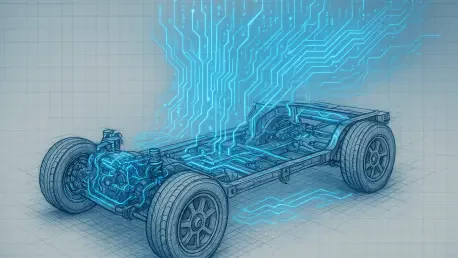
Another critical pillar is the “one platform, many embodiments” strategy, which decouples the intelligence of the software from the mechanical hardware it controls. By creating a universal perception stack, developers can deploy the same core intelligence across passenger cars, delivery drones, and massive mining trucks. This modularity ensures that the high costs of software development are amortized over a vast range of industries. It essentially creates a brain that can be “plugged into” any machine, provided the compute constraints of the edge device are met.
This technical decoupling is significant because it allows software updates to improve performance across an entire fleet of diverse machines simultaneously. Instead of building a new stack for every vehicle model, engineers can refine a single foundation model that masters spatial awareness for all of them. This approach prioritizes software lineage and capital efficiency, ensuring that hardware limitations do not dictate the pace of AI development.
Current Trends and Economic Shifts in Autonomy
The economic landscape of autonomy is undergoing a radical transformation as companies reach commercial milestones once thought to be decades away. Recently, the focus has shifted from capital-heavy research toward a software-first model that prioritizes capital efficiency and operational breakeven. Global OEMs and Tier 1 suppliers are increasingly opting to license these sophisticated foundation models rather than attempting to build proprietary stacks from scratch. This move is turning autonomy into a scalable software-as-a-service market, moving away from the expensive hardware-bundle models of the past.